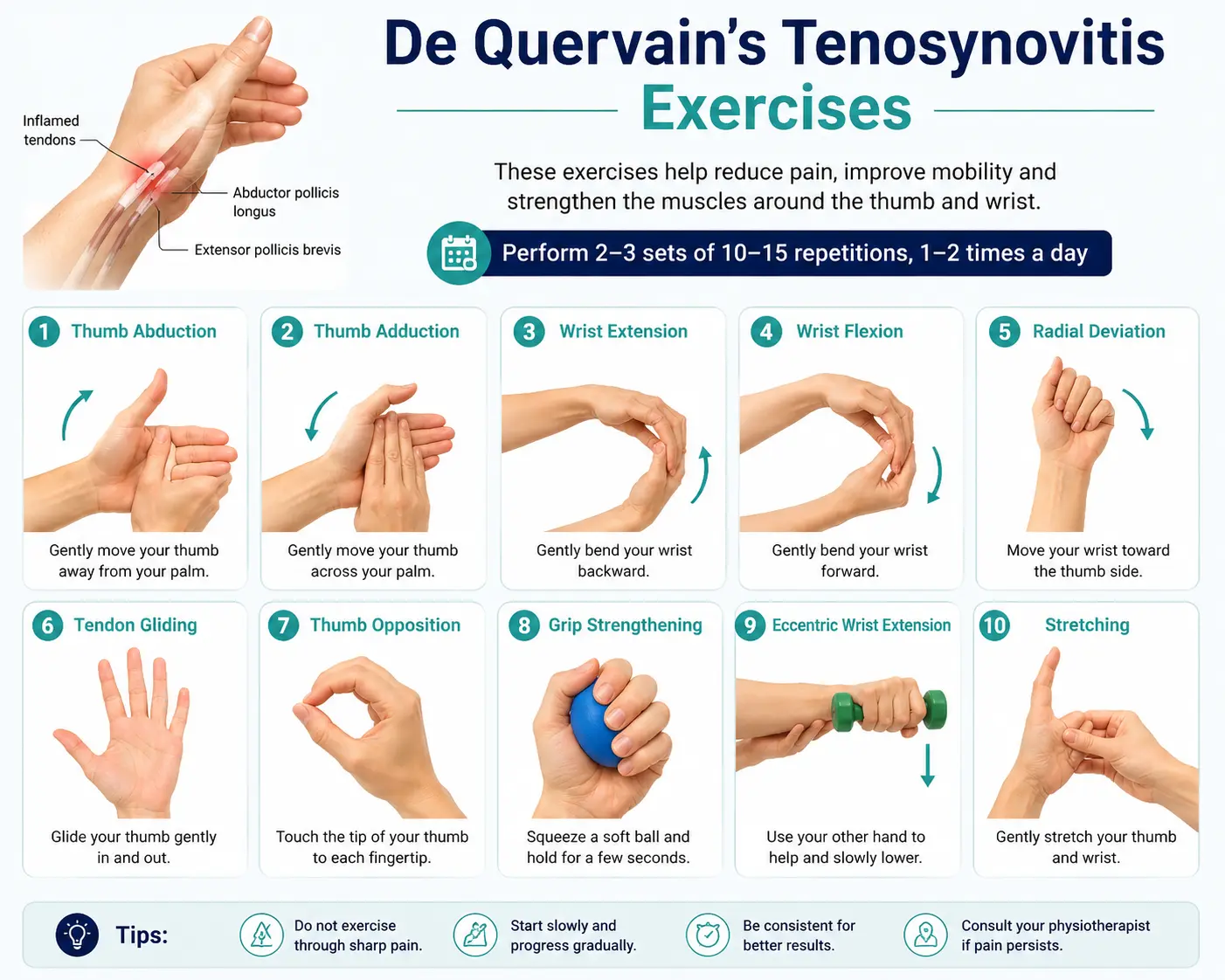
Top Exercises for De Quervain’s Tenosynovitis
Introduction
De Quervain’s Tenosynovitis is a common condition that causes pain and inflammation in the tendons located on the thumb side of the wrist. It often develops due to repetitive hand and wrist movements, overuse, or activities that place excessive stress on the thumb tendons. Individuals with this condition may experience pain, swelling, tenderness, and difficulty gripping or lifting objects.
Physiotherapy plays an important role in the management of De Quervain’s Tenosynovitis. Specific exercises can help reduce pain, improve flexibility, restore range of motion, and strengthen the muscles and tendons around the wrist and thumb.
When performed regularly and correctly, these exercises can support recovery, enhance hand function, and help prevent future recurrences.
What is de Quervain’s tenosynovitis?
The painful inflammation surrounding your thumb tendons is known as De Quervain’s tenosynovitis. Another name for it is de Quervain’s tendinitis or de Quervain’s tendinosis. When referring to the same illness, medical professionals can use these names interchangeably.
Your muscles and bones are connected by tendons. They resemble ropes in that they are strong, flexible tissue cords. Tendons pull the bones they are linked to and cause them to move when you contract (squeeze) a muscle. Your thumb and wrist are connected by two tendons.
Tendons typically pass through a tissue tube known as a sheath with ease. De Quervain’s tenosynovitis occurs when anything causes the sheath surrounding your thumb tendons to thicken or enlarge.
When you use your thumb and wrist, this swelling adds to the friction. Some thumb and wrist actions become difficult and more challenging when this occurs. The discomfort associated with De Quervain’s tenosynovitis typically radiates into the forearm from the base of the thumb.
Symptoms and Causes
What are de Quervain’s tenosynovitis symptoms?
The most typical sign of de Quervain’s tenosynovitis is radial wrist pain. The discomfort may appear suddenly or all at once for some people, but it can also grow gradually. Typically, the pain
- Gets worse when you use your thumb, wrist, and hand.
- Extends (radiates) into your thumb or forearm from your wrist.
- Gets worse when you’re pinching or holding something.
- Other signs and symptoms include:
- Swelling.
- A popping or snapping sensation when you move your thumb on your wrist.
- Your thumb may feel less smooth or stiff.
- Numbness in your thumb or wrist.
What causes de Quervain’s tenosynovitis?
De Quervain’s tenosynovitis can be caused by anything that irritates your thumb tendons. Among the most typical causes are:
- Overusing your wrist or thumb.
- Repetitive grabbing or grasping for a pastime or a job.
- Inflammatory medical disorders (such as arthritis).
- Being struck in the wrist or thumb.
- De Quervain’s tenosynovitis can be caused by repetitive actions while holding an object tightly, such as:
- Sports, including skiing, racquetball, and tennis.
- Using tools, such as a hammer.
- Lifting small children.
- Cultivating a garden.
De Quervain’s tenosynovitis risk factors
De Quervain’s tenosynovitis can strike anyone; some people are more susceptible than others, such as:
- Women.
- Individuals above 40.
- Childcare workers.
- Parents of little ones.
- Those who use their hands or perform manual labor.
- Athletes.
Diagnosis and Tests
How is de Quervain’s tenosynovitis diagnosed?
A medical professional will use a physical examination to diagnose de Quervain’s tenosynovitis. Your thumb and wrist will be examined. Inform your physician when you first had wrist pain and if any activities made it noticeably worse.
Which tests are used by medical professionals to identify de Quervain’s tenosynovitis?
The Finkelstein test is a physical examination used by medical professionals to identify de Quervain’s tenosynovitis. Your healthcare practitioner will instruct you to clench your fingers around your thumb to form a fist.
You will move your wrist up and down while holding that fist shape, as though you were shaking someone’s hand. Your thumb tendons are highlighted by this posture and movement. Moving your wrist during the Finkelstein test will typically cause pain if you have de Quervain’s tenosynovitis.
Additionally, your doctor may use imaging tests, such as X-rays, to examine your wrist joint for indications of additional wrist pain-causing disorders, such as osteoarthritis.
De Quervain’s Tenosynovitis Exercises
Opposition stretch
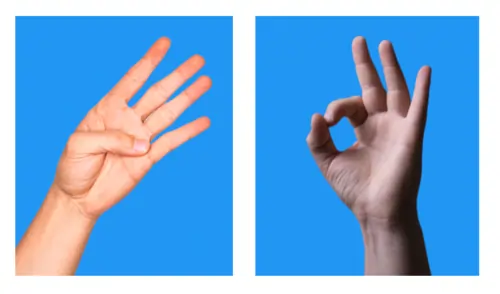
- Put your hand on a table, palm up.
- Lift your thumb and pinky.
- Gently press the tips of your thumb and pinky together. Your thumb’s base will feel stretched.
- Hold this position for six seconds.
- After releasing, repeat ten times.
Thumb flexion
- Hold your hand in front of you as though you were going to shake hands. You can support it by placing it on a table.
- With your other hand, bend your thumb down at the base where it connects to the palm.
- Hold for at least 15 to 30 seconds. Try this five or ten times.
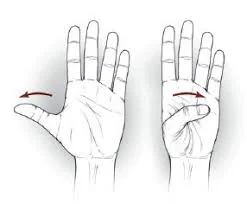
Thumb adduction and abduction

- Using the affected hand, point your thumb and fingers straight up. Your wrist should be relaxed and straight.
- Move your thumb as far away from your palm as you can. Hold for around six seconds. After that, press your thumb to your index (pointing) finger and bring it back to the beginning.
- Repeat this eight or twelve times.
- It’s a good idea to repeat these movements with your other hand.
Resisted radial deviation
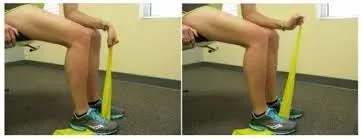
- Lean forward while sitting with your legs slightly apart. Next, place your affected forearm on your thigh and place your hand and wrist in front of your knee.
- Hold one end of an exercise band with your hand pointing toward your other thigh. Step to the other end of the band.
- Bend your wrist slowly upward for two counts. After that, lower your wrist gradually until you count to five.
- Repeat this eight or twelve times.
- It’s a good idea to repeat similar movements with your second arm.
Management and Treatment
How is de Quervain’s tenosynovitis treated?
Treatments for de Quervain’s tenosynovitis that control your symptoms while your thumb tendons and their sheaths heal are typically recommended by a medical professional. The most popular therapies consist of:
Putting on a brace or splint will immobilize your thumb and wrist, relieving pressure on your thumb tendons.
Icing your wrist can help with pain relief and swelling reduction. Apply ice packs to your wrist many times a day for 20 minutes at a time after wrapping them in a thin towel.
Rest: Try to avoid using your affected wrist as much as you can. You must refrain from engaging in sports or repetitive motions, particularly the activity that resulted in de Quervain’s tenosynovitis.
NSAIDs: Pain and inflammation are reduced with over-the-counter NSAIDs. Never take NSAIDs for longer than ten days without first consulting your doctor.
FAQs
What vitamin helps de Quervain’s tenosynovitis?
I generally advise taking calcium and vitamin D supplements, specifically 1000 mg of calcium and 1000–2000 IU of vitamin D3 each day (some individuals may need 5000 IU per day).
Should I massage to relieve my de Quervain’s tenosynovitis?
To reduce excessive muscle stiffness around the affected tendons, stretching is beneficial. Massage therapists might consider applying deep transverse friction directly to the APL and EPB tendons, as massage therapy appears to be beneficial for this disease as well.
Does de Quervain’s ever go away?
Yes. De Quervain’s tenosynovitis usually goes away, especially if treated early. Mild cases may resolve with rest. Others may require treatment with thumb spica splinting, physical therapy, or corticosteroid injections. Minor outpatient surgery is very effective,e and non-surgical methods often fail.
Anticipated recovery timelines
Non-operative treatment: Most will have significant improvement in 4 to 6 weeks.
Pregnancy-related: If as a result of pregnancy or postpartum, symptoms tend to go away on their own by the end of your term or once you stop breastfeeding.
Severe/Untreated: Recovery can take a year or more without intervention, and you are at risk for chronic loss of motion.
Proven Treatment Choices
Immobilisation: A Thumb Spica Splint stops the tendon from moving to reduce rubbing and swelling.
Physical Therapy: Emphasizes systematic, progressive loading to promote tendon strength and endurance.
Injections: A corticosteroid injection is very effective and may cure the condition or provide long-term relief, particularly if given early.
Surgery: When injections and bracing don’t work, outpatient surgery can release the tendon sheath, enabling the tendon to glide freely again.
What movements should be avoided with de Quervain’s?
De Quervain’s tenosynovitis. To treat this condition, you need to avoid activities that cause the inflamed tendons at the base of your thumb and wrist. Key triggers include repetitive thumb movements, forceful gripping or pinching, and twisting your wrist.
What to avoid if you have de Quervain’s tenosynovitis?
Stop doing repetitive thumb movements, gripping tightly, and twisting your wrist immediately to heal De Quervain’s tenosynovitis. 5. Stop doing anything painful to the thumb or wrist. Adequate rest, activity modification, and immobilization reduce tendon inflammation.
What are the first signs of de Quervain’s?
De Quervain’s tenosynovitis initially presents with pain and tenderness around the base of the thumb that can be sudden or develop gradually over weeks. These symptoms usually get worse with activities that involve pinching, gripping,g or twisting of the wrist.
Look for these other common early symptoms:
Swelling: A puffed-up, inflamed patch or small blister filled with fluid at the very base of the thumb.
Stiffness & Catching: When you try to move your thumb, you feel a snapping or “sticking” sensation, often described as a “trigger thumb” feel.
Radiating Pain. The sharp or aching pain may radiate down into your thumb or shoot up the thumb side of your forearm.
References
- 11 Exercises to Reduce De Quervain’s Tenosynovitis. (2025, November 17). David W. Meister, MD. https://www.milwaukeeshoulder.com/blog/11-exercises-to-reduce-de-quervains-tenosynovitis-49397.html
- Coleman, S., Clapis, P., & RelayHealth. (2009). De Quervain’s tenosynovitis rehabilitation exercises. In RelayHealth. https://www.rickysinghmd.com/wp-content/themes/ypo-theme/pdf/dequervainstenosynovitis.pdf
- Cronkleton, E. (2018, November 2). 10 exercises for De Quervain’s tenosynovitis. Healthline. https://www.healthline.com/health/de-quervains-tenosynovitis-exercises
- De Quervain’s Disease: exercises | Kaiser Permanente. (n.d.). Kaiser Permanente. https://healthy.kaiserpermanente.org/health-wellness/health-encyclopedia/he.de-quervain’s-disease-exercises.zp4388
- De Quervain’s tendinosis. (2026, April 6). Cleveland Clinic. https://my.clevelandclinic.org/health/diseases/10915-de-quervains-tendinosis