Levator Scapula Stretch
Introduction
Levator Scapulae Muscle Stretch is a simple and effective exercise that helps relieve tension and stiffness in the neck and upper shoulder region.
The long levator scapulae muscle, which extends down the side of the neck and into the shoulder, is frequently one of the muscles involved when a strain causes the neck to become stiff or painful. The levator scapulae muscles may become stronger to becoming uncomfortable and stiff if extra care is not taken to keep them loose and stretched.
Levator Scapula muscle
Anatomically, the levator scapulae is a long, thin muscle that is part of the back’s superficial layer of extrinsic muscles. Together with the rhomboids, serratus anterior, serratus posterior superior, and inferior muscles, it is regarded as a muscle of scapular mobility in terms of function. The levator scapulae muscle reaches the medial edge of the scapula from the transverse processes of vertebrae C1–C4.
This muscle’s primary purpose is to raise the scapula, as its name says. Levator scapulae also works in conjunction with the trapezius, latissimus dorsi, rhomboids, pectoralis major, and pectoralis minor muscles to stabilise the spine, extend and flex the neck laterally, and inferiorly rotate the glenoid cavity.
Blood supply
The transverse cervical and ascending cervical arteries, two branches of the thyrocervical trunk, supply blood to a significant amount of the levator scapulae muscle. Furthermore, the vertebral artery supplies the muscle’s vertebral part.
Relations
The superficial layer of the superficial (extrinsic) back muscles is occupied by the levator scapulae. The trapezius covers the lower portion of the muscle, while the splenius capitis and sternocleidomastoideus muscles cover the upper portion.
The levator scapulae are only partially exposed. Because of this, this is where the muscle is easiest to palpate. Furthermore, the central portion contributes to the formation of the floor of the neck’s posterior triangle.
Function
The levator scapulae muscle’s primary job is to raise and lower the shoulder girdle at the scapulothoracic joint. Additionally, it aids in avoiding the girdle’s dropping during heavy lifting. The muscle also contributes to the inferior rotation of the glenoid cavity and the stabilisation of the scapula.
Ipsilateral flexion of the neck results from unilateral muscle contraction acting on the cervical joints, whereas bilateral contraction helps to extend the neck. The trapezius, latissimus dorsi, rhomboids, pectoralis major, and minor muscles all contribute to the levator scapulae’s motions.
Levator Scapula Stretch
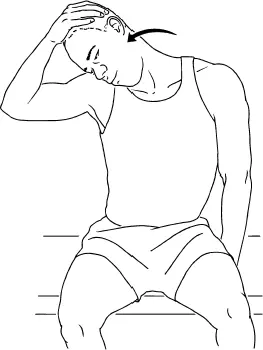
Step-by-Step
- Sit up straight.
- Lift your right arm forward, reach across your back, and press down with your hand on your right shoulder blade. Before the levator scapulae muscle is stretched, this step helps lengthen it further by rotating the shoulder blade downward. This step can be avoided if initially elevating the elbow above the shoulder is too difficult.
- Rotate the head 45 degrees to the left, halfway toward the shoulder, while keeping everything else motionless.
- Until the posterior right side of the neck is well stretched, tilt the chin downward.
- The left hand can be raised to the back of the head to gently pull down a bit further to extend the stretch even farther.
- Hold for as long as you can, 30 to 60 seconds.
- On the opposite side, repeat.
- The majority of advice suggests doing this stretch several times a day, such as in the morning and the afternoon. When neck tightness first appears, some people might benefit from doing the stretch even more frequently.
Levator Scapula Stretch Modification
Levator Scapula Stretch with hand behind
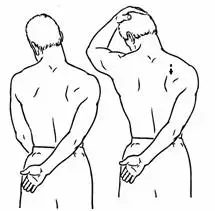
- To lower your shoulder, place one hand behind your buttocks.
- Look down and turn your head to the other side.
- Using the other hand, gently pull down on your head. Hold the position until you feel a stretching sensation. Do it again.
levator scapula stretch with the shoulder down
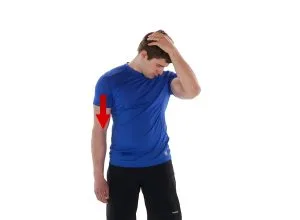
- The stretch can be performed while standing or sitting.
- Look down and toward the opposing hip while keeping your shoulder down on the side you are extending until the back of your neck feels comfortable.
- Hold for the suggested amount of time, then let go.
- To further lower the shoulder, you might sit on your hand on the side you are extending.
- Pull your head down into a deeper stretch with the arm on the other side.
Levator scapula stretch with band
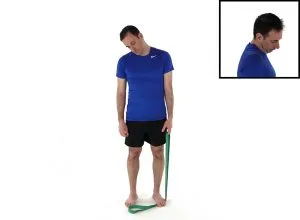
- On the side that needs to be stretched, take a step on a strong band.
- Using your hand, grasp the band such that it supports your arm and shoulder.
- Bend your head sideways in the direction of the fixing side’s opposite shoulder. Next, look at your front pocket by tucking your chin to the other side.
- On the same side as the band, you should be able to comfortably extend above your shoulder blade and on the side of your neck.
- Step on the band with the opposing foot, hold the position, and repeat the exercise on the opposite side.
Levator scapula stretch with Shoulder rolls

- Place your arms loosely on either side of your body as you stand.
- Use your shoulders to make backward circles.
- Then make forward circles.
FAQs
How to fix a weak levator muscle?
Resistance workouts for the eyelids
In this instance, try to close your eyes by opening them wide and holding the upper lids in place with your fingers. Your fingers’ resistance acts as the levator muscle’s weight. At least ten times per session, do this for a few seconds at a time.
Will levator scapulae pain go away?
Active Release Techniques (ART) have a good effect on the levator scapulae. Pain can be reduced, range of motion can be increased, and quality of life can be improved by stretching the Levator Scapulae and the surrounding muscles, such as the upper and lower trapezius.
Does massage help the levator scapulae?
Resources & Methods for Head and Neck Massage
Is it possible to fix something that cannot be fixed? Perhaps not, yet the levator scapula provides us with important insights into how clients feel discomfort, how pain is perceived, and how massage therapy can help change those patterns.
What is a red flag for neck pain?
Red flags for neck pain, such as weakness, numbness, tingling, loss of coordination, fever, severe headache, sudden worsening pain following trauma, or loss of bladder/bowel control, indicate potentially serious problems like nerve damage, infection, cancer, or fracture that call for immediate medical attention. Key indicators include persistent, severe pain and the “5 D’s” (dizziness, diplopia, dysarthria, dysphagia, and drop attacks).
Neurological Red Flags: Problems with the Nerves and Spinal Cord
weakness, tingling, or numbness in the hands, feet, legs, or arms.
handwriting changes, hand weakness, or dropping objects.
unsteadiness, poor coordination, or trouble walking (gait instability).
Loss of bladder or bowel control: (emergency).
Systemic Red Flags: Cancer, Inflammation, and Infection: chills, fever, or inexplicable weight loss.
severe, ongoing headache accompanied by a stiff neck (possible meningitis).
Pain that wakes you up: at night or doesn’t improve with rest.
cancer history.
Vascular Red Flags and Trauma
Car crashes, falls, and high-impact injuries are examples of major trauma.
Pain that starts suddenly, intensely, or with a “thunderclap.”
The “5 D’s” include dizziness, diplopia (double vision), dysarthria (slurred speech), dysphagia (difficulty swallowing), and drop attacks (abrupt falls).
What vitamin deficiency causes shoulder pain?
In the general population, vitamin D insufficiency is very common and linked to several long-term health issues. Apart from its function in bone mineralisation, vitamin D has several physiological effects that could influence shoulder disease development.
Can poor posture cause levator scapulae pain?
Fast Methods for Releasing Muscle
Self-Massage: Gently tilt your head away and press two fingers into the sore muscle, then gently massage in small circles.
Wall Slides (Hitchhiker Stretch): To activate shoulder blades, press fists (thumbs out) into a wall shoulder-width apart, slide hands up, and then try pulling thumbs back.
Finger Hook Stretch: To feel a stretch, hook fingers, pull hands apart at chest level, and then slowly tilt your head to the side. Repeat as necessary.
For Durable Relief and Prevention
Verify your posture: Avoid lowering your head to look at your phone (“tech neck”) and keep your computer monitor at eye level.
Reduce Stress: To ease tension, engage in mindfulness exercises, deep breathing, or meditation.
Stay Active: Frequent exercise, which includes strengthening and stretching, enhances blood flow and reduces strain in the future.
What kind of doctor treats scapula pain?
What causes this muscle to become tense or irritated? Stress, bad posture, or sleeping on your side with your neck squeezed can all cause the levator scapulae to tighten. Additionally, people who work at desks or have a forward-head position frequently experience stress from it.
Which nerve controls the levator scapulae?
Seeing an orthopaedic shoulder specialist who specialises in Upper Extremity areas, such as the arm, shoulder, wrist, and hand, is the best course of action if you have persistent shoulder pain.
What weakens the levator muscle?
The levator scapulae, rhomboid major, and rhomboid minor muscles are innervated by the dorsal scapular nerve, a motor nerve. These muscles are referred to as periscapular stabilising muscles because they function both dynamically and collectively. Each one of them has the ability to raise and retract the scapula.
Can exercise improve the levator muscle?
A systemic condition that results in muscle weakening weakens the levator muscle in myogenic ptosis. These disorders could include various forms of muscle dystrophy and persistent progressive external ophthalmoplegia. A bulk or too much skin weighs down the eyelid in mechanical ptosis.
What is a pinched nerve in the levator scapulae?
Exercises are difficult to “strengthen” muscles like the levator, especially when they involve external manipulation. The majority of eyelid sagging is not due to weak muscles, but rather to thinner or stretched skin. In fact, excessive pulling or stretching of the skin on the eyelids may speed sagging and exacerbate wrinkles.
How long does levator syndrome last?
Levator Syndrome symptoms
Usually, the pain subsides in less than 20 minutes. There could be a dull aching pain in the rectum or a sudden, severe pain. It can startle someone out of sleep and happen on its own or when they are seated. The passage of gas or a bowel movement may seem to alleviate the pain.
How to tell if your levator scapula is tight?
Levator scapulae tendinitis symptoms and indicators
Additionally, it may be a factor in tightness and deep, aching discomfort in the neck, over the shoulders, or in the space between the shoulder blades. Additionally, patients may have neck pain and difficulty rotating their heads or raising their necks from a supine position.
References
- Meyler, Z., DO. (2018, September 10). Easy Levator scapulae stretch for neck pain. Spine-health. https://www.spine-health.com/wellness/exercise/easy-levator-scapulae-stretch-neck-pain
- Levator scapulae muscle. (2022, December 5). Kenhub. https://www.kenhub.com/en/library/anatomy/levator-scapulae-muscle
- Osteopathy in Hatfield. (2020, January 19). Physio Exercise for Levator Scapulae Muscle Pain Syndrome | Osteopathy and physiotherapy in Jersey and Northampton. Osteopathy and Physiotherapy in Jersey and Northampton | Jersey and Northampton Physiotherapy and Osteopathy. https://osteopathy.colganosteo.com/exercises-for-levator-scapulae-muscle-pain-syndrome/