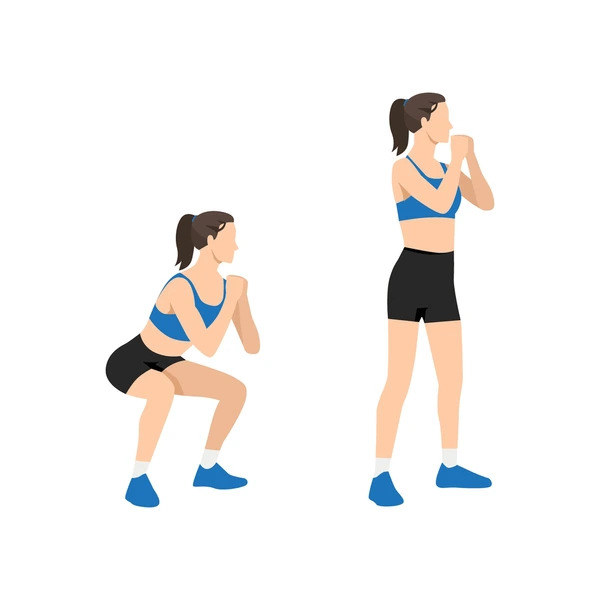

Lateral Jump Exercise
What is a Lateral Jump?
Lateral Jump Exercise is a dynamic plyometric movement that involves jumping sideways from one foot to the other. It helps improve lower-body strength, agility, balance, and coordination.
Start your lateral leap workouts by standing with your feet hip-width apart. Lower yourself into a quarter-squat position by bending your hips and knees.
Make a powerful vertical leap while moving laterally to your side. For the necessary number of repetitions, repeat this jump in the direction of the opposing side.
Muscle Work During Lateral Jump:
- Core Muscles
- Adductor Muscles
- Gluteus Muscle
- Hamstring Muscle
- Quadriceps Muscle
- Calf Muscle
How to Perform?
- Place your feet shoulder-width apart and bend your knees slightly. You should have your shoulders exactly above your hips. Throughout the exercise, keep your head and neck in a neutral position and tuck your chin under your chin, as if you’re clutching an egg.
- To establish a secure foot position, evenly distribute your weight across each foot and use your feet to hold the floor. Your elbows should be slightly bent, and your arms should stay at your sides.
- Relax your shoulders and hips while using your core.
- Maintaining a fairly vertical shin position, start bending your hips and knees while keeping your spine neutral.
- Reach a quarter-squat position by lowering your legs. With your elbows slightly bent, keep your arms outstretched.
- Let your hands move behind your body as you descend into your jumping posture.
- You should have roughly the same torso and shin angles.
- Start your sideways motion by leaping to your left and forcefully pushing through the earth.
- Swing your arms forward at the same time as you start to straighten your legs.
- Allow your hips and knees to bend to absorb force as you land the leap on the balls of your feet and evenly distribute your weight along each entire foot. Keeping your toes active, put your bodyweight into your heel and midfoot. Your feet should be hip-width apart, and your knees should line up with your toes.
- Maintaining a strong core throughout the landing will help you land gently and under control.
- Go ahead and leap to the right.
- Until you reach the necessary amount of repetitions, keep jumping from left to right.
Benefits:
- Your lower body can be strengthened by performing lateral hops. When done correctly, lateral jumps work your glutes, hamstrings, quadriceps, and calves.
- You can improve your balance and coordination by performing lateral hops. For optimal performance, the lateral jump is a full-body exercise that calls for balance and coordination.
- No equipment is needed for lateral jumps. The lateral leap can raise your heart rate and enhance cardiovascular fitness, just like other bodyweight exercises like push-ups and burpees.
Tips for Beginners:
- Increase the height and distance of your jump by using your arms to gain momentum.
- When taking off and landing, keep your knees bent and land gently on the balls of your feet.
- To prevent twisting your upper body, keep your chest elevated.
Variations:
Lateral tuck jumps:

When doing lateral tuck jumps, raise your knees toward your chest in midair and jump higher than you would for a regular jump.
Lateral hops:

Compared to a conventional lateral jump, this single-leg version works your stabiliser muscles more.
Lateral squat jumps:

Incorporate a squat motion in between each repetition to execute this variation.
Lateral box jumps:
To practise lateral box leaps, hop laterally onto a box, step down on the other side, and repeat the motion back and forth.
Common Mistakes:
Hard Surface:
Avoid completing this exercise on a hard surface that is hard on the joints, like concrete. For optimal results, practise on a gym floor, carpet, grass, sand, or hardwood floors.
Absence of Warmup:
Don’t start this exercise cold. Make sure you warm up thoroughly for at least ten minutes to increase your blood flow and flexibility. A sport-specific warm-up is recommended for athletes.
Not Enough Recuperation:
This exercise should only be performed two or three times a week, with at least one day of rest in between. This allows the muscles to grow, heal, and recover.
Inadequate landing technique:
To avoid getting hurt, you need to practice safe landing techniques. To lessen the impact force, gently land on your toes and roll to your heels. Stay away from any knee twisting or sideways motion.
FAQs
What Are The Benefits Of Lateral Jumps?
Lateral jumps are a dynamic plyometric exercise that raises heart rate, burns calories, and enhances lower body strength, balance, lateral agility, and body control. They can help improve change-of-direction speed, which is important for many sports. Lateral jumps also develop the adductors, glutes, and outer hips—muscles that are often neglected in conventional workouts.
How Can a Lateral Jump Be Converted Into a Broad Jump?
A lateral jump into a broad jump is a challenging plyometric exercise that combines the forward motion of a wide jump with the sideways action of a lateral leap. Start with a powerful lateral leap, propelling off one foot and swinging the opposing arm. Put both feet under your hips while squatting, then use your arms to launch yourself into a long forward leap. As you land from the broad jump, make a lateral hop to the opposite side of your initial lateral jump.
How Can You Use an Agility Ladder for a Lateral Jump?
Using an agility ladder as part of your aerobic training improves the coordination of lateral jumps. Take a side location and set the ladder down on the ground. Leap sideways and use one foot to land in a ladder square. Hop laterally through the ladder while keeping your chest upright. Pay attention to landing mechanics and quick feet.
How Can a Lateral Jump Over a Bar Be Performed?
For a lateral jump over a bar, set up a barbell with plates so the bar is elevated. Stand sideways to the bar and leap over it laterally. Leap over the bar from left to right to increase speed while keeping a straight stance and landing gently.
Can lateral jumps help with knee pain?
The lateral leap up is a fairly gentle exercise for knee strength and stability. It works the quadriceps and, to a lesser extent, the glutes, hamstrings, and calves. Additionally, the activity enhances your proprioception and balance. It is therefore ideal for a rehabilitation regimen for knee injuries.
References:
- Lateral Jumps- PureGym/www.puregym.com/exercises/plyometrics/jumps/lateral-jumps
- Lateral Jumps Exercise Guide: How to Do Lateral Jumps- MasterClass (Jun 24, 2021)/www.masterclass.com/articles/lateral-jumps-exercise-guide
- How to do lateral plyometric jumps – 2020 – Ms/www.verywellfit.com/lateral-plyometric-jumps-dynamic-power-balance-3119999