Squats
Introduction
Squats are a fundamental lower-body exercise that strengthen the thighs, hips, glutes, and core while improving balance, posture, and functional movement for daily activities.
If you’re just starting, learn proper technique by working with a trainer. The squat is a useful exercise for strength training, particularly for the lower body.
Squats are a useful exercise that can increase your calorie burn, help prevent injuries, strengthen your core, and enhance your posture and balance when done correctly.
Walking, climbing stairs, bending, and carrying heavy objects are just a few of the everyday activities that many of these muscles assist you with. They also assist you in engaging in sports-related activities.
Squats can improve your workout performance, lower your chance of injury, and make it easier for you to move throughout the day.
Learn more about the benefits of performing squats and the variations you can try for extra advantages by continuing to read.
What muscles do squats work?
The squat is one exercise that can test the majority of your body’s muscles.
In order to perform this compound exercise correctly, you must use several muscles above your waist in addition to the obvious lower body muscles.
During a squat, the following lower muscles are worked:
- Gluteus maximus, minimus, and medius (buttocks)
- Hamstrings (back of the thigh)
- Adductor (groin)
- Quadriceps (front of the thigh)
- Hip flexors
- Calves
You can work the muscles in your shoulders, arms, chest, and back by performing an overhead or back squat.
How to do a Basic Squat?
The simplest kind of squat, sometimes referred to as an air squat or bodyweight squat, uses only your own body weight as resistance. Yoga balls, resistance bands, and weights like barbells or dumbbells can all be used to modify the squat.
When learning to squat, it’s best to have a trainer assist you with your form. The pressure in the squat should be applied nearly evenly through your feet when you first start.
On the sole of your foot, picture a triangle with equal pressure applied to the heel, the front of the foot directly behind the big toe, and the front of the foot behind the pinky toe.
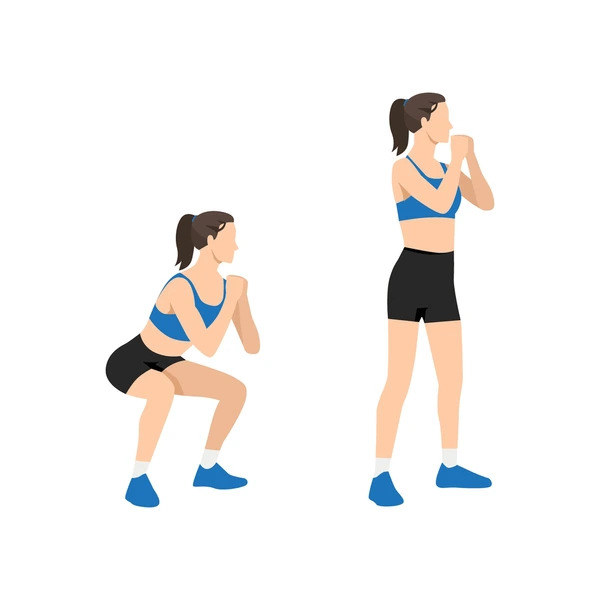
Step 1 Starting Position: Stand with your hands by your sides, palms facing inward, and your feet slightly wider than hip-width, with the toes turned slightly outward. Pull your shoulders back and down by depressing and retracting your scapulae.
Step 2: To stabilize your spine, brace your abdominal and core muscles. Push your hips toward the wall behind you while shifting your weight back into your heels, holding your chest up and out, and tilting your head slightly upward.
Step 3: Downward Phase: To begin the downward phase, move your hips backward and then downward, making your knees and hips move like hinges at the same time. The knees will then begin to slowly shift forward as you lower your hips, but try to control how much the tibia (shinbone) moves forward. Try to keep your back flat and keep your core muscles tight (keep bracing).
Step 4: Keep lowering yourself until your torso starts to round or flex forward, your thighs are parallel or nearly parallel to the floor, or your heels start to lift off the ground. Keep an eye on your knees, ankles, and feet to make sure the knees stay in line over the second toe, the ankles don’t collapse in or out, and the feet don’t move.
Step 5: From the lowered position, maintain alignment of the knees over the second toe while distributing body weight equally between the balls and heels of the feet. From the side, the torso and tibia (shinbone) should be parallel to one another, and the lower back should be flat or beginning to round.
Step 6: Upward Phase: Exhale and push your feet through your heels into the floor to extend your hips and knees while keeping your head, chest, and back upright. With the knees positioned over the second toe and the heels flat on the ground, the hips and torso must rise simultaneously. Until you are back where you started, keep extending.
Modifications and Variations
Depending on your objectives and degree of fitness, there are numerous ways to perform the squat.
Need a Modification?
A bodyweight squat, also known as an air squat or basic squat, is a good place for beginners to start. It is also suitable for people who have knee issues. You send your hips back as though you were sitting in a chair while maintaining a straight back and no weights. For balance, you can reach out with your arms. To raise yourself back up, contract your butt muscles. If you need security, you can also do this with a chair behind you. You can try performing the basic squat while standing on a rebounder or trampoline once you’ve mastered it.
You can perform a squat with dumbbells at your sides or a single dumbbell or kettlebell between your legs once you’re comfortable performing an unweighted squat.
You can then advance to carrying dumbbells on your shoulders.
Until your form is perfect, perform barbell squats using just the bar. Then gradually increase the weight until you are able to perform the squat correctly at each weight.
When performing parallel and half squats, you should only descend to the point where your thighs are parallel to the ground or higher, with your knee joints at a 90-degree angle or slightly higher. A quarter squat is another term for even less flexion. If your range of motion is restricted, this might be suitable.
Up for a Challenge?
Some people decide to perform the full squat on some days and half squats or parallel squats on others because partial squats can work your muscles in different ways. You might think about donning a nice pair of seamless leggings since comfort is essential when performing these exercises.
The barbell is placed on the front of the shoulders during the barbell front squat. This shifts your center of gravity and concentrates the workout on your quadriceps. Compared to the standard barbell squat, you should use a lighter weight.
The barbell hack squat targets the butt and hamstrings by combining a squat and a deadlift. If you are unable to handle upper-body weights, this is a good option. Put a barbell on the ground behind the heels. Grasp the barbell while squatting with a straight back. Lift the barbell from behind while standing.
Back squats
The back squat uses a barbell to add shoulder resistance to the standard squat motion. Because it demands the coordinated action of multiple muscle groups, it is a reliable source.
The back squat targets the quadriceps while concentrating on the glutes and hips.

- Place a barbell slightly below shoulder height in a squat rack.
- Place the bar below you so that it falls across the top of your back and behind your neck. Hold onto the bar with your hands.
- Step back to make room for the rack, keeping your feet slightly wider than shoulder-width apart.
- After a brief pause, raise your hips back to the beginning position by pushing through your feet.
Overhead squats
Your core, particularly your lower back, is worked during this variation.

- This squat will slightly alter your range of motion, so pay close attention to your form.
- Throughout the exercise, keep the medicine ball above your head.
- As in a standard squat, bend your knees and push your hips back while standing.
- Take a moment to stop squatting.
- Squeeze your glutes at the top as you push through your heels to get back to the starting position.
Jump squats
Jump squats don’t require any equipment. This is a powerful aerobic exercise that calls for you to use your muscles to their fullest capacity in a brief amount of time because it’s a plyometric move.
The jump squat raises your heart rate and works your glutes, quadriceps, hips, and hamstrings.

- If you want to try this variation, you should have healthy knees, hips, and ankles because it puts more strain on your joints.
- Place your feet slightly wider than shoulder-width apart and stand erect.
- Your thighs should be slightly higher than your knees when you squat.
- Return to the squat position after landing with soft, bent knees.
Benefits
Squats increase the strength, power, and endurance of lower-body muscles. They also strengthen and stabilize the upper body and trunk while engaging the core. The squat is a key component of a deep weight training approach used by the best athletes.
The quadriceps (front of the thigh) and gluteus maximus (buttocks) are the main muscles used.
The erector spinae of the back, transverse abdominis, gluteus medius, gluteus minimus, adductor magnus, soleus, gastrocnemius, and hamstrings are examples of secondary muscles.
Athletes of all skill levels can effortlessly scale up or down the squat. Exercisers of all skill levels can perform half, mini, and air squats before gradually progressing to the full, weighted squat. With the correct training and progress, any athlete can become an expert at it. Women who frequently avoid the weight room will find it especially beneficial. Learn how to squat safely instead of being afraid of it.
1. Strengthens your core
- Additionally, a strong core can help you maintain proper posture, enhance your balance, and reduce low back pain.
- Back squats increased the activation of the muscles supporting your back, according to research on core muscle activation during a plank.
- In order to lower the risk of injury and improve athletic performance, the researchers suggested using back squats to target the core muscles.
2. Reduces the risk of injury
- You can perform full-body movements with proper form, balance, mobility, and posture when your lower body muscles are strengthened.
- Additionally, adding squats to your overall workout schedule strengthens your bones, tendons, and ligaments, which may lower your risk of injury.
3. Crushes calories
- Running and cycling are examples of aerobic exercises that are frequently associated with burning calories. However, high-intensity compound exercises like the squat can also burn a lot of calories.
- For instance, 30 minutes of difficult strength or weight training exercises, such as squats, can burn about 223 calories for a person weighing 155 pounds.
4. Strengthens the muscles of your lower body
- Your glutes, quadriceps, hamstrings, adductors, hip flexors, and calves are in charge of nearly every movement you make, from getting out of bed to sitting in a chair.
- Your lower body muscles can be toned and strengthened with strength training exercises like squats. When these muscles are healthy, you might be able to walk, bend, and exercise more easily and with less discomfort.
5. Boosts athletic ability and strength
- Jump squats can help you build explosive strength and speed, which can enhance your athletic performance if you participate in a sport.
- The results of performing jump squat exercises three times a week for eight weeks.
- Based on the study’s findings, the researchers came to the conclusion that jump squat training can simultaneously enhance a number of athletic abilities, such as explosive strength and sprint time.
6. Variety helps with motivation
- You can try a variety of squat variations once you’ve mastered the fundamental squat. You can keep the exercise engaging and activate different muscle groups by switching up your squats.
- You can perform squats using only your own body weight. They can also be performed with resistance bands or yoga balls, or with weights such as dumbbells, barbells, kettlebells, or medicine balls.
7. Can be done anywhere
- Your body and sufficient space to lower your hips into a sitting position are all you need.
- Additionally, performing 50 squats a day—25 in the morning and 25 at night—can still help a variety of muscle groups if you’re short on time. Increase the afternoon by 25 as you gain strength.
Common Mistakes
To maximize the benefits of this exercise and reduce your risk of strain or injury, steer clear of these mistakes.
Inexperience
It’s important to master proper technique before lifting a lot of weight because performing the squat incorrectly can result in injuries. To learn it, gain experience, and boost your confidence if you’re just starting, enroll in a class or schedule a session with a certified personal or athletic trainer.
Bar on Spine
Instead of resting on your spine, place the padded bar on your shoulders. It is too high if it is on your spine.
Heels or Ball of Foot Off the Ground
Your feet should stay completely on the floor. Make sure the bar is positioned so that it is not so loose that it doesn’t require you to stand on your tiptoes. You are driving up through your heels during the lift, but you are also placing the ball of your foot. You should never place all of your weight on your toes or the ball of your foot.
Knee Position
Keep your knees from going past your toes. Additionally, rather than being angled to the side, the knees should line up with the toes.
Rounded Shoulders or Back
Throughout the lift, your shoulders should remain back. Instead of being rounded or excessively arched, the back should be straight and in the neutral spine position.
Narrow Stance
A stance that is too narrow puts additional strain on the knee’s posterior cruciate ligament (PCL). Stress is reduced by taking a wider stance.
Looking up or Down
Keep your eyes fixed forward.
Safety and Precautions
To prevent injuries, it’s important to perform squats with proper form. After that, you can add devices and/or equipment.
These are some typical squatting errors and solutions. See a physical therapist or fitness expert if necessary to ensure you’re doing squats correctly and to receive personalized form feedback.
Beginning in the wrong position. You won’t be able to squat correctly if your feet are too wide, too narrow, or positioned incorrectly. Each person’s ideal squat position varies slightly based on their anatomy, so experiment with foot placement to find the most comfortable setup for you.
Overly forward-leaning. An excessive forward lean increases the strain on your lower back. Your back should remain flat, but your torso should tilt slightly forward.
Losing sight of your core. Throughout the exercise, it is essential to keep your core active to avoid overworking your lower back. To achieve this, try to keep your stomach braced throughout your squat repetitions, just like you would if someone were going to punch you or you were going to sneeze.
Letting your knees give way. Another common error is improper knee alignment. To help push your knees out rather than in, make sure your toes are pointed slightly out, and your knees are tracking over your feet.
FAQS
What are squats good for?
Develops Lower Body Strength: Makes everyday tasks easier by focusing on the glutes, quadriceps, hamstrings, and calves.
Strengthens Core: Improves posture and lessens back pain by using the back and abdominal muscles for stability.
Enhances Mobility and Balance: Promotes functional movement and joint health (hips, knees, and ankles).
Increases Metabolism & Burns Calories: As a big compound movement, it increases metabolism and burns a lot of calories.
Fortifies Bones: Being weight-bearing lowers the risk of injury by increasing bone density.
Improves Athleticism: This results in improved athletic and exercise performance.
Promotes Longevity: A lower risk of death is associated with stronger leg muscles.
Are 10 squats equal to a 30-minute walk?
Alright, this is really awesome! An 8 1/2-hour workday was found to be more beneficial for overweight individuals (who are at risk of developing diabetes) if they simply performed 10 squats every 45 minutes instead of going for a half-hour walk!
Can squats lose belly fat?
Squats are great for burning calories, building muscle (which increases metabolism), strengthening your core for a tighter appearance, and contributing to overall fat loss when combined with a healthy diet and calorie deficit. Classic squats provide a solid foundation for weight loss, but exercises like jump squats are more intense for burning fat.
How squats reduce belly fat:
Metabolism and Calorie Burn: Squats are a compound exercise that works a variety of muscles, burns a lot of calories, and increases muscle mass. This raises your resting metabolism and helps you constantly burn more fat.
Core Strengthening: Over time, a stronger, more toned midsection results from your abs and obliques working hard to stabilize your body during squats.
What will 30 squats a day do?
Here’s why adding them to your daily routine can change everything: Strengthens Lower-Body Muscles: Squats help develop muscle and power by focusing on the quadriceps, hamstrings, and glutes. Increases Core Stability: Using your core when performing squats enhances balance and lowers the chance of injury.
Are squats better than walking?
The results were shocking; walking was significantly inferior to the squat routine! You are getting brief bursts of exercise that activate the big muscles in your thighs and glutes if you perform 10 squats every 45 minutes for 8.5 hours.
What happens if I squat every day?
Enhanced Strength & Endurance: Improves muscle tone and endurance for daily tasks by working the glutes, quadriceps, hamstrings, and core.
Enhanced Mobility: Facilitates more natural movement by opening hips, mobilizing ankles, and decompressing the spine.
Improved Posture and Balance: Increases body awareness, strengthens stabilizing muscles, and lowers the risk of injury.
Calorie Burn: An excellent compound exercise that promotes weight control by burning calories.
Bone Health: Squats and other resistance exercises can improve bone density.
Can squats change your body shape?
This is because squats are a great way to gain muscle, which is a great way to lose body fat. Over time, the lower body will lean out, but the change in body composition (more muscle, less fat) will also result in a change in shape and a faster metabolism overall.
References:
- Bodyweight Squat | Exercise Library | ACE. (n.d.). https://www.acefitness.org/resources/everyone/exercise-library/135/bodyweight-squat/?srsltid=AfmBOoodRKTXNpQ9Gf0_jf-K4X9HQAciu0Eck6YjIXlRMvSI6BWmipL8
- Crouch, M. (2025, November 19). Squats: the best exercise you can do for your health. AARP. https://www.aarp.org/health/healthy-living/squats-best-exercise-for-strength/
- Lindberg, S. (2023, May 26). 7 Benefits of doing squats and variations to try. Healthline. https://www.healthline.com/health/exercise-fitness/squats-benefits
- Ms E. Q. (2019, July 23). How to do the squat. Verywell Fit. https://www.verywellfit.com/safe-squat-technique-3119136
- Neudecker, K. (2025, June 24). How to squat: The ultimate guide to the perfect squat. Men’s Health. https://www.menshealth.com/uk/building-muscle/a755607/how-to-master-the-squat/
- Squats. (n.d.). [Video]. Hingehealth. https://www.hingehealth.com/gb/en/resources/articles/squat/