Dandasana (Staff Pose)
What is Dandasana?
All yogis can benefit from practicing Dandasana, also known as Staff Pose, which is a basic seated yoga pose that promotes better body alignment and increased mental focus. Because the spinal column is held straight and vertically upright, resembling a real staff or stick, this pose is called the Staff or Stick pose. The first pose in the Primary Ashtanga Yoga Series is this one.
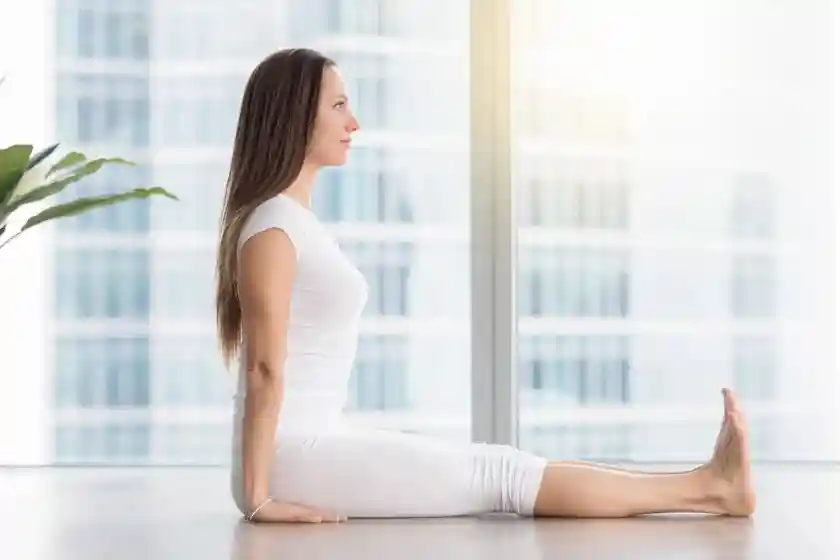
When performing the Staff Pose, the practitioner sits up straight, both legs out in front of them, and both palms rest on the sides of their glutes. Although it may seem simple to do, it might be difficult to immediately achieve the appropriate level of conscious awareness.
Asana + Danda is Dandasana. Asana means position, and spine means Danda, or stick, which stays straight as a staff. The posture in which our spine stays perpendicular to our flexed feet is known as Dandasana. Dandasana is also known as Base Pose since the entire trunk is supported by the contracted, firm legs. An upright stance with a straight angle at the pelvis is required for this pose.
Muscle Work During Dandasana:
- Lower Back Muscles
- Hip Muscles
- Pelvic Muscles
How to Perform?
- To begin, sit upright on the mat with your knees together and your arms out in front of your chest.
- By placing your hand just behind your hips, you may stabilize your spine and relax your shoulders.
- Sit over the front of the sitting bones by slightly adjusting your hips. After that, swivel your thighs towards one another while maintaining the suppleness of your core muscles by pressing them firmly against the floor.
- With your fingers pointed up and your heels pressing on the mat, flex your feet.
- At this point, extend your torso from the tailbone to the shoulder while also extending your legs from the tailbone to the heels.
- Raise your sternum, broaden your clavicles, and lift your rib cage while your ankles are bending and pressing out through the heels.
- This is Dandasana’s last pose. Hold the position for a minute while looking straight ahead.
Benefits:
- Body awareness is developed via regular Dandasana practice. Distribute your body weight evenly across your thighs, chest, and hips. The entire body becomes more conscious as a result of such an endeavor.
- Your lower body opens forward, and your upper body expands upward in the Staff Pose. This results in a good stretch of the lumbar region around the sacrum. Additionally, it strengthens, tones, and stretches the back muscles.
- Since your hips are sufficiently contracted to maintain your torso perpendicular to the floor, practicing Dandasana offers you a sense of foundation. It can restore equilibrium to the disrupted root chakra. Similar to the other seated yoga postures, this one aids in re-establishing the natural contours of your leg, hips, and spine.
- It increases flexibility in the hip extensors and pelvic muscles because the main goal of Dandasana is to bring the torso perpendicular to the floor, which requires a lot of strength at the hips to support the back.
- Simply sitting in Staff Pose, this pose provides the fundamental core strength. It is possible to strengthen and work on the muscles in the abdominal area. All of the main core muscles are strengthened. The erector spinae in the lumbar back, the transverse abdominus in the lower abdomen, and the psoas in the hips and upper leg are all actively used.
- It improves the sciatic nerve’s function by strengthening the pelvic floor muscle and facilitating healthy blood flow. Sciatica discomfort can be reduced with regular Dandasana practice. In addition, it helps asthma because it opens up the chest, which facilitates the passage of oxygen.
- Since the spine is straight in this position, prana, or subtle energy, moves through the chakras or energy centers from the base of the spine to the top of the head. Additionally, it soothes the brain, neurological system, and endocrine system while directing energy throughout the entire body. You must practice this pose regularly and for prolonged periods of time if you want to feel the flow of prana.
Beginner’s Advice:
- Beginners who have tough, rough bodies typically practice regularly. Avoid attempting to strike a position with force. Connective tissues may be torn.
- Do not consume anything before the practice. The abdominal muscles used in Dandasana may have an impact on digestion.
- Put the same amount of weight on each hip. Avoid sagging on either side of your body.
Preparatory Pose:
Tadasana (Mountain Pose):
- This pose strengthens the legs and is the basis for all standing yoga poses. In order to prepare for the Staff Pose, this pose will help you engage your knees, ankles, and core.
- Keep your hands by your sides and stand upright with both feet close to each other to enter Mountain Pose. Hold the posture for one to five minutes while taking deep breaths.
Uttanasana (Standing Forward Bend):
- This forward bending action is a great method to exercise your core muscles and lower back. Dormant hamstring muscles can be effectively warmed up with uttanasana.
- Proceed from Mountain Pose by carefully lowering yourself vertebrae by vertebrae while bending your torso forward gently. As you exhale, bend from your forehead to your knees, having begun with an inhale. Before going back to Tadasana, hold this pose for a few minutes.
Bound Angle Pose (Baddha Konasana):
- This is a great pose to open your hips and activate your spine if you have tightness in your inner thighs and glutes.
- Make a Namaste with your legs while sitting with your knees bent. Make sure your spine is tall and your knees are near the mat. For three to five minutes, hold your feet with your hands and stay in this position.
Modifications:
- Tight hamstrings limit the thighs’ range of motion. Therefore, eight to ten pounds of sandbags can be placed on top of it to touch the ground.
- The curve of the back can be easily erased by the use of a folded blanket or blocks underneath the sitting bone. As a result, elevation will help with posture.
- The wall can be used as support for alignment. Remember that your scapulae and sacrum, not your lumbar back or the back of your head, are in contact with the wall. A tiny rolled-up towel can be placed between the lumbar and the wall.
Variations:
Urdhva Hasta Dandasana (Staff Pose With Raised Arms):

- Raise both arms gently above your head while sitting in the standard staff stance. Verify the alignment and engagement of your arms, core, and spine.
- Feel the mild burn in your shoulders and core as you hold this variant for 60 to 90 seconds. Your upper body will get stronger the longer you hold this version.
Parivrtta Dandasana (Revolved Staff Pose):

- The seated twist pose, known as Parivrtta Dandasana, helps to release any remaining tension in your spinal column. Sitting in the standard Staff Pose, begin by softly twisting your spine sideways.
- You can gradually enhance your range of motion and flexibility by holding this pose for 60 to 90 seconds on each side. This will boost the flow of Prana in your lower back and spine.
Paschimottanasana A:

- Try this variation of Staff Pose, where you put your forehead on your knees and grab onto your big toes with your fingers, if you want to go a bit deeper.
- Your shoulders, back, and tailbone will all feel incredibly warm. Feel the flex in your leg and back muscles as you hold this pose for five to ten deep breaths.
Precautions:
- Keep your legs straight and flexed; do not allow them to swing outward. Stability is thus guaranteed.
- To avoid knee hyperextension, always microbend your leg.
- Steer clear of overstretching the inner thigh, spinal region, etc.
- Full stretch may be impeded by chilly muscles and tight hamstrings. Therefore, it is preferable to avoid overstressing particular stiffness regions. Here, pay attention to your physique.
Contraindications:
- Intense leg stretching in Dandasana is avoided by those who suffer from sciatic nerve disorders. Mild stretching, however, is acceptable as long as it doesn’t exacerbate the problem.
- Refrain from performing Dandasana if you have wrist or back pain. Lower back balance is necessary for the spine to straighten, and hands must also help with this.
FAQs
What does Dandasana mean?
‘Danda’ means stick or staff, and ‘Asana’ means posture. These two Sanskrit words combine to form the name Dandasana. This basic yoga pose helps to stretch the hamstrings and improve spinal alignment.
Can beginners perform the Dandasana pose?
Yes, the Dandasana stance is simple enough for novices to execute. Just begin by sitting on the yoga mat with your spine stretched vertically erect and your torso rooted on the floor. Stretch your legs straight out in front of you while maintaining a strong core.
Who should not perform Dandasana?
Until fully recovered, practitioners with significant spinal injuries or operations should refrain from this stance. It’s also a good idea to train with a certified yoga instructor if you have a slipped disc, spondylitis, or hernia. They can assist you in making adjustments and preventing more injuries.
What is Chaturanga Dandasana?
For improved core balance, perform Chaturanga Dandasana, a four-limb staff pose, in the low plank position. Even though Dandasana and this posture are very distinct from one another, they have a somewhat similar name.
What are the benefits of Chaturanga Dandasana?
The following are some advantages of Chaturanga Dandasana:
enhances focus.
Strengthens the arms, back, and core.
Improves the coordination of the breath, muscles, and mind.
Activates the Chakras of Manipura and Solar Plexus.
Helps the body and mind become ready for more difficult arm-balance poses.
References:
- Allen, W. (2025d, August 26). Dandasana. https://myyogateacher.com/yoga-asana/dandasana
- Dandasana (Staff Pose): Steps, Benefits, & Precautions – Fitsri Yoga. https://www.fitsri.com/poses/dandasana.
- Staff Pose Yoga Pose (Dandasana). Tummee. https://www.tummee.com/yoga-poses/Dandasana