

Tadasana (Mountain Pose)
What is Tadasana?
Tadasana (Mountain Pose) is a foundational standing yoga pose that promotes balance, posture, and body awareness. It helps align the spine, strengthens the legs, and improves stability while encouraging mindfulness and steady breathing.
The Sanskrit terms “tada,” which means “mountain,” and “asana,” which means “pose,” combine to form the name. It is a strong pose that encourages equilibrium, focus, serenity, and proper alignment.
On a deeper level, it facilitates solo body exploration while preserving alignment awareness.
You must be conscious of every component that contributes to keeping your spine straight and your bones in alignment. Additionally, the energising and soothing flow of prana in this position helps to build the balance of the seven chakras.
The easiest poses are sometimes the most difficult to perfect, and Tadasana (Mountain Pose) is no exception. Samasthiti is generally done with your feet together; however, Tadasana may be done with them apart or together. Tadasana (Mountain Pose) tones the hips, glutes, and belly while strengthening the legs and feet. It helps with balance and bodily alignment.
Muscle Work During Tadasana:
- Arm Muscles
- Shoulder Muscles
- Upper Back Muscles
- Middle Back Muscles
- Lower Back Muscles
- Hip Muscles
- Feet and Ankle Muscles
How to Perform?
- Stand barefoot on a yoga mat. You have the option of keeping your feet hip-width apart or together.
- To equally distribute the weight, raise the toes, spread the toe fingers apart, and position them.
- Ascertain that your knees and hips are in alignment and that your pelvis is forward in a neutral position.
- Pull your kneecaps up, spin your thighs inward, and squeeze them together.
- Preserve the spine’s natural curvature.
- Without extending the lower ribs, raise the sternum.
- Make sure your shoulders are above your pelvis and enlarge your collarbones.
- To release your shoulder blades downward, bring your shoulders to your ears and then draw them back.
- To maintain your head straight and in alignment with your spine, extend the top of your head towards the ceiling.
- Spread the fingers while holding the arms at the sides, palms facing inward or forward.
- Hold this position for five to ten breaths.
Benefits:
- Enhances balance and posture: You are effectively bringing your head, back, pelvis, and spine into their natural alignment when you stand up straight. Long durations of sitting can cause a rounded back and a stiff pelvic region, which can be countered by doing the mountain pose.
- Strengthens the muscles in your legs, abdomen, and glutes: Your lower back’s natural bend will be supported by the contraction of your abdominal muscles. Maintaining a neutral pelvic posture is aided by the glutes. And all of your leg muscles are fully contracted to stand solidly on the ground.
- Your ankles, knees, and thighs get stronger: Pulling your knees up causes your thigh muscles to actively tighten. In order to support your body weight and maintain your legs straight, your ankles must also provide some pressure.
- Permits energy to pass through the spine without interruption: Because this position allows you to stand straight, it encourages the prana flow to easily flow through the spine. By stacking the vertebrae on top of one another and paying attention to them, you can keep the spinal column in alignment.
- Enhance coordination since you must uniformly distribute your weight in this posture; tone your core because you are urged to use these muscles.
- Enhance posture which is paying attention to and adjusting your back, knees, and pelvis.
Beginners’ Advice:
- Try not to skip or hurry through Tadasana, even when it seems like you’re merely standing up. Do at least one flawless mountain position with full awareness before starting any yoga practice.
- To prevent the ankles from grinding against one another, you might maintain your feet slightly apart rather than closing them together.
- Placing the legs hip-width apart is frequently advised since it helps you discover stability and balance.
- Squeeze a yoga block between your thighs to feel the rotation of your thighs. The inner Part of your thighs should have the block’s biggest surface.
- To check your alignment, practise the position in front of a mirror.
- To ease any pain, place a folded blanket beneath the heels. You can fold one end of the mat if you don’t have a blanket.
Follow-up Poses:
- Tree Pose (Vriksasana)
- Eagle Pose (Garudasana)
- Standing Forward Bend (Uttanasana)
- Five-Pointed Star (Utthita Tadasana)
- Upward Salute (Urdhva Hastasana)
Modifications:
Arm placements are among the most popular adjustments for the mountain position, including:
- Stretching your arms straight and high. In this pose, the fingers of both hands can be interlaced or the hands can be united in Anjali Mudra.
- Place your hands in front of your chest to make the Anjali mudra.
- Make the Anjali mudra with your hands, but place them behind you. This is known as reverse namaste or reverse Anjali mudra. Those with stiff upper backs and tight shoulders may find this a little challenging.
You may use a wall as support by leaning your back against it to get a straight spine and back.
Maintaining the alignment of your hips and chest may be achieved by placing a yoga block between your back and the wall:
- To keep the chest from dropping, position a yoga block between the centre of the upper back.
- To keep the hips and lower back from collapsing, place a yoga block between them.
Variations:
Extended Tadasana (Palm Tree Pose):
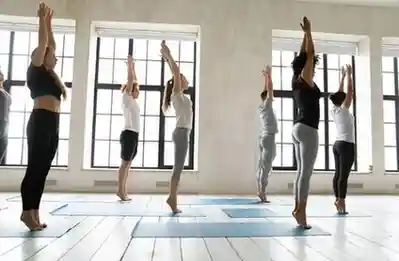
This version is especially helpful for height gain and improves general body flexibility. While standing in Tadasana, lift your heels and extend your hands over your head, interlocking your fingers. With each breath, repeat the procedure, letting go.
Tiryaka Tadasana:

This variant gives the sides and waist a nice stretch. Beginning in Palm Tree Pose, bend your upper body from the waist to the right while taking a breath. Breathe out and let go. On the left side, do the same.
By providing special strains and advantages, these variants let practitioners experiment with various aspects of the Tadasana stance.
Contraindications:
- Because this posture demands some degree of balance, people who have headaches, migraines, vertigo, or low or high blood pressure should proceed with caution. The same is true for elderly people and pregnant women.
- You should stay away from this posture for the time being if you have just had surgery or if you have an ailment in your hip, knees, ankles, or back.
Conclusion:
The most accessible stance that everyone can do is the mountain pose. It boosts your self-esteem and confidence while calming your body and mind. You will acquire mental clarity and relief from brain fog even if you only do this stance for two minutes every day.
FAQs
Is Tadasana good for the heart?
Tadasana (Mountain Pose) is a good place to start if yoga is new to you. It is also the best yoga posture for heart health since it is the simplest and most fundamental. You can maintain heart health, strengthen your lower back, and do the other postures successfully with the support of the mountain pose.
What are common mistakes in Tadasana?
Locked knees: To prevent strain, maintain a micro-bend.
Collapsed arches: To re-engage the foot, try raising your toes and then lowering them again.
Overarched back or tucked pelvis: Use your glutes and core softly to achieve a neutral spine.
How long should you hold the mountain pose?
Hold mountain stance for five to ten breaths, or up to one minute. No yoga posture should be held for longer than you feel comfortable.
What muscles does the mountain pose work?
Your quads, knees, and calf muscles are among the many muscles that are worked in mountain pose. Additionally, it works the shoulders, neck, and core.
What are the disadvantages of the mountain pose?
You should not stand for extended periods of time if you are a beginner. Your legs are not accustomed to this kind of force as a beginner; thus, prolonged practice may cause your legs to tire out sooner. Furthermore, it could hurt and strain your knee. To maintain the posture for extended periods of time, you should start small and add supports for your feet, such as blankets or towels, and then progressively increase your strength.
How long should you hold the mountain pose?
Hold the mountain posture for ten to twenty seconds at a time in the beginning. Increase the duration gradually and make this pose a regular workout at the start of your yoga asana sequence.
Does mountain pose increase height?
Although there isn’t any concrete proof that the mountain posture may help people become taller, it’s thought to be conceivable since it lengthens and stretches all of the main muscle groups. By stimulating the pituitary gland and endocrine system, it aids in the release of growth hormone. Therefore, you may have a growth surge if you regularly perform the mountain posture five times a day.
References:
- Cronkleton, E. (2024a, September 9). The benefits of standing tall in Tadasana (Mountain pose). Healthline. https://www.healthline.com/health/fitness-exercise/tadasana-benefits#benefits
- Mountain Pose (Tadasana): How to Do, Benefits, and Precautions – Fitsri Yoga. https://www.fitsri.com/poses/mountain-pose
- Mountain Pose Yoga Pose (Tadasana). Tummee. https://www.tummee.com/yoga-poses/Tadasana