
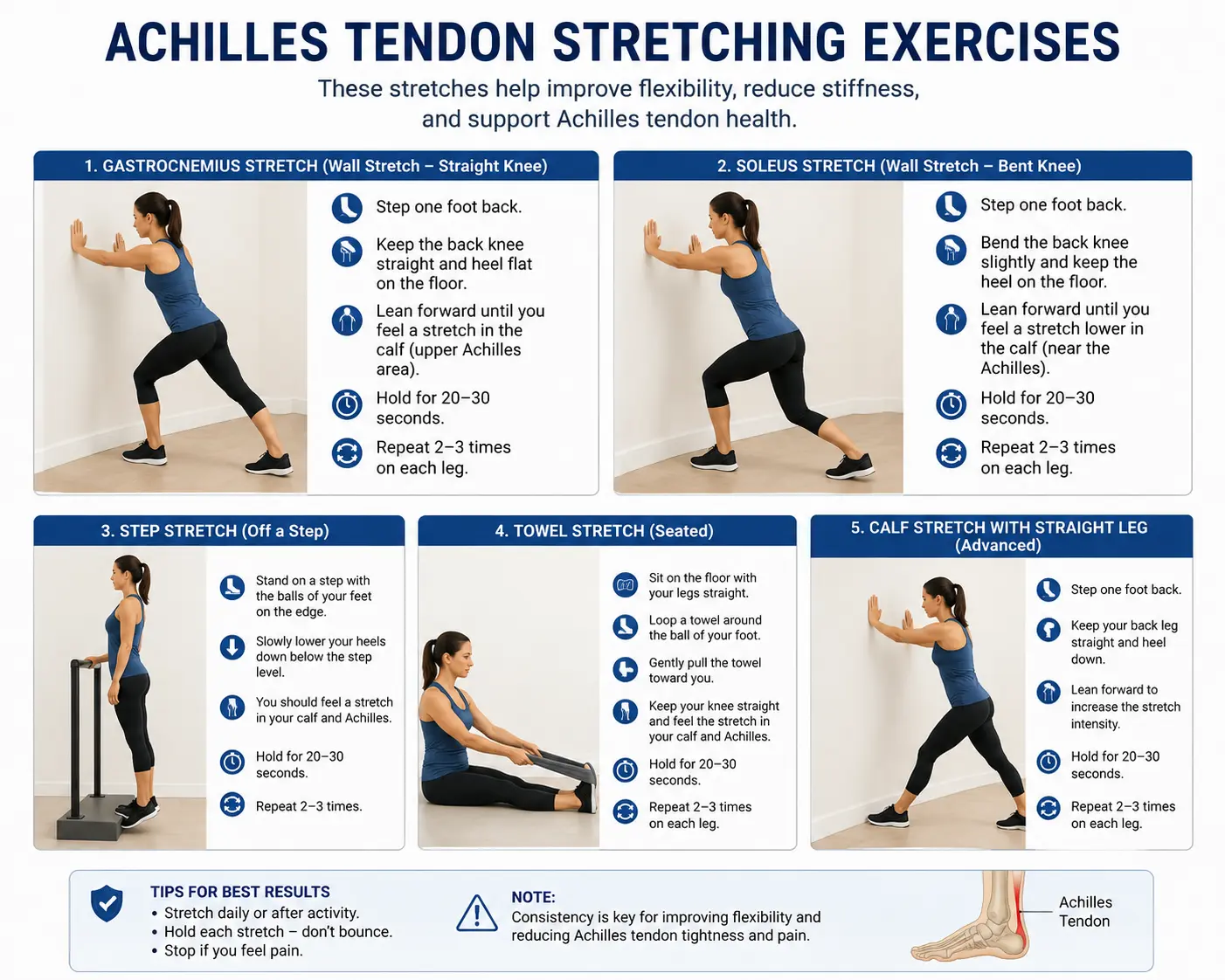
Achilles Tendon Stretching Exercises
Introduction
The Achilles tendon is the strong band of tissue that connects your calf muscles to your heel bone. Tightness in the Achilles tendon can lead to discomfort, reduced ankle mobility, and an increased risk of injury. Regular stretching exercises help improve flexibility, reduce stiffness, enhance movement, and support recovery from overuse or minor tendon problems.
Achilles tendon stretching exercises are commonly recommended by physiotherapists for athletes, runners, and individuals experiencing heel or calf tightness. Performing these stretches consistently can improve ankle range of motion, decrease tension in the calf muscles, and promote better overall foot function.
For best results, perform the stretches gently, avoid bouncing movements, and stop immediately if you experience sharp pain. Always consult a healthcare professional if you have severe pain, swelling, or a recent Achilles tendon injury.
What causes Achilles weakness?
Achilles tendons are primarily weakened by repetitive stress, sudden increases in physical activity, tight or weak calf muscles, es and aging. This micro-trauma exceeds the capacity of the tendon to repair itself and results in inflammation or deterioration.
Cause of weakness:
- Overuse and sudden increases in activity: Increasing workout intensity, mileage, or starting a new high-impact sport too quickly.
- Foot Mechanics: Problems with the structure of the foot that cause the tendon to rub and strain are overpronation (rolling the foot inward), flat arches, or bone spurs on the heel.
- Lifestyle & Health Factors That Contribute
- Bad shoes – exercising in worn-out shoes or wearing high heels all the time without stretching every day can shorten the calf muscles.”Weekend Warrior Syndrome: The body is not conditioned for the stress of intermittent bursts of activity, only on weekends.
- Medical Conditions: General health conditions such as diabetes, rheumatoid arthritis, or obesity can affect overall tendon health and healing.
- Medications: Some antibiotics (such as fluoroquinolones) and steroid injections have been associated with an increased risk of weakness and tears in tendons.
Achilles Tendon Stretching Exercises
Standing calf stretch
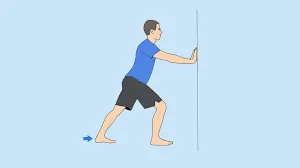
Because it loosens the Achilles tendon, the standing calf stretch may offer some relief.
You’ll need a wall or other support, like a chair, to perform this workout.
- Put your hands on the chair or the wall. Place your hands at eye level if you’re using a wall.
- Take a step behind you with the leg you wish to stretch.
- While maintaining a straight back leg, bend your other knee in the direction of the wall.
- Stretch your calf gently while you lean toward the wall. Avoid bending so much that it hurts.
- After 30 seconds of holding, repeat the stretch on the opposite side. Finish three repetitions.
Try a standing calf stretch with bent knees if straightening your leg hurts. Bend your back knee until you feel a stretch, starting closer to the wall. After 30 seconds of holding, repeat the stretch on the opposite side. Do this three times.
Toe-to-wall stretch
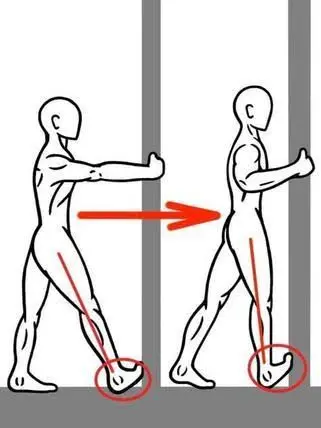
If the standing calf stretch causes discomfort in your shoulders, the toe-to-wall stretch is the best option. By lessening the strain on the Achilles tendon, it can still improve mobility even if it puts less strain on the upper body.
Use the leg that is hurting to follow these steps.
- Place your toes against the wall while facing the wall. The stretch is deeper the higher your toes are positioned.
- Keeping your heel on the ground, bend forward. (Your toes are front and your other leg is behind you.)
- After 30 seconds of holding, repeat the stretch on the opposite side. Finish three repetitions.
Heel drop

The heel drop is an additional Achilles tendon stretch. This stretch can be done on a step stool, curb, stair step, or other stable household object. Additional support can come from a wall or chair.
Use the leg with the Achilles tendon problem to perform this stretch.
- Place the ball of your foot on the bottom step’s edge.
- Allow your other foot to relax as you lower your heel.
- After 30 seconds of holding, repeat the stretch on the opposite side. Finish three repetitions.
- Do this exercise under the guidance of a medical professional if you have trouble balancing.
Seated heel raises
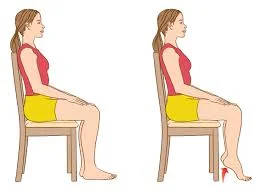
Your calf muscles cooperate to raise your heel when performing seated heel lifts. This strengthens and supports the Achilles tendon.
- Take a seat at the edge of a bed or in a chair. Spread your feet shoulder-width apart on the ground.
- Raise your heels as high as you can, stop, and then bring them down. Continue the exercise and raise your toes instead of stopping at the bottom. After pausing, bring them back to the beginning position. This is one rep.
- Perform 15 to 20 repetitions in a single set. Five or six times a day, repeat.
Standing heel raises
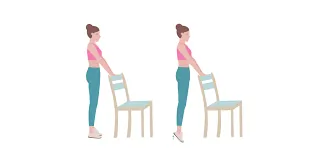
Heel lifts can be performed standing up if they are comfortable when seated. The muscles that are connected to your Achilles tendon are used in this variant.
- Place your feet shoulder-width apart as you stand. For stability, cling to a chair or countertop.
- Then raise your heels.
- After pausing, lower your heels gradually.
- Stand on the bottom of your heel after lifting your toes. Lower your toes slowly after pausing. This completes one set.
- Finish one set of fifteen to twenty repetitions. Up to five or six times a day, repeat.
Resistance band calf exercise
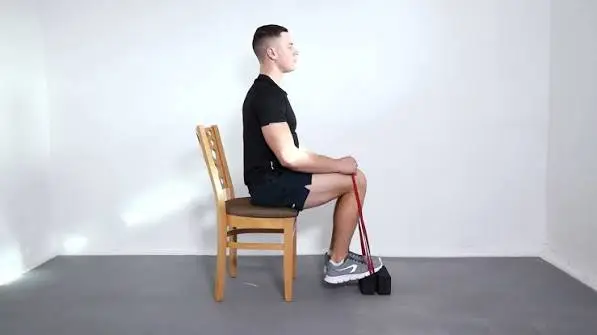
To strengthen your heel and calf muscles, you can also utilize a resistance band. By making these muscles work against resistance, this workout strengthens them.
Use a band with little resistance at first. As your tendon gets stronger, you can use a thicker band with more resistance.
- Sit on the chair. Extend the leg you want in front of you.
- Put a resistance band over the ball of the foot you want to stretch, then slightly bend your knee. Grasp the ends with your hands. Pull the band.
- Pause, release your grip, and point your foot away from you.
- After ten to fifteen repetitions, switch to the other side. Complete the three sets.
Achilles tendon stretching and strengthening tips.
Remember these pointers and techniques to maximize each stretch:
- Take your time: Whether you’re shifting positions or delving into a stretch, move gently. This will reduce the possibility of pain and harm.
- Steer clear of bouncing: Sudden, fast movements will exacerbate Achilles tendon problems. As you stretch, maintain your composure.
- Keep your heel down: Plant your heel on the floor when you stretch your calf. The Achilles tendon won’t extend correctly if you raise your heel.
- If you are in agony, stop: Stretch until you start to feel a little uncomfortable, then let go.
- Avoid pushing or straining your muscles. Stretching should be stopped right away if you experience severe pain.
- A physiotherapist or medical expert can assist you in creating an exercise routine to help you manage your injury.
Other treatments for the Achilles tendon
Stretches and exercises are frequently just one aspect of an Achilles tendon injury therapy routine. Depending on how serious your injury is, a physician might advise:
- Resting the leg for a specific amount of time
- Using over-the-counter (OTC) analgesics
- Wearing orthotics or a heel pad in your shoes and providing a cold or warm compress
- Engaging in low-impact sports like weightlifting, cycling, and swimming
If you rupture or tear more than 50% of your Achilles tendon, you can potentially require Achilles surgery. You can choose the appropriate course of action with the assistance of a physician or physical therapist.
FAQs
Is stretching good for the Achilles?
It’s highly recommended to stretch the Achilles tendon to prevent injury, manage tightness, and improve mobility. If your Achilles tendon is acutely sore or inflamed (tendinitis), you may make it worse with passive stretching, as this squeezes the irritated tissue. In those cases, you want to go to gentle strengthening and physical therapy.
Prevention & Maintenance: Stretching daily, especially after workouts, helps keep the calf muscles and the Achilles tendon flexible, reducing your risk of tears or strains. When to Stretch
Pre-Exercise: Warm the tendon up with dynamic warm-up exercises prior to activity (ankle circles) instead of static holds for long periods of time.
How long does it take to stretch out your Achilles tendon?
Usually, it takes 3-6 months of consistent, daily stretching to loosen a tight Achilles tendon. Some mild tightness can improve in as little as 3 weeks. It takes patience to break through a long-standing contracture, as tendons take time to heal and stretch, as they have a low blood supply.
Is walking good for a tight Achilles?
Which strengthening exercises work best for Achilles tendonitis? The two calf muscles that link to the Achilles tendon, the gastrocnemius and soleus, are strengthened by the best exercises for Achilles tendonitis. When walking, sprinting, or climbing stairs, these muscles raise the heel and force the foot off the ground.
How long does a tight Achilles tendon take to heal?
Any Achilles tendon injury or inflammation often takes a long time to heal and fully restore strength. The healing process can take anywhere from six weeks to more than a year. This explains why it can be a highly disruptive condition, particularly for athletes.
What are two signs of Achilles tendonitis?
Common symptoms of Achilles tendonitis include: Pain. Stiffness. The pain is usually felt in the back of the leg or over the heel and is usually worse during or after activity. Tendons are usually stiffest in the morning or after rest.
Should I massage my Achilles tendon?
Yes, you can massage your Achilles tendon, but the timing, technique, and location are key.
Do Achilles tendons ever fully heal?
Achilles injuries usually recover rather well. Depending on the extent of the damage and your level of activity, both surgical and non-surgical procedures can be used to facilitate healing.
References
- Achilles tendinopathy Exercises – United Lincolnshire Hospitals. (2025, August 5). United Lincolnshire Hospitals. https://www.ulh.nhs.uk/patients/patient-information-library/achilles-tendinopathy-exercises/
- Achilles Tendon: Exercises. (n.d.). https://myhealth.alberta.ca/Health/aftercareinformation/pages/conditions.aspx?hwid=ad1461
- Nunez, K. (2025, August 26). Achilles tendon stretches and strength exercises. Healthline. https://www.healthline.com/health/achilles-tendon-stretch#strength-exercises
- Standing calf stretch. (n.d.). [Video]. Hingehealth. https://www.hingehealth.com/resources/articles/achilles-tendon-stretches/


