
Iliotibial Band Stretch
Introduction
The iliotibial band, or Maissiat’s band, are another name for the iliotibial band (IT band). It is a lengthy segment of fascia, or connective tissue, that extends from the hip to the knee and shinbone on the outside of your leg. Your hip can be extended, abducted, and rotated with the aid of the IT band. Additionally, it protects your outside thigh while assisting with knee movement and stabilisation.
Iliotibial band syndrome (ITBS) is a disorder where the iliotibial band becomes tight and inflamed after running, walking, or hiking. In addition to being painful and uncomfortable, it can result in poor movement patterns and muscular imbalance.
Physical therapy may be helpful in treating ITBS. Exercises like the IT band stretches in this program might be prescribed by your physical therapist after they have evaluated your strength and range of motion. What you should know about the condition is provided below.
Symptoms of Iliotibial Band Syndrome
- Hip pain: Hip pain is caused by your iliotibial band rubbing against your hip’s greater trochanter. Where the bone spreads close to the head of your femur is called your greater trochanteric. Your tendon becomes inflamed, and your hip hurts as a result of the friction. There may be a snapping sound.
- Clicking sensations.
- Knee pain: On the outside of your knee, close to the bottom of your femur, where the bone spreads, is your lateral epicondyle. When you flex and extend your knee, your stiff iliotibial band constantly scrapes against your lateral epicondyle. Your knee hurts, and your tendon becomes inflamed as a result of the friction.
- Warmth and redness: Your knee’s outside may seem discoloured and feel heated to the touch.
Causes of iliotibial band syndrome
Excessive friction from the IT band being too tight and pushing against the bone is what causes ITBS. Repetitive motions are the main cause of this overuse condition. When the knee is moved, ITBS produces friction, irritation, and pain. It appears to only occur in certain individuals, while the causes are unknown.
It is particularly prevalent among runners and cyclists. Even wearing high heels, sitting for extended periods of time with bent knees, or walking up and down stairs repeatedly might cause it.
The following are risk factors for having ITBS:
- Iliotibial band tightness or past trauma
- Weak abdominal, gluteal, and hip muscles
- Weakness or lack of flexibility when walking or jogging on a track or uphill
- Excessive sitting; weak hip abductors, knee flexors, and knee extensors; repetitive exercises like cycling and jogging; and knee arthritis
- Uneven leg lengths
- Flat feet and bowed legs
Iliotibial Band Syndrome symptoms
The symptoms of IT band syndrome don’t always exist, but they usually get worse when you exercise or spend a lot of time in one place, like sitting in a movie theatre, working at a desk, or taking a lengthy flight. They may consist of:
- Pain or soreness behind the knee or around the outside of the leg
- Discomfort in the thigh or outer hip
- Inflammation and swelling surrounding the outer hip or knee
- Making a popping or snapping sound while moving your knee
Iliotibial band stretch
Strap the iliotibial band stretch.

- Position: Supine lying position.
- On your back, lie down.
- Put your right knee up against your chest.
- To your left, gently move the knee across your body.
- Turn your head to the right and extend your right arm.
- Return to the centre after holding the pose for three to five breaths.
- With the left leg, repeat the stance.
Half Splits Pose (Ardha Hanumanasana)

- Position: Sitting Position.
- Get on your hands and knees to begin.
- Place your right foot between your hands.
- Raise your hips above your left knee by shifting them back. With your sit bones up and back, flex your right foot and extend through your right leg.
- To engage your IT band, turn your heel left and right.
- Take three to five steady breaths. Get back on your hands and knees.
- On the opposite side, repeat the stretch.
Figure 4 stretch

- Position: Sitting Position.
- Sit up straight, either on the floor or in a non-wheeled chair.
- Put the same amount of weight on either side of your glutes.
- Cover your left thigh with your right shin.
- To sit up taller, softly grab your left shin with your hands without letting your pelvis roll back. Hinge forward a little at the hips to deepen the stretch.
Low lunges
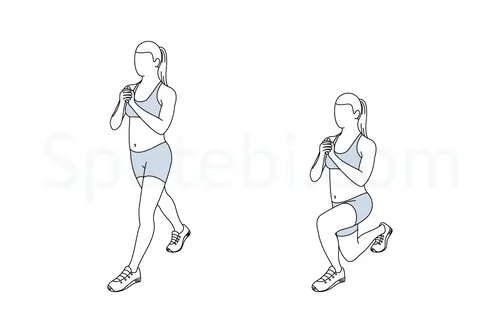
- Position: Kneeling position.
- Take a large step forward with your right foot while standing, then lower your back knee to the mat in a low lunge. Draw your shoulders down and extend your spine.
- To stack your hips over your lower knee, move them back a little. Your front foot may need to be moved back.
- With your left arm extended overhead, tilt your upper body to the right while resting your right hand or forearm on your front leg.
- This should be felt in your left leg’s outer hip. To prevent overriding in your back, keep lifting and lengthening throughout your spine.
- Take a 30- to 60-second breath here. Repeat on the opposite side after that.
Standing IT Band Stretches

- Position: Standing position.
- You can perform standing IT band stretches at home, the office, or the gym before working out, which makes them beneficial. If it’s easier, you can balance yourself by leaning against a wall.
- Maintain a straight posture. Behind the opposing leg, cross the affected (hurting) leg.
- Until you feel a stretch across the affected IT band, lean to the uninvolved side (away from the sore side).
- Hold for thirty seconds. Re-stand upright after uncrossing your legs.
- Do this four times. While some people experience a tightness in their knee during this stretch, others experience a stretch in the hip region where the IT band emerges.
Reclined Thread the Needle (Sucirandhrasana)

- Position: Supine lying position. Bend your knees and lie on your back.
- Open your right hip and cross your right ankle over your left knee.
- Use one or both hands to push your right thigh away while keeping your right foot contracted.
- You can raise your left foot off the ground if your hips feel open.
- Hold the back of your left leg while reaching your hands around its thigh. Bring the left knee closer to your chest while using your right elbow to push the right knee away.
- For three to five breaths, breathe steadily while in that position.
- On the opposite side, repeat.
Side-lying iliotibial band stretch
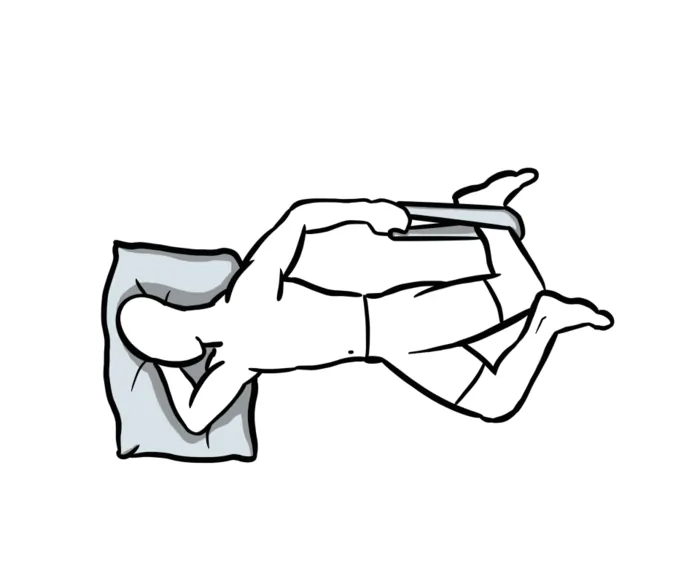
- Position: Side-lying position.
- Bend your knees and hips while lying on one side with your legs together. You can let your head rest on an extended arm or bend at the elbow to cradle it.
- Hover your upper leg a few inches above your lower leg while maintaining a bent knee.
- You should feel a slight stretch in the side of your thigh after letting your upper leg sweep back a few inches. Hold for thirty seconds.
- On the other side, repeat.
Foam rolling

- Position: Side-lying position.
- Place a foam roller at the base of your right outer thigh. Support your upper body with your arms.
- Place your left leg on top of your right by stacking them.
- Place your left foot in front of your right leg while bending your left leg.
- Roll your outer thigh up and down the foam roller from the outside of your knee to your outer hip while supporting your weight with your arms and left leg.
Triangle pose

- Position: Standing position. Step your left foot back, turn it slightly outside, and root down through the heel while standing at the top of the mat.
- Bring your hands to your hips and square your hips to the front of the mat.
- Fold forward from the hips, putting your torso over your right leg while maintaining an extended spine.
- Turn your torso to the right, anchor your hips, and reach your left hand toward your right foot.
- You can raise your right arm to the ceiling and glance up if you feel stable and your shoulders are open.
- Step your left foot forward, lower your right hand, and stand back up after three to five breaths. On the opposite side, repeat the posture.
Special test for Iliotibial band syndrome
- Ober test: The injured extremity is facing up as the patient lies on his side. The thigh is kept in alignment with the trunk as the knee is flexed to a 90-degree angle and the hip is in abduction and extension. The patient is asked to extend their thigh as far as they can. If the patient is unable to move past the examination table, the test is considered successful. A short or tense ilio-tibial band or tensor fasciae latae, which is often associated with the friction syndrome, is indicated by a positive Ober test.
- A patient suspected of having iliotibial friction syndrome can be examined using both the Ober test and the Noble compression test. When we combine the two into a single special test, the outcome will be more evident. In order to do this, the Ober test position is used, and the lateral epicondyle is compressed during passive knee flexion and extension. If the combination doesn’t work, moving the knee may increase the strain on the damaged structures and help replicate the patient’s symptoms.
- By tending the patellar expansion of the iliotibial band, medial patellar glide can potentially exacerbate symptoms and expose their exact location, whereas lateral glides can lessen them. The symptoms may also be caused by an internal rotation of the tibia as the knee is shifted from flexion to extension. The symptoms can also be replicated by combining the Nobel and Ober tests with an unloaded knee or in a weight-bearing position.
Treatment for Iliotibial band syndrome
Fortunately, ITBS typically only requires conservative/nonsurgical treatment.
Usually, does this issue require surgery? Rest, ice, anti-inflammatory drugs, and physical therapy exercises are useful treatment choices because this condition is caused by swelling and inflammation:
- REST: Avoid vigorous exercise and lengthy walks, particularly on uneven ground.
- ICE: Every six to eight hours, apply ice to the affected area for 15 to 20 minutes.
- Medicines: Nonsteroidal anti-inflammatory medicines (NSAIDs) are anti-inflammatory medications that include ibuprofen, Acetaminophen, naproxen, and meloxicam. It may help reduce the discomfort and swelling. Additionally, you can try topical gels or creams like capsaicin, aspercreme, or diclofenac.
- INJECTION: To help provide short-term relief, you might be eligible for a steroid injection around the inflamed area.
- EXERCISES: It is highly advised to follow an exercise regimen. Below is a general exercise regimen that we have offered. A foam roller, electric massage, or scraping tool can also be used to “massage” away tight, deep spots along the IT band.
Contraindications
- Recent Hip, Knee and lumbar surgery.
- Inflammation (Redness and swelling)
- Acute lumbar disc herniation.
- Knee ligament injury.
- Pregnancy (Third trimester)
- Hip osteoarthritis
- Knee osteoarthritis
Advantages of IT Band Stretching
- Minimises Pain in the Outer Knee: Particularly in runners and cyclists, tightness in the IT Band can pull on the knee joint, resulting in pain and inflammation. Stretching eases soreness and relieves tension.
- Enhances Hip Mobility: Walking, running, crouching, and other lower-body exercises require smoother hip mobility, which is made possible by a flexible IT band.
- Prevents Damage: Overuse injuries such as IT Band Syndrome, hip bursitis, and lateral knee pain can be avoided by keeping the IT Band strong and elastic.
- Boosts Sports Performance: Increased mobility translates into improved running mechanics, a stronger stride, and increased power during lower-body exercises.
- Encourages Healing: By increasing circulation and reducing tension, incorporating IT Band stretches into your post-workout regimen promotes a quicker recovery.
Conclusion
In order to avoid muscular imbalance and further dysfunction, it is important to treat the painful condition known as IT band syndrome. You can attempt these IT band stretches at home, but it’s best to have a specialist, like a physical therapist, assess your symptoms. Avoid pushing yourself into discomfort or doing anything that makes it worse.
The IT Band Stretch is revolutionary whether you’re preparing for a marathon, recuperating from strenuous exercise, or simply trying to avoid pain. It promotes healing, enhances lower-body function, and guards against persistent injuries that might hinder your advancement. If you include it in your routine on a daily basis, you’ll see improvements in your training, movement, and mood.
FAQs
What signs indicate a tight IT band?
Knee Pain May Be a Sign of IT Band Syndrome
Iliotibial band syndrome, another name for a tight IT band, is characterised by intense or searing pain on the outside of the knee or hip that gets worse with movement, tenderness and stiffness in these areas, and a popping or clicking sound when the knee or hip moves. Warming up may initially relieve the discomfort, but over time, it may become more persistent. Activities like jogging downhill or sitting for extended periods of time with your knee bent may also make the pain worse.
How is iliotibial band syndrome treated?
Iliotibial band syndrome (ITBS) is usually treated with non-surgical techniques such as anti-inflammatory drugs, physical therapy to strengthen and stretch muscles, and the RICE method (rest, ice, compression, elevation). Other alternatives include surgery to relieve stress in the IT band in rare but persistent cases, as well as steroid injections for discomfort.
If you neglect IT band syndrome, what will happen?
ITBS, or Iliotibial Band Syndrome
ITBS can develop into a chronic illness if left untreated. Ignoring symptoms might result in compensatory damage elsewhere in the body, restricted mobility, and chronic knee discomfort.
What might be confused with iliotibial band syndrome?
Because they have similar symptoms, particularly in the area of the outer knee, iliotibial band (ITB) pain and biceps femoris discomfort are frequently mistaken. Both can result in intense or achy discomfort accompanied by a clicking or cracking sensation, and they are common in athletes like cyclists and runners. Let’s remove these structures.
How is iliotibial band syndrome tested?
Easy Explanation of the Ober Test
The Ober test and the Noble compression test, which are physical examinations carried out by a medical professional, are the primary tests for iliotibial band (IT) syndrome. The Noble test simulates pain by applying pressure to the outside of the knee as the leg is moved, whereas the Ober test measures tightness by seeing whether the affected leg stays high when lowered. Additionally, imaging tests like MRIs and ultrasounds can be utilised to demonstrate inflammation or rule out other injuries.
Does walking help people with IT band syndrome?
Can someone with IT band syndrome walk? Indeed. You might feel discomfort when walking, though, if your injury is more serious. Generally speaking, you can walk on even flat terrain for brief to medium distances without making the injury worse.
References
- Cronkleton, E. (2018, August 18). IT band stretches, strength exercises, and more. Healthline. https://www.healthline.com/health/it-band#stretches
- Pt, L. I., DO. (2024, April 26). 4 Essential IT band stretches. Verywell Fit. https://www.verywellfit.com/iliotibial-band-stretches-2696360
- American Association of Hip and Knee Surgeons. (n.d.). [Home Therapy Exercises for Iliotibial Band Syndrome (ITBS)]. https://hipknee.aahks.org/wp-content/uploads/2021/01/IT-Band-Handout-knee-Jan-2021d.pdf
- Cruikshank, T., & Cruikshank, T. (2025, March 18). If you have iliotibial band syndrome, you need these 5 stretches. Yoga Journal. https://www.yogajournal.com/poses/anatomy/knees/3-stretches-relieve-iliotibial-band-syndrome
- Peterasoto. (2025, November 19). Iliotibial Band Stretch – 1 Great Guide Hip & Knee Health. SportsandMartialarts. https://sportsandmartialarts.com/iliotibial-band-it-band-stretch
- Iliotibial band Syndrome. (2025, November 26). Cleveland Clinic. https://my.clevelandclinic.org/health/diseases/21967-iliotibial-band-syndrome
- Walsh, K. (1970, January 1). Why Figure 4 stretch can offer your hips the relief they’re craving. https://www.onepeloton.com/blog/figure-4-stretch
- Clinic, C. (2024, September 26). IT band stretches for tight muscles. Cleveland Clinic. https://health.clevelandclinic.org/it-band-stretches


