
Curl-ups (Sit-ups)
What are Curl-ups?
Curl-ups are one of the most popular abdominal exercises. Curl-up exercises increase abdominal endurance, which is essential for back support and core stability. Strong abdominal muscles help prevent low-back pain.
The curl-up demands that the abdominal muscles lift the upper body off the floor. The hip flexors, of which the iliopsoas is the strongest, do not engage in the activity because it only requires a half-sit-up. According to research, the hip flexors perform the majority of the effort during a complete sit-up.
Muscle work during Curl-ups
Curl-ups typically activate the rectus abdominis, external oblique, internal oblique, and transversus abdominis muscles. Curl-up angles impact abdominal muscle activation.
The abdominal muscles are completely stimulated at a 30-degree eccentric curl-up angle, which is achieved by raising just the shoulders off the ground.
Instead of assisting with trunk flexion, the transversus abdominis muscle functions as a corset, helping to regulate the lumbar spine between segments.
Video of Curl-ups
How to perform Curl-ups?
- Lie back, knees bent, and feet anchored.
- Your neck will appear longer if you tuck your chin into your chest.
- Your hands can be resting near your chest, crossed over opposing shoulders, or interlaced at the base of your skull.
- Exhale while raising your upper body to your thighs.
- Inhale and slowly lower yourself back to the floor.
Health Benefits of Curl-ups
Helps to relieve back discomfort: This workout strengthens and stretches your hip and back muscles. You are relieved of back discomfort, and your back strengthens as a consequence.
Increase your core muscle power: Curl-ups are commonly performed for the purpose of increasing core muscular strength.
Your core becomes stronger and tighter, reducing your risk of back discomfort and injury. You’ll be able to move freely while performing your daily jobs and participating in physical activities.
Helps to boost athletic achievement: People who participate in sports tend to perform better and feel less exhausted when their core muscles are stronger. Athletes might use it to maintain proper posture.
Improve stability and balance:
A strong core muscle can help you stay solid and balanced as you go about your regular jobs and sports. The coordination of your hips, pelvis, lower back, and core may all be enhanced by this workout.
Better alignment of posture:
A strong core muscle allows for greater movement of the hips, spine, and shoulders, ensuring optimal anatomical alignment and improving or maintaining excellent posture. Proper posture reduces back pain and strains while also improving respiration.
It helps to lessen the likelihood of back problems and discomfort. Curl-ups help to strengthen the muscles in the lower back, hips, and pelvis.
Hip flexor strength:
The rectus femoris, iliacus, and iliopsoas are the muscles that lift your legs off the ground and bend your hips as you walk, the most fundamental human movement. Sit-ups strengthen both these and your abdominal muscles.
Variations of Curl-ups
Stability Ball Curl-ups (Sit-ups):

- Sit on a stability ball.
- Slowly lean back, ensuring that your shoulders, back, and tailbone are in alignment with the ball.
- Place your midfielder at the ball’s highest point.
- Pull your elbows back, interlace your fingers at the base of your skull, and press your shoulder blades together.
- Exhale as you tighten your core and move down to your thighs to lift your upper back off the ball.
- Pause in this posture, then inhale and slowly lower yourself back onto the ball.
V ups:

- Lay on your back with your knees straight and your arms outstretched overhead.
- Arms and legs raised to the ceiling.
- Keep your chest and legs outstretched at an angle.
- Position your arms parallel to the floor.
- Hold this posture for five seconds.
- Return slowly to the starting position.
Elbow to Knee Curl-ups:

- Place your fingers together at the base of your skull while lying on your back.
- Maintain a raised leg position with bent knees.
- To do a body twist, bring your right elbow up to your chest and pull it to your left knee.
- Perform on the opposing side.
Curl up with your legs straight:

- Align your legs naturally and have a level stance on the ground.
- The legs should not be flexed at the knees, as in a typical sit-up.
- Maintain a still, supine stance with your hands at your sides.
- Lift your upper body off the ground by taking a deep breath and tensing your abdominal muscles.
- Once your spine is parallel to the ground, carefully lower your body back into its original position.
- Then calm down.
Decline Curl-ups:
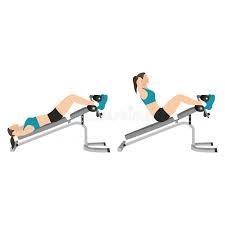
- You can change the arrangement’s level of difficulty by changing the bench’s angle.
- When the decline bench’s angle rises, the workout becomes more difficult.
- Place your feet beneath the padded bar and sit on the bench with your knees bent.
- Wrap your fingers around the base of your skull or fold your arms across your chest.
- Lift yourself till your body and thighs come into contact.
- Hold your position for a few seconds.
- Then return to the neutral position.
- Then calm down.
Bicycle Crunches:

To do Bicycle Crunches:
- To begin, take a comfortable position on the floor.
- Resting on the ground, raise your shoulders and stretch your legs.
- Bend to one side and press one knee on the nearest elbow, extending the opposite leg as much as possible.
- Return to where you were before crushing on the opposite side.
- Then calm down.
Russian Twist Sit-ups:

To do Russian Twist:
- Get into the standard sit-up beginning posture.
- Lay on your back, spine straight, knees slightly bent, and feet flat on the ground.
- Secure your feet with dumbbells or get assistance from a spotter.
- Bend your elbows and place your fingers at your temples, or cross your arms in front of your chest.
- Achieve a 45-degree angle with the floor by raising your trunk towards your knees while strengthening your core.
- Spin your trunk slowly to the right before returning to the ground.
- Raise yourself and immediately pivot to the left before returning to your starting position.
Contraindications and Precautions of Curl-ups:
- A spinal injury occurred recently.
- Hernia in the abdomen.
- Abdominal surgery was just conducted.
- Weakness of abdominal muscles.
- If any discomfort occurs during exercise.
- Lumbar disc bulging.
- This exercise is not required in situations of lumbar retrolisthesis.
- If your back discomfort worsens during exercise.
Advice for doing Curl-ups:
- Make sure your body is sufficiently warmed up before exercising.
- If you are experiencing any discomfort while exercising, stop.
- To avoid overtraining and sore muscles, gradually increase the number of repetitions and length of your workouts.
- When exercising, use good form to prevent harming your body and enjoy the advantages you seek.
- When exercising, try to wear clothing that does not limit your movement too much. Wear loose clothes as an alternative.
- Maintain a straight spine throughout activity.
- Before exercising, take a deep breath and exhale slowly.
Common Mistakes:
Avoid swinging during sit-ups, as this is a typical mistake that diminishes the exercise’s efficacy. Fewer regulated repetitions will result in a higher muscular stimulation.
Pulling your head up while your hands are crossed behind it might result in a swinging action and raise the risk of injury from excessive neck straining. Be careful where you rest your hands, and keep your arms relaxed behind your head or on your sides. Alternatively, place your hands in front of your chest or on your hips while maintaining them relaxed.
Basic sit-ups should be performed with your feet on the ground. Do not elevate your feet only because the repetition is tough. To change the training stimulus, only raise your legs when performing sit-ups with your legs bent in the air.
FAQs
Can I perform curl-ups each day?
If the weight is high enough to produce the perfect environment for overload and muscle growth, you will never need to skip a day between sessions.
How many curl-ups do you do each day?
The greatest technique to tone and improve your abs is to do three sets of sit-ups with 20-30 reps each. Even better, if you combine crunches with weight and aerobic activities, you will only need to perform them three times each week.
Does curl-up exercise help with abs?
Curl-ups are a simple approach to strengthen your core without requiring any extra equipment at home. We’ve broken down how to do curl-ups correctly so you can start incorporating them into your workout routine.
References:
- Cronkleton, E. (2023, July 17). 9 Benefits of Sit-Ups and How to do them. Healthline. https://www.healthline.com/health/sit-ups-benefits#exercises
- Bariya, D. (2024, August 3). Curl ups Exercise (Sit Ups): Health Benefits, How to Do? Physical Therapy Treatment and Exercise. https://physical-therapy.us/curl-ups-exercise/
- Colletta, M. (2022, January 21). 10 Sit-Up variations (From easiest to hardest). Steel Supplements. https://steelsupplements.com/blogs/steel-blog/10-sit-up-variations-from-easiest-to-hardest?srsltid=AfmBOoqFGGBzsxUASE8tRIydrCPqd7ao-XNUU8wfNZg4Q8ZyK3VGzfNb
- Sit ups. (2023, April 17). Training.fit. https://training.fit/exercise/sit-ups/