
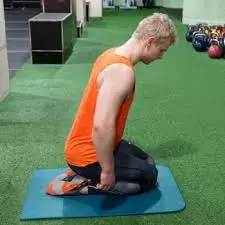
Knee Jump Exercise
Introduction:
The Knee Jump Exercise is a powerful plyometric movement that helps improve lower-body strength, explosive power, and coordination.
When Knee Jump is performed correctly and with proper form that makes your muscles more explosive, enabling you to jump higher, leap farther, run quicker, and kick harder. Therefore, this workout is ideal if you are a long jumper, high jumper, short-distance runner, or even a black belt in karate.
Muscle Work During Knee Jump:
- Primary Muscles: Quadriceps and Gluteal Muscles
- Secondary Muscles: Core Muscles, Hip Flexor Muscles, and Hamstring Muscles
How to Perform?
- To begin, kneel on the ground so that your glutes are in contact with your heels and calves.
- Next, quickly and deliberately swing your arms backward, then forcefully bring them forward and up while simultaneously using your knees to propel yourself off the ground.
- This way of using your arms will help generate the momentum required to get yourself off the ground.
- As you lift yourself off the ground, concentrate on landing in a deep squatting position by pulling your knees to your chest.
- To complete the repetition, stand up straight. Lunge back down to get back to your original kneeling position after you’ve straightened up.
Benefits:
Develops Explosive Power: Kneeling jumps aid in the development of explosive strength, which is necessary for sports like sprinting, basketball, and volleyball. Your capacity to leap higher and move more swiftly is enhanced by the movement’s requirement for rapid force generation.
Strengthens Lower Body Muscles: The quadriceps, glutes, hamstrings, and calves are the main muscles worked during this exercise. It’s a fantastic method of strengthening your lower body without using large weights.
Enhances Core Stability: Using your core muscles is essential for performing kneeling jumps effectively. This enhances your stability and balance, all of which are critical for general fitness.
Improves Coordination and Balance: Kneeling jumps help you become more coordinated and aware of your body because they require you to move from a kneeling position to a jump.
No Equipment Required: Kneeling leaps are a convenient addition to your exercise regimen because you can perform them anywhere. To leap safely, all you need is enough room.
Beginners Advice:
- Don’t start with a box or platform. Before gaining height, concentrate on perfecting the movement.
- To cushion your knees, use a soft surface such as a yoga mat.
- Avoid hurrying through the workout and maintain control of your movements.
- If you’re new to plyometrics, start with fewer repetitions (5–8 leaps, for example) and progressively increase as your strength increases.
Variations:
Two Leg Knee Jump:
Simply starting from the kneeling sitting posture and working your way up to a full squat is the simplest knee jump sequence. For the following repetition, go back to the sitting position.
Because the movement might cause severe skin damage, it is advised to put some cushioning under your knees and shins.
One Leg Knee Jump:
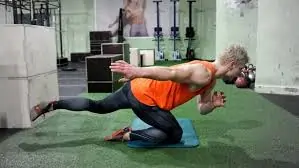
Since you are just utilising one leg for the jump, the one-leg knee jump is obviously the more difficult progression!
A one-leg knee jump demands a lot more leg strength, but it also calls for balance because you are only using one leg.
The exercise can be started by simply balancing on one knee. Move forward and backward to test your range of motion; this will improve your balance and stability!
Box Jump:

Doing more box jumps following the knee jumps is another technique to make them more challenging and successful overall!
In this manner, the exercise turns into a continuous movement flow in which you jump twice in succession without pausing.
Common Mistakes:
Inadequate landing technique:
To prevent injuries, it is essential to know how to land correctly before starting training. Overuse can cause discomfort even in the absence of an unexpected accident. You can absorb the power of the landing if you acquire the proper technique.
Ignoring Quality to Boost Quantity:
While striving for improvement is admirable, it can occasionally backfire if done incorrectly. The quality of the movements will deteriorate if repetitions are increased too rapidly. Doing fewer repetitions and doing them effectively is preferable to aiming for quantity and performing poorly.
Ignoring Strength Restricts Our Ability:
Power is a combination of strength and speed. Take note of the formula: power = force x velocity. It can be tempting to concentrate just on the speed at which movements are executed (velocity). However, we are losing half of the picture if speed is the only consideration.
One definition of strength is the capacity to produce force. The only way to improve the power of our movements is to increase both our strength (force) and speed (velocity). Both strength and speed must be taken into account to realise full potential.
Things to keep in mind:
Including knee jumps in your exercise routine is advantageous for a number of reasons. The first and primary reason is that it’s an excellent exercise for developing your lower body’s explosive strength and power.
To perform a Knee Jump flawlessly, you must land with soft knees and pay attention to the position of your feet throughout the exercise. Your knees should line up with your toes, and your feet should be shoulder-width apart. For optimal technique throughout this exercise, maintain your torso slightly forward, your glutes slightly back, and your hips slightly flexed.
Once you get the hang of them, knee jumps are a reasonably easy manoeuvre to master. Before attempting more repetitions, like with any new exercise, make sure you can execute it correctly.
Make sure you swing your arms forward as you leap to make sure you are doing things correctly and lower the chance of damage. You’ll gain momentum as a result. To help you maintain your balance and support your feet as you land the manoeuvre, it’s also a good idea to do it on a rubber surface or exercise mat.
FAQs
What are the benefits of Knee Jumps?
Knee jumps activate the quadriceps, hamstrings, glutes, and calves, increase hip drive and coordination, and develop explosive lower-body power. When done correctly and with sufficient recuperation, they can also improve athletic jumping ability and tax core stability.
What Common Mistakes should I avoid with the knee jump?
Leaning forward, compressing the spine, landing stiffly, and allowing the knees to buckle are common mistakes. By bracing the core, maintaining an elevated chest, absorbing impact with the hips and knees, and practicing on a soft surface, you can prevent bad posture.
How can I progress to knee jumps or regress them?
Once form is excellent, advance by adding weighted vest practice, higher jumps, or controlled repetitions. While increasing hip strength and mobility, regress with supported kneel-to-squat transitions, squat-to-stand exercises, tuck jumps, or step-up power drills.
Are knee jumps effective?
By strengthening the quadriceps, glutes, hamstrings, calves, hip drive, and reactive landing ability, knee jumps increase lower-body explosive power. When used correctly, they also improve athletic performance in sprinting and jumping as well as core stability.
Do knee jumps increase speed?
High knee skips are an excellent option for increasing cardio endurance and burning calories because they are more strenuous than standard skipping. Your coordination, timing, and agility will all improve with this workout, which can help you train for power and speed in sports.
References:
- KNEE JUMPS for explosive lower body development – 2020 – Samuli, Samuli/vahvafitness.com/knee-jumps-for-explosive-lower-body/
- Freeletics exercises: knee jumps – David/www.freeletics.com/en/blog/posts/freeletics-exercises-knee-jumps/
- Kneeling jumps: a powerful exercise for strength and fitness – 2025 – MyFitnessCoach/myfitnesscoach.fit/blogs/workout/kneeling-jumps
- common vertical jump training mistakes to avoid – Junkyard Training Blog/junkyardtraining.net/blogs/common-vertical-jump-training-mistakes-to-avoid.html


