Exercises For Proximal Hamstring Tendinopathy
Exercises for proximal hamstring tendinopathy play an important role in reducing pain, improving flexibility, and restoring strength in the hamstring muscles near the sitting bone. This condition often occurs due to overuse, prolonged sitting, or sports activities such as running and jumping.
A planned physiotherapy exercise regimen focusing on progressive strengthening and mild stretching can aid in healing, increase mobility, and stop additional injuries.
What’s Hamstring Tendinitis/Tendinopathy?
Hamstring tendon degradation and chronic inflammation, or pain and swelling, are the characteristics of hamstring tendinopathy.
The three muscles at the back of your thighs are called your hamstrings. The Ischial Tuberosity, a bony protrusion at the back of your pelvis, is where they all start. The Common Proximal Hamstring Tendon is a strong, fibrous tissue that connects these muscles to their origin.
Two of these muscles go down the inside of the thigh before narrowing into long tendons that attach to the upper section of the Shin bone (Tibia). In medical terminology, these muscles are referred to as the semimembranosus and Semitendinosus.
The remaining muscle, known as the Bicep Femoris, runs around the mid-outer parts of the thigh before narrowing into another long tendon that inserts into the outer surface of the Fibula.
The Fibula runs along the outside of the tibia. When a tendon’s structure and function are compromised, hamstring tendinitis develops.
Current research on damaged tendons reveals fiber breakdown and reduced post-injury healing capacity. This is typical of tendinopathies in other important tendons, like the rotator cuff and Achilles tendon.
The most at-risk tendon is the common hamstring tendon, which connects the three muscles to the pelvis. This is because it is subjected to much greater compressive and tensile pressures during a range of activities.
What Causes Hamstring Tendinitis?
Repetitive Stress
Most significantly, this is the most frequent cause of hamstring tendinitis. When a tendon is overloaded, it may experience structural damage that sets off a sequence of tiny healing processes.
These healing mechanisms may be interfered with when the tendon is continuously loaded at similar amounts. As a result, it is unable to repair effectively, which eventually results in a cycle of pain and inflammation as well as structural integrity.
Because of this, the majority of proximal hamstring tendinopathies affect athletes who participate in sports requiring quick, forceful lower-body movements, such as hockey players, soccer players, and sprinters. Outside of athletics, hamstring tendinopathies are also rather common in people who work in a variety of jobs requiring prolonged or repetitive hip and knee motions.
Sudden, forceful Hamstring loading
The processes underlying tendinitis can occasionally be triggered by a single incidence of a sudden and severe load or stretch in the hamstring muscle and its tendon. Tears in the tendon’s structure might result from a rapid shift of direction that necessitates a strong muscle contraction or from landing in an uncomfortable position that overstretches it. These wounds may not heal properly over time, potentially leading to tendinitis.
Intrinsic factors
Hamstring tendinitis can occasionally develop without intense or repetitive stress or strain. Numerous factors have been identified by studies as the cause of these types of hamstring tendonitis.
One of the main factors is aging. By raising the compressive and tensile strains on the hamstring tendons, additional significant intrinsic factors increase the total risk. These include muscular imbalances, postural abnormalities (such as leg-length disparities), and being overweight.
Treatment Overview
Conservative Treatment
The initial line of treatment for hamstring tendinitis is conservative, non-invasive methods. Here, physiotherapy is crucial since it provides a range of therapeutic strategies to reduce symptoms, restore function, and stop recurrences. Important physiotherapy interventions consist of:
Exercise therapy is the application of different exercise-based techniques to correct any biochemical dysfunctions, encourage healing, and lessen tendon tension. It has been demonstrated that certain types of exercise, such as isometric exercise, are quite successful in reducing pain.
Manual therapy is the application of several hands-on methods to treat a range of symptoms and dysfunctions, such as pain, hamstring tendinopathy, and tightness in the muscles.
Adjunct Therapies: Short-term pain treatment may be supported by complementary therapies such as TENS and interferential therapy.
Surgery
When conservative treatments for hamstring tendinitis don’t work, surgery can be the best course of action. Depending on your demands and other considerations, the surgeon may choose an endoscopic or open technique. An endoscopic repair is a less invasive alternative that employs smaller incisions and specialized tools to guide the repair. In contrast, an open repair requires a big incision to access the tendon.
When conservative treatments for hamstring tendinitis don’t work, surgery can be the best course of action. Depending on your demands and other considerations, the surgeon may choose an endoscopic or open technique. An endoscopic repair is a less invasive alternative that employs smaller incisions and specialized tools to guide the repair. In contrast, an open repair requires a big incision to access the tendon.
Best Exercises for Hamstring Tendinitis
1) Lying Hamstring Stretch

Aim: Prevent or lessen hamstring tightness and pain.
How to do it:
- On your back, lie down.
- Lift the afflicted leg so that it is vertical.
- Hold for two to three repetitions of 15 to 20 seconds.
2) Seated Hamstring Stretch

Aim: lessen pain and tension.
How to do it:
- Take a seat on a chair or bench.
- With the heel lying on the ground, extend the afflicted leg forward.
- Try to reach for your toes on the afflicted side while bending forward. The back of your leg should extend firmly but gently.
- Hold the pose for three to four repetitions of 15 to 20 seconds.
3) Glute-Ham Bridge

Aim: Reduce discomfort and maintain or increase hamstring strength.
How to do it:
- With your feet on an elevated platform (a chair or bench), lie on your back with your arms by your sides.
- Elevate your low back and pelvis.
- Return to the beginning position with control.
- Aim for 3–4 sets of 10–15 repetitions, then repeat the exercise to hit another rep.
4) Squat

Aim: Strengthen your quadriceps, hamstrings, and glutes.
How to do it:
Starting position
With your feet shoulder-width apart, stand erect.
The Movement
- With your thighs parallel to the floor, lower yourself to a mid-squat position.
- Go back to where you started. For another rep, repeat.
- Aim for 3-4 sets of 10-15 repetitions.
Note:
- When lowering yourself to the lowest position, avoid curling your back.
- During the lowering phase, move as though you were trying to recline in a chair.
- To start, use merely your bodyweight. After you’ve mastered the right form, think about adding more weights.
5) Nordic Curl
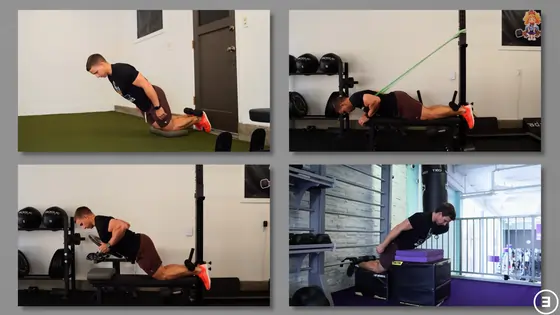
Aim: Increase Hamstring Power
Note:
- In the later stages of recuperation, this isolation hamstring exercise is usually utilized to strengthen the hamstrings. Before attempting anything, ensure that you speak with your therapist.
- To finish this one, you’ll need the following extras:
- A pillow, folded towel, or soft pad to place your knees on.
- A steady anchor for your feet, or someone to hold them.
Starting position
Maintain a straight line with your hips, abdomen, and shoulder while you kneel on the soft cushion. Get your ankles secured by someone. As an alternative, you can use any sturdy anchor just enough to keep your ankles down while performing the exercise.
The Movement
- Reduce your body’s height by about 20 to 30 degrees.
- Go back to where you were. For a second rep, repeat. Aim for 3–4 sets of 10–15 repetitions.
Alternatively,
- Reduce your body’s height by 20 to 30 degrees.
- Hold for ten to fifteen seconds.
- Go back to where you were. Do these two to three times.
after you’ve mastered the form. Increase the range of motion all the way to the floor to increase intensity. When you get to the lowest position, use your hands to support your body. Then, push off the ground to start the ascending phase.
6) Standing Knee Bend

If necessary, stand while using a chair for balance.
- Return to the starting position after bending your knee and bringing your heel as close to your bottom as you can.
- Avoid bending at the hips. Maintain a straight posture.
7) Elastic Band Hip Extension
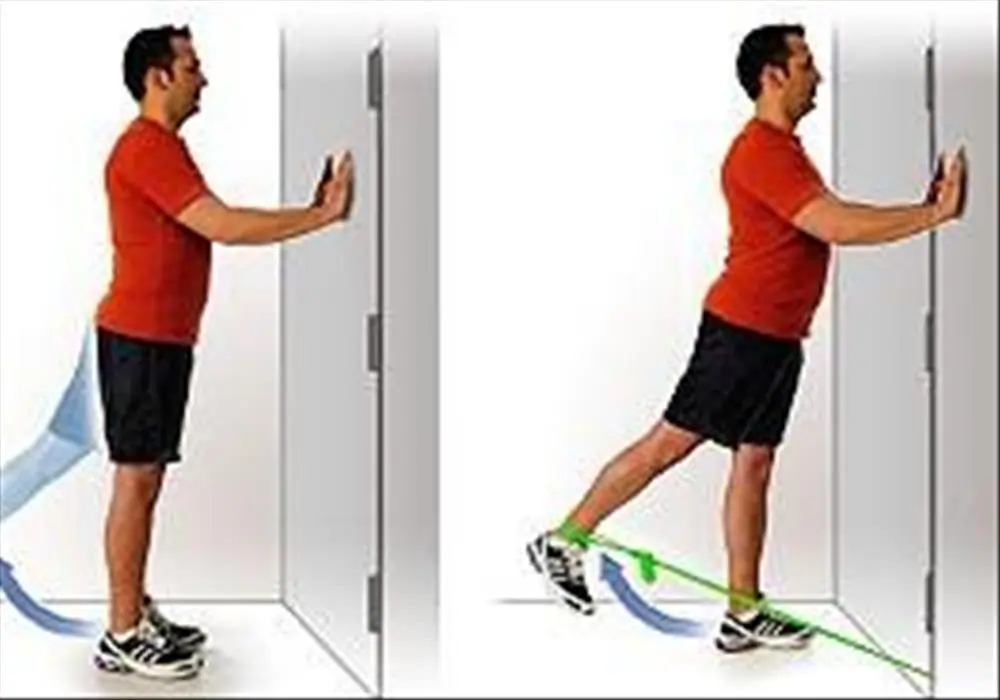
- Hold an exercise band with one end attached to a firm point and the other to your ankle.
- Grip a table or chair.
- Retract your leg behind you.
- Throughout, maintain a straight knee.
Summary
It can take a while to treat high hamstring tendinopathy. When tendons get irritated, it may require months of constant effort to make them happy again, but the outcome is always worthwhile.
You can eliminate your high hamstring tendinopathy and run pain-free if you dedicate yourself to a basic routine of progressively more challenging exercises. It just comes down to consistency, resistance, and time, just like any other running issue.
FAQs
How to get rid of proximal hamstring tendinopathy?
To strengthen the tendon and lessen compressive pressures on the ischial tuberosity (sit bone), gradual, high-load resistance training is the mainstay of treatment for proximal hamstring tendinopathy (PHT). Isometric and eccentric workouts (such as Nordic curls and bridge variations), load management, changing stressful activities like sitting or jogging, and even shockwave therapy are important interventions.
What not to do with proximal hamstring tendinopathy?
The high hamstring tendons are stretched by more than just your standard hamstring stretch workouts. The upper hamstring tendons will be stretched and compressed against your sit bones by any workout that involves moving your hip forward and beginning to straighten your knee.
Can you exercise with hamstring tendinopathy?
Exercises that load the hamstrings eccentrically are the best for treating hamstring injuries and high hamstring tendinopathy. This just indicates that the muscle is contracting as it grows longer.
How long does it take to heal proximal hamstring tendinopathy?
Although early-stage cases of proximal hamstring tendinopathy (PHT) may heal in 8 to 12 weeks with appropriate load management, recovery typically takes 3 to 6 months. Rather than being an acute rupture, it is a chronic overuse injury that frequently necessitates regular, intense loading and strengthening workouts for the hamstrings and glutes to heal.
References:
- SportsMed, Y. (2025, August 19). 5 best exercises for hamstring tendinitis You need to know | Physiotherapists in Toronto | Yorkville Sports Medicine Clinic. Physiotherapists in Toronto | Yorkville Sports Medicine Clinic. https://www.yorkvillesportsmed.com/blog/5-best-exercises-for-hamstring-tendinitis
- Grand River Sports Medicine Centre. (2025, October 9). 6 Key exercises to target Proximal hamstring tendinopathy. Grand River Sports Medicine Centre Serving Cambridge and Kitchener-Waterloo. https://www.grsm.ca/proximal-hamstring-tendinopathy/
- Kafker, N., & Kafker, N. (2021, August 27). Exercises that fix high hamstring tendinopathy in runners. Recover Athletics. https://recoverathletics.com/exercises-that-fix-high-hamstring-tendinopathy-in-runners/
- Unknown. (2020). Hamstring tendinopathy. http://airedalemsk.co.uk/wp-content/uploads/2021/01/MSK-leaflet-hamstring-tendinopathy-sml.pdf