Exercise For Long Sitting Hours
Introduction
Although sitting may seem harmless, remaining in the same position for extended periods can place extra stress on the muscles, joints, and spine. Over time, this may contribute to neck pain, shoulder stiffness, lower back discomfort, tight hip flexors, poor posture, reduced flexibility, and decreased blood circulation. A sedentary lifestyle is also associated with lower energy levels and reduced physical fitness.
Performing simple exercises and stretches throughout the day is an effective way to reduce the negative effects of prolonged sitting. Short movement breaks help relax tight muscles, improve joint mobility, increase blood flow, and activate muscles that become inactive during long periods of sitting. Regular movement can also improve posture, reduce fatigue, enhance concentration, and support overall physical and mental well-being.
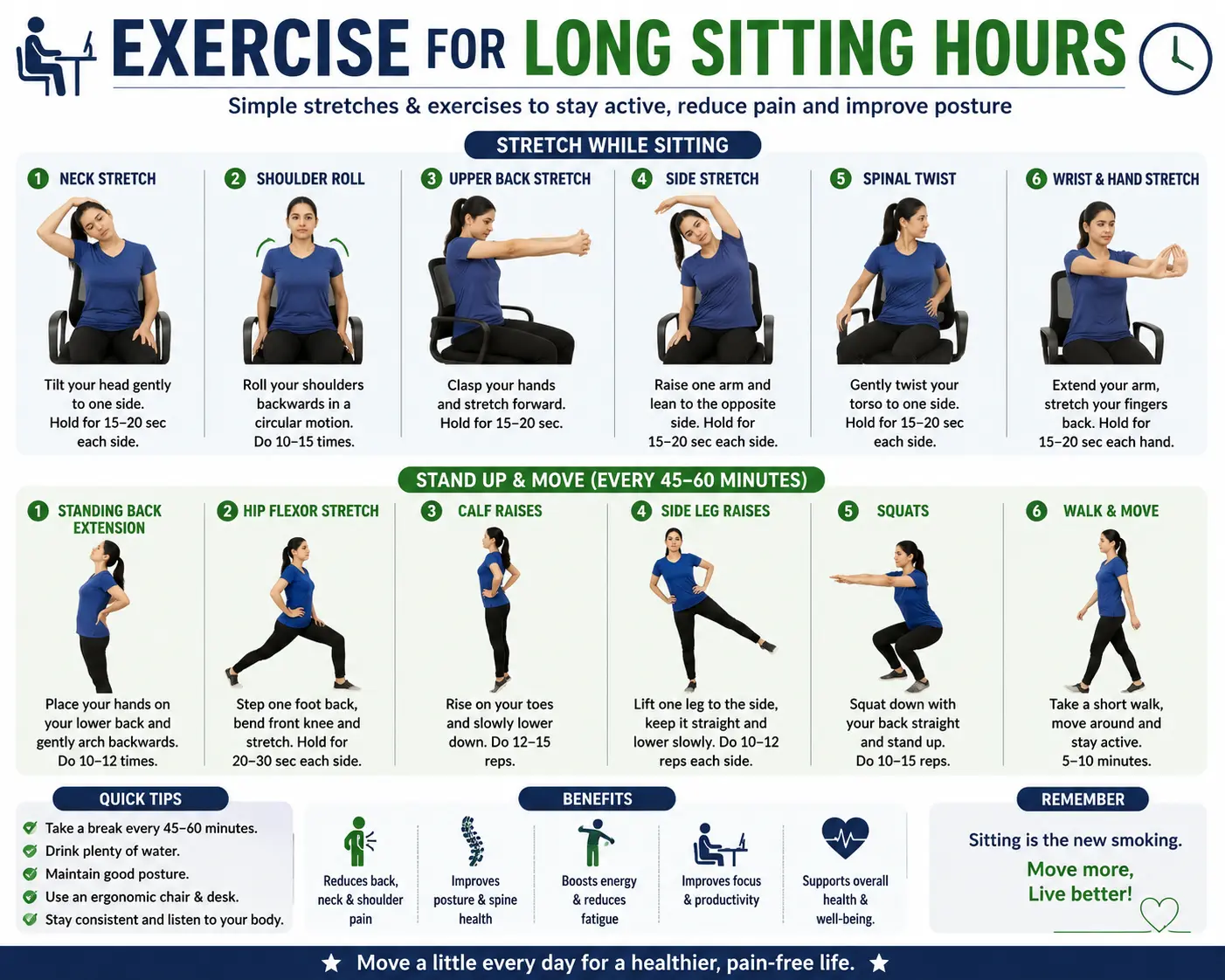
Exercises for long sitting hours do not require expensive equipment or a gym membership. Gentle neck stretches, shoulder rolls, spinal twists, hip flexor stretches, standing back extensions, squats, calf raises, and short walks can be performed almost anywhere, including at home or in the workplace. Health professionals generally recommend standing up and moving for a few minutes every 30–60 minutes to help maintain mobility and reduce stiffness.
Making these exercises part of your daily routine can help prevent discomfort before it develops into long-term problems. Combined with an ergonomic workstation, proper sitting posture, and regular physical activity, these simple exercises are an easy and practical way to stay healthy, improve productivity, and maintain better posture despite long hours of sitting.
Exercise For Long Sitting Hours
Head tilts
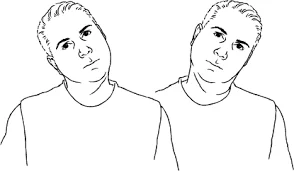
The muscles on the sides of the neck that run from the head to the shoulders are stretched by this exercise.
How to Do It:
- To begin, take a comfortable stance.
- Return your head to its initial position with ease.
- Tilt your head in the other direction now.
- Return your head to its initial position with ease.
- Your neck muscles may stretch as you perform each repetition.
Head turns
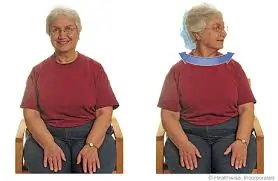
Your neck’s range of motion is increased by this stretch, which makes it simpler to tilt your head and see over your shoulder when backing up your automobile, for example.
How to Do It:
- To begin, take a comfortable stance.
- Turn your head so that you appear to be looking over your shoulder.
- Hold on to this stretch.
- Return to the center and turn your head in the other direction.
- The muscles on the side of your neck may stretch as you perform each repetition.
Cross-arm stretch

The muscles at the rear of your shoulders are stretched by this exercise. Your upper back will feel less tense as a result.
How to Do It:
- Your one hand should be on your elbow.
- Now use your hand to push that elbow up and across your body in the direction of your opposing shoulder.
- As you maintain this position, pay attention to relaxing your stretched arm.
- Return to the initial position by relaxing your arms. On the opposite side, repeat.
- Your arm, upper back, and shoulder may extend as you perform each repetition.
Hand behind back stretch

Your arms and shoulders will become more flexible in several ways after doing this stretch. You can more easily reach behind your head and back when taking a shower and putting on clothes when these areas are loose.
How to Do It:
- Start by placing one hand close to your lower back and the other behind your head, clutching one end of a towel.
- To make the towel extend between your hands, grasp the other end at your lower back.
- Raise your hand above your head in the direction of the ceiling. To give you a stretch, draw your other hand up along your spine.
- As you hold this stretch, pay attention to maintaining a relaxed lower arm.
- Repeat with your hands in a different position.
- Your arm and shoulder muscles may stretch with each repetition.
Doorway stretch

This will cause your arms to expand, enabling you to reach deeper behind you. Additionally, it helps prevent the forward rounding of your head and shoulders that occurs when you sit for extended periods of time by opening up the front of your chest.
How to Do It:
- Start by bending your elbows and placing each forearm on one side of the door frame while standing in a doorway. Your elbows ought to be roughly chest height.
- While keeping your forearms in place, advance your hips and chest by stepping one foot inside the doorway.
- Make an effort to lengthen your arms and chest.
- To ease out of the stretch, move your chest and hips back.
- You may experience a stretch in the front of your arms, shoulders, and chest throughout each repetition.
Wrist extensor stretch

While working with your hands for extended periods of time, such as while typing, texting, crafting, or playing an instrument, this is an essential exercise.
How to Do It:
- With the palm of your hand toward the floor and your elbow straight, raise your arm in front of you to begin.
- Gently press the back of your elevated hand with your other hand until your fingers point downward toward the floor. As you hold this stretch, let your fingers be mostly straight and relaxed.
- Release the pressure and go back to where you were before.
- On the other hand, repeat the stretch.
- You will feel it stretch.
Standing rotation
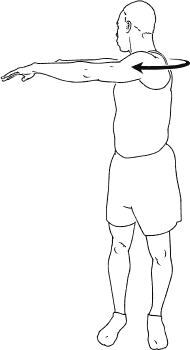
The muscles that surround your body are activated by this stretch, allowing you to twist. It is easier to perform duties like emptying the dishwasher when these muscles are kept flexible. You can perform this exercise while seated if you are unable to stand.
How to Do It:
- Cross your arms across your chest and maintain a straight posture.
- To turn your chest to one side, twist from your waist. As you twist, keep your feet motionless.
- Repeat on the opposite side after returning to the middle.
- Your back, sides, and core may feel stretched as you perform each exercise.
Standing side bend
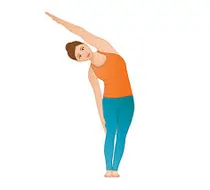
The muscles along the sides of your body, from your shoulders to your hips, are stretched by this exercise. You can perform actions like reaching up to put away dishes without straining if you lengthen these muscles.
How to Do It:
- To make your shoulder lean sideways and toward the floor, slide one hand down your side and toward your knee. Naturally, your other hand will move up your leg and toward the top of your hip.
- As you hold, concentrate on taking slow breaths to ease into this position.
- Go back to where you were.
- Slide your opposing hand down to your knee and repeat on the other side.
- Hold, then go back to where you were before.
- Your hips, sides of your core, and lower back may all feel stretched as you perform each repetition.
Standing back extensions
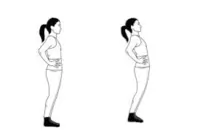
All of the hunching you do while reading a book, using a computer, cooking, browsing through your phone, or performing household tasks like vacuuming or washing is countered by this stretch. It can ease neck and upper back pain, expand the chest, and enhance posture.
How to Do It:
- To begin, place your hands on the back of your hips and stand with your feet comfortably apart.
- Allow your shoulders to drop toward the floor as you push your hips forward.
- Arch your back and look at the ceiling level. As you hold, concentrate on becoming comfortable in this position.
- Go back to where you were.
- You may experience tension in your back and a stretch in your core and front hip muscles as you perform each repetition.
Hip flexor stretch

For daily tasks like walking and climbing stairs, your hip flexor near the top of your thigh is crucial, but excessive sitting soon causes it to become tight. Tight hip flexors can worsen back pain in addition to making these exercises more difficult.
How to Do It:
- Start by placing your feet hip-width apart while standing comfortably.
- Push your other hip forward while bending through your front knee.
- As you maintain this stance, keep your chest straight.
- Step back and stand up again by pushing through the front foot. On the opposite side, repeat.
- The front of your hip should stretch as you complete each repetition.
Standing calf stretch
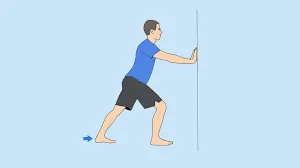
Your walking gait is enhanced by flexible calves. If your calf muscles are flexible, you’ll run or walk with greater force and be less likely to trip. The hamstring muscles at the back of your thighs are also loosened by this exercise.
How to Do It:
- To begin, place your palms flat on a wall while facing it.
- Step back on one leg.
- Move your hips and front knee in the direction of the wall while pressing your back heel down toward the floor. During the stretch, your back leg should stay nearly straight.
- As you hold this stretch, make sure your feet are facing straight ahead.
- Repeat with the opposite leg after returning to the beginning position.
- Your calf, foot, and ankle muscles may stretch as you perform each repetition.
Seated Glute Set
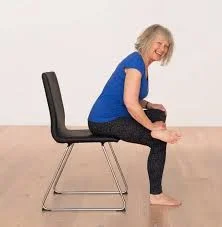
This stretch releases the rotating muscles around the hips and buttocks, which are vital for movement, even though you are seated.
How to Do It:
- To begin, place your feet flat on the floor while seated in a chair.
- Tighten the muscles in your butt.
- Tightening your muscles may cause your hips to raise or shift slightly.
- While you maintain this position, concentrate on applying as much pressure as you can.
- To get back to the beginning posture, relax your muscles.
- Your hip and butt muscles may be engaged as you perform each repetition.
How long is too long to sit?
Sitting for more than 6 to 8 hours a day poses a health risk and is very critical beyond 11 hours. But the real danger is sitting in one position; don’t sit in the same position for more than 30 to 60 minutes without getting up and moving around.
30 Minute Rule
Within just 30 minutes of inactivity, your body’s circulation slows,s and your metabolism drops substantially. To keep your joints from getting stiff and to prevent blood pooling, here are some simple movement tips:
Micro-breaks: Every 30-45 minutes, get up, stretch, or take a short walk for 2-5 minutes
The Daily Boundaries
Your long-term health is also significantly impacted by the total amount of time you spend sitting each day:
Minimal Risk: Less than 4 hours
4 to 8 hours is a medium risk.
Eight to eleven hours is a high risk.
Extremely High Risk: Over 11 hours
What is the most unhealthy sitting position?
The worst position to sit in is a slumped C-shape, particularly when it’s combined with a forward-crowned neck. This position flattens the natural curves of the spine, applies excessive pressure to the intervertebral discs, and overuses the neck muscles, significantly increasing your risk of chronic back pain, spinal degeneration, and reduced lung capacity.
The Mechanics of the “Slouch”
When you lean back without lumbar support:
Chairman Furniture,
Disc Pressure Multiplied: The pressure on your discs in the lower back is far greater than when standing or sitting upright.Tech Neck: When you look down at a lower screen on your laptop, you are putting your head forward. For every inch your head is moved forward, the effective weight of your head on your neck increases by about 10-12 pounds.
Other Bad Postures to Avoid
Sitting cross-legged: This puts uneven pressure on your body, leading to pelvic and lower back strain over time. It can also restrict blood flow and may contribute to varicose veins.
Perching on the Edge: Sitting on only the front edge of the chair means your lower back has no backrest, forcing core muscles to overwork and eventually fatigue.
Over-Reclining: Leaning back too far can throw off your spinal alignment and weaken your core muscles.
How to resolve it
Experts suggest trying to maintain a neutral sitting position, with your head, shoulders, and hips in alignment:
- Keep your hips and knees at a90-degreee angle.
- Sit on a chair with good support for the lower back (lumbar support).
- Keep your feet flat on the floor.
- Your monitor should be at eye level so you don’t have to hunch over.
Sitting for long periods slows your metabolism and your circulation, and can lead to weight gain, muscle atrophy, and increased risks of chronic conditions such as heart disease, diabetes, and even some cancers. It also strains your spine,e which can cause chronic back, neck, and hip pain.
Musculoskeletal and Postural Problems
Muscle atrophy: Not moving causes your glutes and leg muscles to become weak, which are important for stability.
Tight Hip Flexors: Sitting for long periods of time shortens your hip flexors, rs which alters the natural curve of your spine and causes intense lower back pain.
Neck and Spine Strain: Slouching over a keyboard or screen puts a lot of stress on the shoulder muscles and the discs of the cervical spine.
Cardiovascular & Circulatory Risks
Blood clots:ots Sitting or lying in one position for a long time can cause blood to pool in the legs, which significantly increases the risk of deep vein thrombosis (DVT).
Varicose Veins: Sitting for too long can lead to poor circulation, which can cause veins in your legs to bulge and swell.
Heart Disease: A sedentary lifestyle is associated with high blood pressure and a higher risk of cardiovascular disease.
Metabolic and Chronic Diseases
Metabolic Syndrome: A group of risk factors that increases your risk for heart disease and other health problems, like diabetes and stroke.
Diabetes Risk: Sitting can change the way your body responds to insulin and can directly increase your risk of developing type 2 diabetes.
Cancer: Recent studies have shown that extended periods of sitting could increase your risk of developing some types of cancer, such as colon, lung, a nd uterine cancers.
Brain & Mental Wellness Impact
Cognitive Decline: Long periods spent sitting have been linked to a reduction in the thickness of the medial temporal lobe, a region of the brain vital for memory.
Mental Health: Prolonged isolation, which is frequently linked to screen-based sedentary time, and a lack of physical activity raise the risk of anxiety and depression.
What is the 20 8 2 rule?
The 20-8-2 rule is an ergonomic workplace guideline that divides every 30 minutes of desk work into: 20 minutes of sitting, 8 minutes of standing, and 2 minutes of moving. Developed by Cornell University ergonomics experts, it is intended to prevent the stiffness and health hazards associated with prolonged, static postures.
The Way It Works
20 Minutes Sitting: Maintain the correct posture, with your feet flat on the floor, support for the lower back, and the monitor at eye level.
8 Minutes Standing: Use a sit-stand desk to transition to a standing position. This gets your muscles moving and increases blood flow.
2 Minutes Moving: Walk around the room, do some light stretches, or get a drink of water. This movement activates the body and lubricates the joints.
Benefits of stretching
Movement is stretching. The muscle fibers that shorten when you’re not moving are lengthened by it. In fact, one study discovered that stretching for just ten minutes a day improved flexibility and mitigated the negative consequences of inactivity. Stretching has several advantages and is a gentle approach to moving from a sedentary lifestyle, including:
Increased range of motion. The muscles, ligaments, and tendons that surround your joints may begin to stiffen and shorten if they remain immobilized for extended periods of time. This can eventually reduce the range of motion, making daily tasks like walking and climbing stairs more difficult. Stretching, on the other hand, counteracts weariness and stiffness by bringing fluid and nutrients to every part of your body through the contraction of your muscles and movement of your joints.
Improved blood flow. Stretching and movement improve blood flow, which helps the body absorb more nutrients and oxygen.
More vitality. Contrary to popular belief, sitting depletes your energy. Your body awakens when you get up and stretch. Your body and brain are fueled by the increased blood flow, which makes you feel more alert and productive.
Improved equilibrium. Stretching enhances your awareness of your body in space and keeps your muscle fibers functioning together, which both help you feel secure, maintain or regain your balance when necessary, and lower your chance of falling as you move throughout the day.
PT tip: Schedule breaks
Movement snacks are a favorite among our physical therapists. Movement snacks are little bursts of activity, such as the exercises mentioned above, that you may fit into a hectic day when you’re sitting too much or are unable to complete a longer workout, much like snacks are little bites in between larger meals.
Setting aside time for activity snacks could be beneficial. Suggest moving for at least a minute or two and setting a timer every 30 minutes. You can perform workouts while seated if you are unable to stand. Even during a meeting, you can shift around without anyone knowing.
Signals might also be incorporated into your regular activities. For instance, stretch while watching TV during commercial breaks. Go to the farthest water station across the office if you need water. Stretch or rise and sit down five times as you move from one meeting to the next. There’s not much you have to do. All you need to do is remember to provide yourself with a way to stretch your body.
FAQs
Is it okay to sit 12 hours a day?
Excessive sitting is thought to reduce metabolism, which can lead to weaker muscles and bones and impair our ability to control blood pressure, blood sugar, and fat metabolism. Early in the 1970s, studies on astronauts revealed that living in zero gravity was associated with accelerated aging and bone and muscle loss.
What is the 90-90-90 sitting rule?
The 90-90-90 sitting rule is an ergonomic recommendation to sit in three right-angle (90-degree) postures. Your body is in a neutral position, with 90-degree angles at the hips, knees, and elbows, reducing stress on the joints and strain on the muscles.
Tearing Down the Rule
If you want to take on this posture at your desk, do these three things:
Hips 90º: Sit with your buttocks firmly pushed against the back of the seat and your thighs parallel to the ground.
Knees bent at 90 degrees: Bend your knees at a right angle, just over the edge of the seat. Your feet should be flat on the floor. If your legs are too short to reach, use an Adjustable Ergonomic Footrest to keep your legs from dangling.
Elbows at 90°: Keep your elbows bent at right angles, close to your body, and rest your hands comfortably on your keyboard and mouse.
The application of the Rule
This rule is often used for office workers to prevent back pain and carpal tunnel syndrome, but is also important for pediatric seating. The 90-90-90 rule (sometimes including 90° at the ankles) for babies and toddlers in high chairs maintains core stability, which is necessary for safe swallowing and choking prevention during feeding.
Modern ergonomics view
Static sitting, in perfect posture, can be tiring.
Changing positions, using a lumbar pillow for support, and getting up every 30 to 60 minutes to stretch or go for a walk are all strongly advised.
What muscles are affected by sitting?
Gluteals (bum muscles) and legs
Long durations of sitting can cause the major leg and gluteal muscles to atrophy and deteriorate. These big muscles are essential for both walking and maintaining your balance. You are more likely to get injuries from falls and strains during exercise if these muscles are weak.
Which foods should be avoided when trying to build muscle, and why?
However, a lot of highly processed and packaged foods, including desserts, candies, and pastries, won’t provide you with the best energy to build muscle. When concentrating on growing muscle, these can be avoided. Alcohol can hinder rather than improve physical performance, which has been demonstrated to impede recovery.
References
- 7 Yoga poses to counteract the effects of prolonged sitting. (2024, February 23). https://www.acefitness.org/resources/everyone/blog/8599/7-yoga-poses-to-counteract-the-effects-of-prolonged-sitting/?srsltid=AfmBOorHpVtF3Fw22c6GtBED9_r906tMVwLNxVtdqZETf9fN6RoeHhQK
- Anil, A. (n.d.). 10 exercises to do while sitting at a desk in 2025. The Sleep Company. https://thesleepcompany.in/blogs/lifestyle/10-exercises-to-do-while-sitting-at-a-desk-in-2025?srsltid=AfmBOorYZ-uRS_x9BYNHF4F0re8PWayvZYs7G-4aeQTLCKLcMFVWwGwB
- Raleigh Medical Group. (2022, November 18). Sitting too long? Use these four office exercises to take a break. https://www.raleighmedicalgroup.com/blog/sitting-too-long-try-these-office-exercises/
- Schlinger, A., CPT, A. M. W., & CPT, C. S. (2022, January 27). How to exercise after sitting all day: 6 moves to try if your day involves a ton of sitting. SELF. https://www.self.com/gallery/the-workout-you-need-to-do-if-you-sit-all-day
- Seated head tilt. (n.d.). [Video]. Hingehealth. https://www.hingehealth.com/gb/en/resources/articles/sitting-stretches/
- Thompson, Z. (2024, November 18). Seated exercise: our ultimate chair workout guide — power for Parkinson’s. Power for Parkinson’s. https://www.powerforparkinsons.org/blog/seated-exercise-our-ultimate-chair-workout-guide?gad_source=1&gad_campaignid=692702325&gbraid=0AAAAADPRS_Bd9S80EN9hPYepUbq0I4FKk&gclid=CjwKCAjwx7LSBhB3EiwAjcodxEHl-1zMoWV6Q7U-QmWCWRLPpBBqrNuSMdQ5QE9jOAGAzNJOmY4gxhoCddoQA
- Website, N. (2026, April 9). Sitting exercises. nhs.uk. https://www.nhs.uk/live-well/exercise/sitting-exercises/