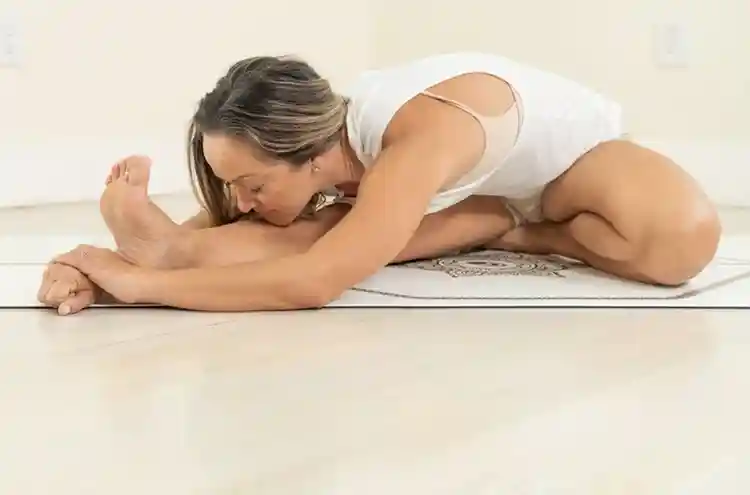
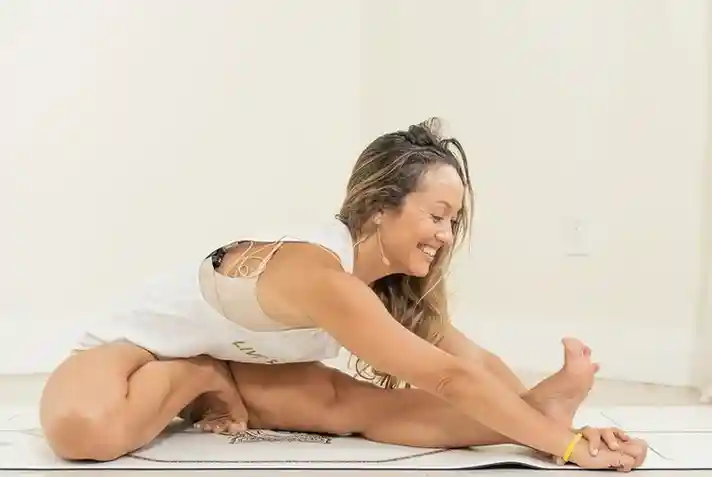
Janu Sirsasana, commonly known as Head-to-Knee Pose, is a sitting forward bend that is suitable for beginners. This position is a close version of Paschimottanasana, or Seated Forward Bend; however, the alignment differs significantly.
The trunk is bent forward throughout this position, causing the head to contact the knee in the final posture, thus the name Janu-sirs-asana. The forward bend is related to generating self-reflection.
The fundamental goal of the head-to-knee posture is to fold your upper body forward over your single extended leg on the ground, while your other leg is bent and the sole touches your extended leg’s inner thigh.
It promotes inner serenity and relaxation and is hence performed as a restorative position. The stretches increase the flexibility of the spine, groin, and hamstrings.
Do not allow your folded foot to go below the extended leg. Hold it on your inner crotch and keep it active.
Ensure that you can see the sole of the bent leg.
Benefits:
Enhances strength and flexibility: Janu sirsasana is the ideal position for providing a deep stretch to the muscles. It entails extending the neck, shoulders, spine, hamstrings, abdominals, and groin. During the forward bend, all of them participate. Deep stretching increases flexibility and strengthens the muscles.
Improves digestion: The abdominal muscles are engaged in forward bending. These muscles are subjected to extreme pressure, which causes the release of stress hormones. The pressure also massages the stomach organs, increasing the effectiveness of the digestive system.
Ensures hormonal equilibrium: The uterus is stimulated as a result of muscular strain on numerous organs such as the kidneys, liver, pancreas, and spleen. It enhances hormone secretion. This also helps with the detoxification process.
stimulates the reproductive system: The reproductive organs are also stimulated by this exercise. In addition, it helps with menstrual cramps and menopausal symptoms. It also helps to treat male impotence.
Improved respiration: Holding the ultimate pose necessitates steady, deep breathing. It promotes the enlargement of the chest and lungs. It also delivers new blood to the diaphragm. It gradually improves the respiratory system.
Treats mental diseases: This is a restorative position. It soothes the mind by removing mental blockages. Janu sirsasana relieves exhaustion, sleeplessness, and anxiety. It is even effective in treating moderate depression.
Variations:
Janu Sirsasana B
Janu Sirsasana B
In this version, hold your bent leg’s foot behind your extended leg, with the heel below the pelvic floor.
Now begin to bend your upper body forward onto your extended leg and maintain the position for a few minutes. This variant stimulates the root chakra, which improves overall body balance.
Janu Sirsasana C
Janu Sirsasana C
Many beginners may find this variant difficult; hence, it is only suggested for intermediate or experienced yogis with a wide range of motion in their feet.
Curl your toes into your bent leg, tucking them neatly into the ground, and place the sole of this foot on the inner thigh of your extended leg. Begin to lean forward, touching your head to your knee, and hold this stance for a minute.
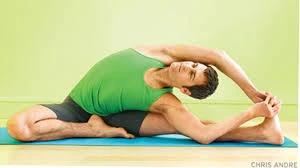
Parivrtta Janu Sirsasana Posture
Parivrtta Janu Sirsasana Posture
The left hand clutches the left big toe, leans forward, and places the elbow on the ground. The right arm then reaches the left foot, which extends above the head. In the final posture, the head is between the two arms.
Precautions & Contraindications:
Asthma patients should avoid doing janu sirsasana.
Do not execute this asana if you have diarrhoea.
To avoid stressing an injured knee, execute janu sirsasana with complete flexion.
It is not recommended if you have a lower back injury or a lumbar disc herniation.
Bend forward and use the pelvic muscles first, followed by the spinal muscles.
Common Mistakes:
A common mistake is rounding the back when reaching for a foot. This disrupts alignment and diminishes the stretch’s efficacy. Instead, extend your spine as you fold forward.
Another common blunder is forcing flexibility by tugging on the foot or leg. This can cause strain and damage. Aim for a moderate method that uses gravity to assist you in stretching without overextending.
Another risk is failing to engage the core. A weak core can cause instability and discomfort when in this position. To correct this, intentionally move your navel towards your spine, offering support throughout.
Finally, many individuals disregard their breathing habits. Holding one’s breath reduces the advantages of relaxing and causes muscular tension. Maintain regular breaths while you maintain the posture, inhaling deeply before shifting into deep stretches to promote relaxation.
FAQs
Can beginners perform Janu Sirasana?
Yes, novices may execute Janu Sirasana, which can improve hamstring and lower back flexibility. This is a great sitting forward bending stretch for lengthening the spine and strengthening both legs.
Who should not perform Janu Sirasana?
Pregnant women in their second and third trimesters should avoid performing Janu Sirsasana owing to increased strain on the knees, core, and lower back.
Which asana should be practiced after Janu Sirasana?
After Janu Sirasana, two counter-stretching yoga postures can be performed: Dandasana (Staff Pose) and Purvottanasana (Upward Plank Pose). These will help you restore your spine’s natural curvature and relax your hamstrings.
What are the benefits of Janu Sirasana?
Janu Sirasana offers several health advantages, including the following: Toned hamstrings Strong and toned core Relief for back pain Increased spine and hamstring length Better functioning of digestive organs Better functioning of reproductive organs
Can Janu Sirsasana relieve back pain?
Janu sirsasana is a basic yet effective asana for reducing back discomfort. Extreme stretching of your back muscles causes suppleness in your spine.
What Is the Gomukhasana (Cow Face Pose)? Gomukhasana (Cow Face Pose) is a seated yoga posture that deeply stretches the hips, thighs, shoulders, and chest. Named for its resemblance to a cow’s face, this pose helps improve posture, enhances flexibility in the lower body, and releases tension in the upper back and shoulders. This position…
What is Dove Pose? Dove Pose (Vajra Kapotasana) is a deep back-bending yoga posture that opens the chest, shoulders, hips, and spine while improving flexibility and posture. It is done with hands by the sides while seated in Vajrasana. Bending backward, arching the back, and lowering the head come next. The torso is raised as…
Introduction: The Band Pull-Apart Exercise is a simple yet highly effective resistance band exercise that helps strengthen the upper back, shoulders, and posture muscles. It primarily targets the rear deltoids, rhomboids, and middle trapezius, which play an important role in stabilizing the shoulder blades and improving posture. To do band pull-aparts, hold a resistance band…
Introduction Plyometric exercises for beginners concentrate on controlled, explosive movements like Pogo Hops, Squat Jumps, Broad Jumps, Lateral Jumps, and Skater Hops. These exercises promote quick ground contact and soft landing, building power with minimal impact. They frequently use bodyweight movements like basic jumps, skipping, or controlled hops over lines, and as strength increases, they…
Introduction The spine and sacroiliac joints are the main targets of ankylosing spondylitis (AS), a chronic inflammatory disease that causes stiffness, discomfort, and decreased mobility. By preserving spinal flexibility, enhancing posture, and lowering pain, exercise is essential for controlling AS. Frequent, focused exercise maintains joint function, strengthens supporting muscles, and avoids the distinctive spinal fusion…
What is Baby Grasshopper Pose? Baby Grasshopper Pose (Bala Parsva Bhuja Dandasana) is a beginner-friendly arm-balance preparation pose that builds the foundation for the full Grasshopper Pose. It helps improve hip mobility, core stability, and upper-body strength while introducing gentle twisting. This pose is great for developing balance and control before progressing to more advanced…