
9 Best McKenzie Exercises for Lower Back Pain
Introduction
The McKenzie approach is utilized for the appropriate assessment and physiotherapy management of lumbar pain, as lower back pain is a significant topic of research in the field of physiotherapy. Robin McKenzie discovered the McKenzie technique. It categorizes back pain into several categories and uses specific exercises to alleviate lower back pain and enhance mobility.
McKenzie exercises often involve repetitive motions and sustained postures to centralize pain, meaning transferring pain from the extremities back to the spine, which is considered a good indication. The McKenzie approach is designed to help you evaluate whether you have lumbar (lower spine) pain caused by lumbar derangement syndrome, lumbar dysfunction, or postural syndrome.
- Lumbar derangement syndrome is caused by the movement of the lumbar discs.
- Scarring or soft tissue shortening is the cause of lumbar dysfunction.
- Postural syndrome is produced by continuous stressors on the posture.
- Your PT may prescribe a home exercise program to help you manage your condition, and if they are trained in the McKenzie Method, they may integrate some of these exercises.
- Centralization (pain migrating to your spine) is part of the assessment process; if your pain goes from your extremities to your back when performing particular motions, it is thought that the exercises may be therapeutic.
- An analysis of 11 trials indicated that the McKenzie approach was superior to other rehabilitation strategies for lowering pain and impairment in patients with chronic lower back pain, but not for acute back pain.
Exercise for lower back pain
Lie on your stomach

- This exercise relieves pain by releasing pressure from your lower back.
- Position: prone position.
- Hold for 2–3 minutes. Repeat as many as eight times each day.
Lie on a cushion

- A soft pillow should be placed under your stomach to support your lower back.
- Position: Prone position
- Hold for 2–3 minutes. Repeat as many as eight times each day.
Prone on your elbows

- Position: Prone position
- Prop yourself up on your elbows.
- Slowly extend your arms to raise your upper body. Hold for two seconds. Return to the starting position.
Prone Press-Ups

- The prone press-up exercise maintains the normal curvature of the spine.
- Position: Prone.
- Slowly extend your arms to raise your upper body. Hold for two seconds. Return to the starting position. Complete ten repetitions. Repeat this up to eight times each day.
Standing Lumbar Extension
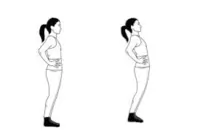
- Position: Standing
- Hold your hand around your waist.
- As much as you can, extend the lumbar spine.
- Hold the end position for a few seconds before returning to a completely upright position.
- Repeat ten times.
Knee to chest
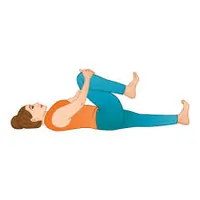
- Position: Supine position
- Bring the two knees together. Hold for two seconds. Return to the starting position.
- Complete six repetitions. Repeat up to four times daily.
Standing flexion

- Position: Standing
- Reach your hands to the ground.
- Pause for 1-2 seconds. Return to the starting position.
- Repeat ten times. Complete up to twice a day.

- Position: quadruped position.
- Raise one shoulder with the elbow fully extended first, then the other leg with the knee completely extended.
- Perform 2-3 sets of 8-12 repetitions.
Bridges

- Position: Supine
- Arms by your sides, palms facing down.
Variations of bridge exercise:
Single-Leg Bridge
Extend one leg while elevating the hips. Increases effort while activating stabilizing muscles.
Bridge with Resistance Bands
To further work your abductors, wrap a resistance band over your thighs.
Marching Bridge
While in the bridge posture, elevate one foot off the ground at a time.
Elevated Feet Bridge
To improve stability and intensity, place your feet on a step or exercise ball.
Assessment, clinical response, and physical therapy management
- Assessment: The doctor collects a history of symptoms as well as information on what activities exacerbate or alleviate them. You should use a goniometer to measure the range of your lumbar muscles. The doctor then instructs the patient to undertake particular repetitive or prolonged motions to test their influence on the symptoms.
- The clinical response during repeated or prolonged mobility tests has been assessed to arrive at a classification. Dysfunction syndrome, postural disorders, and various spine structural conditions affect a large number of people. The exercises used in MDT are selected based on the direction in which the symptoms lessen, centralize, or disappear.
- Treatment: In order to alleviate lumbar pain and tightness, management involves stretching the lumbar or back muscles. This is followed by core and lumbar muscle strengthening exercises. Prevention involves teaching and encouraging the patient to exercise frequently and practice self-care.
Prevention
Practice good posture
- Always practice supported sitting (keeping a soft pillow for support while sitting in a chair).
- For support, use a lumbar orthosis.
- Always keep your feet supported.
- While standing, distribute your weight equally. Avoid bending over or resting on one leg.
Strengthen the core and back muscles.
- You may develop strong spine muscles by regularly strengthening your core. Include:
- Bridge exercise.
- Pelvic Tilts.
- Bird-dog Planks
- Superhero workout
Maintain a healthy weight
- Excess body weight, particularly around the midsection, causes additional strain on your back.
- Maintain a well-balanced diet and regular exercise.
- Avoid prolonged sitting or inactivity.
Lift Objects Properly
- Use your hip and knee muscles while bending and avoid flexing your lumbar.
- Keep the thing near your body.
- Avoid twisting while lifting.
Use ergonomic support
- Use chairs that provide lumbar support.
- Adjust computer screens to eye level.
- Sleep on a firm mattress and use a pillow that keeps your spine aligned.
Stay active with low-impact activities.
- Walking, swimming, and cycling promote back strength and flexibility without overstraining.
Stretch regularly
- Stretch the hamstrings, hip flexors, and back muscles to relieve stress.
- Perform a morning or nightly stretch regimen.
Manage stress
- Stress can cause muscular strain and bad posture. Try deep breathing.
- Practice relaxation techniques, such as meditation or yoga.
- Wearing supportive footwear can improve posture and prevent back pain.
Exercise Protocol for Lumbar Pain (McKenzie Method)
Depending on the length of pain and the intensity of symptoms, the seven back exercises are done in stages. To fully benefit from the workouts, adhere to the suggested number of repetitions and sessions.
- For Acute conditions and constant pain: Complete exercises 1 and 2 before proceeding to exercise 3 if you are experiencing severe, ongoing back pain. Perform exercise 4 after exercise 2 if you are unable to complete exercise 3 because of severe back pain when lying down. For the first several days, keep doing exercises 1 through 4 until the severe back pain goes away.
- To preserve the spinal curvature, lie on your back for a few minutes after finishing an exercise session and place a lumbar (low back) roll or rolled-up towel below your low back.
- While acute pain has reduced, you should continue basic exercise such as lying on a cushion, prone on your elbow and knee to chest, and also you should add strengthening exercises such as the bird dog. Exercise 5 can be discontinued, and exercise 6 can begin once it is bearable and increases low back flexibility.
FAQs
Which exercise is best for lower back pain?
Best exercise for lower back pain:
Calf stretch
Hamstring stretch
Piriformis stretch
Adductor stretch
Ankle-toe movements
Knee to chest
Back extensor stretch
Bridging
Is the McKenzie approach effective for sciatica?
McKenzie treatment for lower back and leg pain (sciatica) consists of a series of backward and forward-bending therapeutic movements designed to ease acute leg pain while also restoring spinal mobility.
How do you treat lumbar spondylosis?
Lumbar spondylosis, a degenerative disorder of the lower back, is often treated with a variety of methods focused on pain relief and functional improvement. Usually, the initial line of treatment is nonsurgical, such as physical therapy, medication, and lifestyle modifications..Only severe patients who have not improved with conservative treatment are approved for surgery.
How can I sleep to ease back pain?
To sleep comfortably and relieve back pain, try sleeping on your side with a cushion between your knees or on your back with a pillow under your knees. Sleeping in the fetal position (side-lying with knees brought up) can also be useful, particularly for people with spinal stenosis, because it aligns the spine and relieves pressure.
Is walking effective for lower back pain?
Is Walking Good for Lower Back Pain? Based on research.
Walking is typically considered a good activity for lower back pain. Walking for more than five minutes is beneficial for your general health, but if you have back pain, you should avoid it. Walking should be continued when back pain is acute, but it should be avoided when it is chronic.
Refrences
- Pt, B. S. (2023, August 24). McKenzie exercises for your lower back. Verywell Health. https://www.verywellhealth.com/mckenzie-exercises-for-your-low-back-2696222
- Nunez, K. (2020, November 5). Try this: McKenzie exercises for back pain. Healthline. https://www.healthline.com/health/mckenzie-exercises#What-are-McKenzie-exercises