
Chinese Plank Exercise
Introduction:
Chinese Plank Exercise is an advanced core and posterior chain strengthening exercise that primarily targets the hamstrings, glutes, and lower back muscles. In this variation, the heels are elevated on a bench or support while the upper body is supported on the hands, creating a straight, plank-like position.
Learning how to strengthen your lower back and posterior chain with this elevated supine posture could revolutionise your strength training regimen. It’s a really underutilised exercise, especially if you’re working out at home without a lot of equipment.
As we’ll show in this exercise guide, you can also modify the distance between the two elevated surfaces to better meet your current level of fitness.
What is Chinese Plank?
In a Chinese plank, you place your ankles and shoulders on high surfaces and then raise your hips to keep your body in a straight line.
You must maintain the activation of your glutes, hamstrings, core, and lower back throughout this position.
It’s a “supine” activity, meaning you’re facing up, as opposed to a “prone” position, which means you’re face down, like a traditional plank.
You can begin with a lesser space and gradually raise it as you gain confidence because the plank is simpler to grasp the closer the two elevated surfaces are.
Muscle work during the Chinese Plank:
The Chinese plank mainly strengthens the posterior chain and lower back muscles, such as:
- Core Muscles
- Erector Spinae Muscle
- Glutes Muscle
- Hamstrings Muscle
- Calves Muscle
- Latissimus Dorsi Muscle
To target your traps and rhomboids as well, you can modify the exercise by placing your elbows on two different surfaces, leaving your head unsupported.
Benefits:
- Chinese planks are a great way to work and improve the posterior chain muscles, especially for people without access to free weights or exercise equipment.
- This is a wonderful place to start if you don’t already practice many exercises that strengthen your core, lower back, hamstrings, and glutes.
- Variations of the Chinese plank, like resting your elbows on two different surfaces, will also engage your entire back and shoulders, which again enables anyone without any equipment to make sure they are working these muscles.
- Due to their ability to build muscle groups without placing undue strain on the knees or back, Chinese planks are also frequently recommended in physical therapy and rehabilitation programs.
- They are therefore an excellent method of strengthening following an injury.
Variations:
Unsupported Chinese Plank:
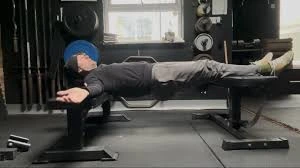
Resting your elbows on two different surfaces, leaving your head unsupported, is an easy method to advance the exercise and make it harder. Because you also need to drive through your elbows to maintain stability, this makes the technique more difficult.
Compared to the standard Chinese plank, this works your arms, lats, traps, and rhomboids more.
Weighted Chinese Plank:
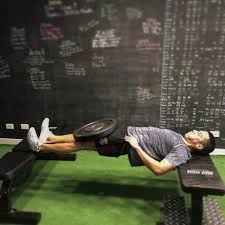
Adding more weight to the workout is another method of adding progression. Your muscles will have to work harder to maintain the parallel positioning if you load bumper plates on your stomach or quadriceps.
But to securely load the weight, you’ll need a training partner.
If you can still keep your body straight—that is, without your hips dipping—then increase weight.
Single Leg Chinese Plank:
You may exercise each side independently if you raise one leg. This will make things much more difficult because it will take more strength and steadiness in general.
Similar to psoas marches, you can also perform alternating marches to make it even harder as you raise each leg.
Face Down Chinese Plank:
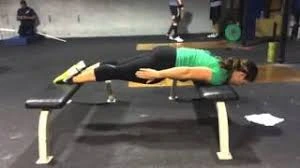
Another option is to execute a face-down Chinese Plank. Your face will be pressed against whatever you’re using as an elevated surface (such as a weight bench or plyo box), and we find that this position feels more awkward to get into. Therefore, it is unlikely that this will be very pleasant.
Try the face-down version and see how it works for you; you might find that you like it.
Chinese Plank March:
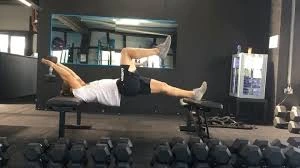
Traditional Chinese planks are an excellent exercise for two people or two legs. But a lot of the most demanding things in life are done unilaterally, or one leg at a time. The way your limbs function when you walk, run, kick, etc., is how the Chinese plank march teaches each leg separately. For athletes and others who enjoy functional fitness, the Chinese planks march is a great choice.
This variant can help you find and correct your left-to-right strength imbalances and is a great approach to put more strain on your muscles.
Safety Tips for Beginner’s:
- Consider it almost like a hip push to get into position. Maintain this position by keeping your hamstrings and glutes active and using them to truly push your hips high.
- Adapt the spacing between the platforms to your own height.
- For comfort, use a padded platform. If needed, place a folded mat under your heels and shoulders.
- To get the most out of your hamstrings, keep your knees and toes pointed toward the ceiling.
- Throughout, maintain a neutral pelvis.
- This is a full-body exercise that involves creating tension in all of your major muscles.
- Inhale evenly and slowly.
- This exercise can be performed at home with chairs or other appropriate platforms, such as a set of robust chairs or chairs with ottomans.
Common Mistakes:
- Holding your breath can cause vertigo and raise your blood pressure, so avoid doing it.
- Steer clear of hyperextending your spine and raising your hips too high. You should have a straight line between your heels, hips, and shoulders.
- Avoid making your belly button protrude. Instead, think of “flat abs” and brace your core.
- When you can no longer maintain perfect alignment, end your set. Beyond this point, there is no advantage to expanding your set.
- As you gain strength, extend the time of your short holds. Prioritise quality above quantity. Chinese planks are harder to work with than they appear.
Conclusion:
Despite their seemingly easy appearance, Chinese planks are a challenging exercise that need for stability and muscle to do correctly.
They can be performed alone or in supersets with other exercises for the posterior chain.
Keep your hamstrings and glutes engaged throughout, and make sure you are actually pushing your hips up.
Start with a few quick sets at first, then gradually extend the duration as you get more at ease. Likewise, you may make the workout harder by increasing the distance between the two raised surfaces as you become more accustomed to it.
FAQs
What does Chinese plank work?
The complete opposite of a traditional plank is this exercise. The Chinese Back Plank will build the muscles of the lower back and posterior chain, whereas a standard plank will improve the abdominal and core muscles along the front of your body.
What are common Chinese plank mistakes?
Incorrect Body Alignment: Failure to maintain correct alignment is one of the most common errors. Aim for a straight line between your head and heels. Your hips should be level with your shoulders; do not allow them to lift or fall.
Are Chinese planks good for beginners?
To begin strengthening your glutes and developing strong isometric grips, the Chinese plank is an excellent core exercise for beginners. Although it doesn’t involve the shoulder mobility required for the reverse plank, this exercise nevertheless provides the desired glute activation.
What are the benefits of Chinese planks?
Injury prevention, particularly during deceleration, is achieved by loading the hamstring at length.
Introducing hip flexion for running mechanics on the opposing leg.
stability of the pelvis.
Easy to advance or regress, suitable for athletes of all skill levels, from young to expert.
How long should you hold a Chinese plank?
Hold your Chinese plank for however long it takes you to notice the target muscles contracting. This could take 20 to 60 seconds, depending on how fit you are. To sustain your improvement, gradually extend the duration, for example, by five seconds per week.
References:
- Chinese Plank Exercise – Muscles Worked, benefits, and variations | Fitness Drum – 2023 – Drum/fitnessdrum.com/chinese-plank-exercise/
- Master the Chinese plank: Total Core & Full-Body Strength – 2024 – Ex-Marine/fitnessvolt.com/chinese-plank/