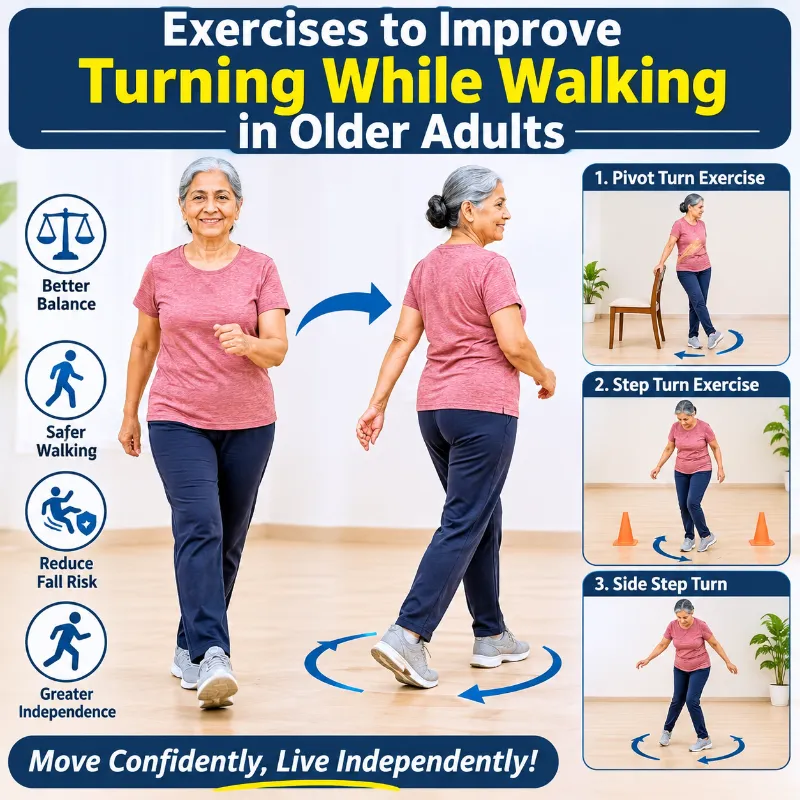
Exercises to Improve Turning While Walking in Older Adults
Introduction
Turning is an important component of walking in older adults to enable them to complete daily tasks,s including walking around the home, visiting others, going shopping, climbing stairs, and participating in some form of social activity.
It can be hard and/or unsteady for people to turn, circumnavigate items, open and shut doors, and turn in order to communicate with others. Result: Others may begin to lose their balance and may feel like they may fall.
Why is turning important?
As well as multiple joints co-ordinating to allow an individual to walk, some people can also experience more difficulty with their turning ability as they age.
This can cause;
- Reduced speed of walking
- Problems with turning
- Short strides
- The use of aids to facilitate turning.
Reasons for poorer turning
Poor turning can occur due to a variety of reasons:
Reduced muscle strength
Muscle weakness within the lower limb may cause difficulties with turning.
- Areas that are affected are:
- Quadriceps
- Hamstrings
- Glutes
- Calves
- Hip abductors
- Core
- Weakness within the hip and lower limb muscles can cause a lack of stability during the transfer of body weight from one leg to another.
- Poor balance and coordination
- Good balance is required to be able to turn whilst walking. From one leg to another.
- An older person who suffers from poor balance may have problems when changing direction and/or reversing.
- Limited movement
- Limited movement may affect the hips, knees, ankles, or back, which can in turn affect turning.
- As well, this restricted hip movement can also affect a person’s ability to rotate.
- Limited movement may affect the hips, knees, ankles, or back, which can in turn affect turning.
- Fear of falling
- Elderly people who have fallen before may be afraid of falling again.
- This may lead to them:
- Turning
- Object use
- Failure to adapt to new surroundings000
- Walking
- Neurological problems
- There are a range of neurological problems which can cause people to have difficulties with turning whilst walking.
- These include:
- Parkinson’s disease
- Stroke
- Peripheral neuropathy
- Multiple Sclerosis
- Vestibular issues
Benefits of exercising to improve turning while walking
Help older people improve turning while walking by regularly completing the right balance, strengthening, coordination and mobilisation exercises.
- Benefits may include:
- Improved balance whilst turning
- Improved strength in the legs so that you can walk and turn with control
- Better coordination so that walking becomes smooth
- Increased hip range of motion to allow the body to twist and change direction
- Increased confidence for walking
- Improved functional mobility to allow people to walk around objects or from room to room
Best Exercises to Improve Turning While Walking in Older Adults
- Weight shift in standing position
- Marching
- Lateral walking
- Walking forwards and backwards
- Abduction in standing position
- Heel raises
- Sitting to Standing
- Torso rotation in standing position
- Clock exercise
- Figure of 8 walking
- Turning around cones whilst walking
- Walking in tandem
- Tap in turn each of your toes on the step.
- Changing direction while walking
Weight shift in standing position

How to do
- Stand with your feet shoulder-width apart.
- You can place your hands on an appropriate object if required.
- Transfer your body weight onto your right leg.
- Maintain this position for 3-5 seconds.
- Then move onto your left leg.
- Repeat this exercise 10-15 times.
Marching

How to do
- Stand and put your hands on a chair or rail.
- Lift your right knee towards your chest.
- Then, move your right foot down.
- Raise your left knee.
- Repeat with both legs in turn.
- Complete between 10-15 sets on each leg.
Lateral walking

How to do
- Stand up and balance yourself.
- Draw your left foot in so that it is next to your right.
- Next, move five to ten steps to the right.
- Do the same but to the left.
Walking forwards and backwards

How to do
- You should move to the back of a chair.
- Ensure that your feet and hips are equally distant from each other.
- Lift your right foot forwards.
- Then place it back into its initial position.
- Next, take your right foot backwards. Again, place it back into its original position.
- Now complete the exercise using your left foot.
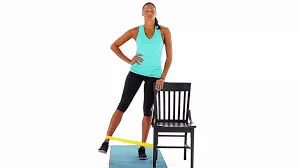
Abduction in standing position
How to do
- Sit with your back to a firm chair and use it as support.
- Sit in and hold on to a strong chair in order to support yourself
- Move your right leg slightly sideways, but still maintain the correct position of your toes so that they are facing ahead.
- Continue to make sure that your toes are facing forwards.
- Also, do not lean your body.
- Afterwards, move it slowly back into position.
- Lastly, carry out the above exercise with your left leg.
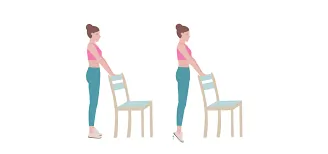
Heel raises
How to do
- Stand beside the chair
- Ensure that your feet are apart at the same distance as your hips.
- Advance your right foot.
- Then move it back to its initial position.
- Then move it once more to its initial position.
- Repeat these movements, but this time utilising your left foot.
- Then, carry out these movements using your left leg.
Sitting to Standing

How to do
- Use your feet to stand up from your sitting position.
- Place your feet on the floor.
- Space your feet so that they are approximately the same width apart as your shoulders.
- Sit with your upper body slightly forward
- Use your feet to stand up from your seat.
- Good posture and balance should be sustained
- Then slowly flex your knees and sit down.
Torso rotation in standing position
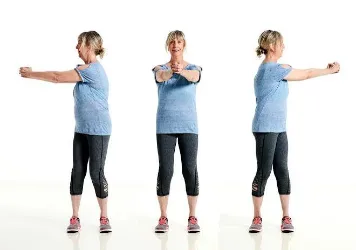
How to do
- Stand with your feet shoulder-width apart.
- Have slightly bent knees.
- Cross your arms and/or place your hands on your waist.
- Slowly turn your upper body to the right.
- Bring the upper body back to the middle
- Slowly turn to the left.
- Do not twist your lower back.
Clock exercise

How to do this exercise
- Sit up on a supportive chair so that you can recline.
- Envision that you are standing at the middle of a clock.
- Place your left hand on the chair to support you.
- Very gently point your right foot towards the 12 o’clock direction.
- Very carefully return your foot to the central area.
- Next, take your foot out towards the 3 o’clock mark.
- Again, return to the centre.
- Proceed by stretching your right foot towards the 6 o’clock mark and then diagonally (only as far as is comfortable).
- Then repeat the exercise but with the other leg.
Figure of 8 walking

How to do
- Place 2 cones (or suitable markers) upon a flat area.
- Leave gaps so that you can manoeuvre.
- Walk round the point at an even speed.
- Then continue to walk towards the second marker.
- Move round this marker but in the opposite direction.
- Carry on drawing figure-of-8s.
- Perform this in both directions.
Turning around cones whilst walking

How to do
- Position 3 or 4 cones in a line, with good spacing in between.
- Stand at the start position.
- Walk slowly and easily to the first cone.
- Then take a number of small steps to turn around.
- Carry on and walk to the next cone.
- Make one further turn around each of the cones.
- Now carry out the same task again, but this time making both right and left turns.
Walking in tandem

How to do
- Stand next to something you can lean on if required.
- Move your right leg so that it is in front of your left.
- Attempt to position the heel of your front foot so that it is close to the toes of your back foot.
- Take a further step forwards.
- Then move so that the opposite foot is now in front.
- Take a number of further steps.
- Finally, continue to walk forward a number of times.
Tap each of your toes on the step.

How to do this exercise
- Stand so that you are facing a low step.
- Again, sit up and ensure that you have good posture. Also, as previously, make sure that you are both well balanced and well supported.
- Lift up your right foot and do so in a slow and controlled manner.
- Use the toes of your right foot to lightly and delicately strike the step.
- Very carefully lower your right foot back down to the floor.
- Carry out the same controlled action with your left foot.
- In a continuous and even manner, continue to alternate between your right and left feet.
Turning
The following steps can be used to safely turn.
- Turning
- The following advice will assist you to turn.
- Slowly and easily.
- Visualise
- Look in the direction in which you wish to turn. Ideally, try not to move your head quickly – especially if you are prone to feeling dizzy.
- Synchronise
- Carefully synchronise the movement of your legs, hips and top body so that they all turn in the desired direction.
- Keep one foot down in front of you at a time.
- Rather than twisting on one foot, move your body and turn in a fluid and controlled manner.
- After regaining your balance, then move on, using your feet to provide the power for your movement.
- Whilst continuing to maintain good balance, stroll about in an easy and relaxed manner.
Exercises can increase strength, balance, co-ordination and rotary movement in older people.
An example of exercises suitable for beginners is given below.
| Exercise | Number of repetitions |
| Weight shift | 10 on each side |
| In-place marching | 10 on each side |
| Lateral walking | 5-10 on each side |
| Walk forwards and backwards | 10 on each leg |
| Abduction at the hips | 10 on each leg |
| Heel lifts | 10-15 |
| Sitting up from chair | 8-10 |
| Rotation at the trunk | 10 on each side |
| Move to point to clock | 5 in each direction |
| Figure-of-eight walking | 2-3 times |
| Stepping turn | 5 in each direction |
| Walking around cones | 2-3 times |
Important Tips
When carrying out balance and turning exercises, make sure to:
Always be able to obtain constant, trustworthy support. Try to do these exercises next to a strong chair/counter/parallel bars.
- Wear suitable footwear-Wear suitable, non-slip footwear.
- Start simple – start with simple exercises and progress to more difficult turning exercises.
- Rest – stop and rest when you feel fatigued.
- Good lighting – ensure that the area you are exercising in has adequate lighting.
- Remove hazards – remove loose mats, cords or objects from your walking route. If advised by a health care professional,
- use an aid to walk – for example, a walking frame or stick.
- See a physiotherapist – Physiotherapists can assess your balance, strength, gait, and turning.
Don’t do
- Walk at a suitable speed and in short stages.
- Rest your head in a relaxed manner and look ahead.
- Whilst turning on one leg, extra pressure is put upon the knee ,and this can also affect your balance.
- Gently move both legs in the direction that you wish to turn.
- Longer steps can also present difficulties in controlling your weight.
- This can be achieved by using a firm support, or by working with a Physiotherapist.
- Breathing
- Sometimes people subconsciously fail to breathe when undertaking more strenuous actions.
- Breathe in a natural manner and release tension in any superfluous muscles
FAQs
Can older people exercise?
Provided that an older person has suitable balance and physical health, they can exercise in the comfort of their own home. The area in which they are exercising should be clear of any superfluous objects. Suitable equipment and shoes should also be used, and additional support may be required.
Do turning exercises help to avoid falls?
Alongside balance and strength exercises, suitable exercise can help to minimise an older person’s chances of falling.
What is the most secure method of an older person turning?
Generally, an older person should reduce their speed, stand in a relaxed position, and then take numerous short steps in their chosen direction
Can physiotherapy assist an older person with their turning and walking?
Yes. Through a personalised re-training exercise programme, physiotherapy can support an older person’s gait, balance, leg strength and co-ordination, thereby enhancing their functional mobility.
What is a good exercise to aid turning in older people?
Weight shifting, marching on the spot, lateral steps, forwards and backwards steps, trunk rotation, clock reaching, figure-of-8 walking, cone navigation, and step and turn are all good exercises for aiding turning.
References
- Mandy French. (2025). Gait Training Exercises for Older Adults. Healthline Media. https://www.healthline.com/health/senior-health/gait-training-exercises
- Ashari Asmidawati. (2014). Home-based exercise to improve turning and mobility performance among community-dwelling older adults: protocol for a randomized controlled trial. BMC Geriatrics. https://pmc.ncbi.nlm.nih.gov/articles/PMC4166017/
- rahuleldercare. (2025). Balance and Gait Training Exercises for Elders – Dr Rahul’s Elder Care. Dr Rahul’s Elder Care. https://www.drrahulseldercare.com/balance-and-gait-training- exercises-for-elders/