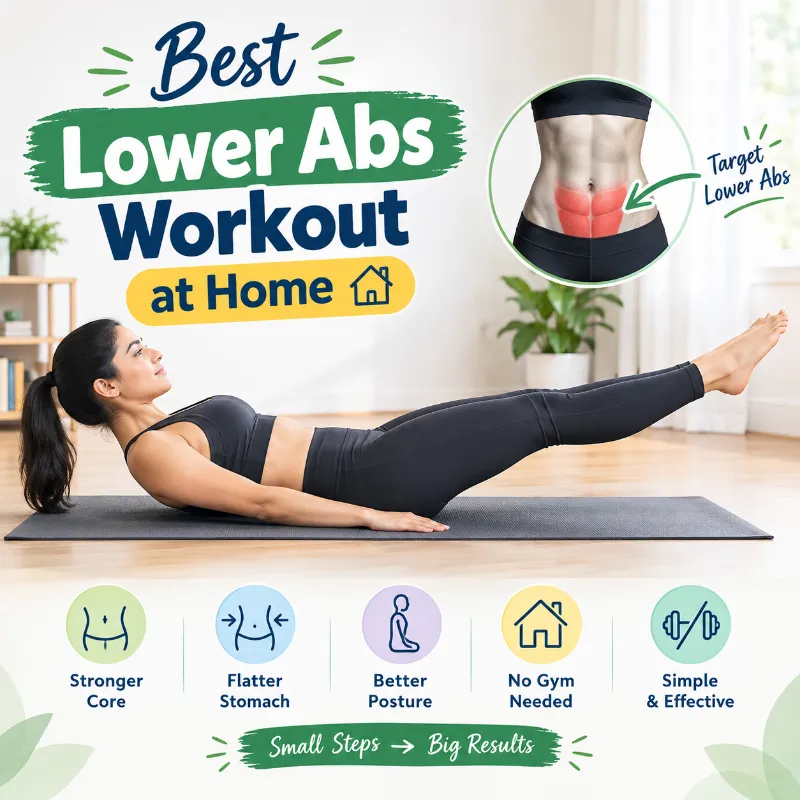
Best Lower Abs Workout at Home
When practicing abdominal workouts, you frequently get an intense burning sensation, but you realize that this mainly affects your upper body and not your lower. It doesn’t appear to do anything in the lower region.
We often hear this complaint, and it’s mostly because traditional sit-ups (like sit-ups) move your shoulders toward your hips, which puts more stress on your upper body and very little stress on your lower body.
If you want the bottom half to work, it’s not like you’re not using it. The point is, you need to train differently.
What are the lower abdominal muscles?
According to Earnest, your core is composed of much more than just those six-pack muscles. These consist of the obliques, rectus abdominis, and transverse abdominis.
The lower abdominal muscles are part of the rectus abdominis, which is the outer layer of muscle that runs along the front of your stomach, as explained by Earnest. She goes on to say that when people think about abs, they usually picture these “six-pack” muscles. The term “lower abs” refers to the lower portion of that muscle.
- Make use of the mind-muscle link
- You can improve the activation of your lower abs by just concentrating on them while performing the workouts shown below. Imagine yourself swimming at the beach: To avoid being knocked over, crouch down and use your core as a large wave approaches. “That tightening of the core is going to help you get the most out of your session.” These are your lower abs.
- Go more slowly
- “When I have people perform dead bugs, they frequently go extremely quickly and don’t feel it, but when I have them perform it slowly, after ten repetitions, they will undoubtedly feel the core.”
- Just take a breath
- You should exhale during the part of the exercise where you’re exerting effort, such as when you’re lifting your upper body in a crunch. To maximize the benefits of each workout, simply remember to breathe rather than hold your breath.
- Maintaining consistency is essential
- Even though everyone’s fitness path is different, Earnest suggests that the lower abs can—and should—be trained regularly, either through dedicated core workouts or by incorporating them mindfully into other types of exercise.
Can you actually target your lower abs?
In a way. In essence, your rectus abdominis—the muscle that people refer to as “abs”—is a single, lengthy sheet that extends from your ribcage to your pubic bone. You’re not attempting to isolate a distinct lower ab muscle. Biasing more of the effort toward the lower section is one thing you can do.
The evidence here is mixed, but helpful. Some studies have shown that the rectus abdominis muscles fire fairly evenly as a unit. In other cases, there are large regional differences depending on exercise. A study published in the journal Physical Therapy found that reverse crunches at a 30-degree incline produced the highest activity in the lower muscles of all the exercises tested.
Additionally, the 2024 ultrasonography investigation revealed that recruitment is often biased in favor of load. While leg exercises redistribute the burden downward, sit-ups increase the strain on your upper body.
It may be helpful to think of it this way:
- When you bring your feet closer to your body, your feet will feel lower.
- When your shoulders are closer to your hips, they will feel larger.
A lot of work is already being done on the latter, whereas very little is being done on the former. You also won’t be able to get rid of the fat in your lower abdomen, and no matter how much you lift your legs, that won’t change. A continuous caloric deficit attained by balanced exercise and healthy eating is necessary to alter body composition. But it’s definitely possible to build strength there, and these exercises are designed for that.
Why lower ab strength is worth training
Throughout the day, mobility, stability, posture, spinal health, and ease of movement are all supported by a strong core from top to bottom and side to side.
When one part of your core becomes weak, other muscles compensate for it. This usually means that your lower back and hip flexors are working harder than necessary when you’re doing common activities like lifting heavy objects, running, or lifting your baby out of a car seat. Over time, this is where pain and trouble begin. Core strength shows up everywhere. Even if beauty isn’t your goal, it’s still worth developing core strength.
The Importance of Lower Abdominal Strength
- First and foremost, it is evident that the lower abdominal muscles do not exist in the body. The rectus abdominis, internal and external obliques, quadratus lumborum, hip flexor psoas major, deepest core muscle transversus abdominis, and internal pelvic floor muscles are among them.
- Each of these areas needs to be trained, but they can be a little more difficult to move than other parts of your body.
- Mainly because it is not connected to the pelvic floor and transverse abdominis (TVA).
- “These two are often undertrained and don’t participate in programming simply because they aren’t mirror muscles.”
Key Muscles and Their Functions
From a slightly different angle, TVA helps with deep breathing, pelvic stability, posture, and internal core compression for strength training and weightlifting. Stretching from the sternum to nearly the base of the pelvis, this is the deepest layer of the core muscles. In contrast, the sixteen muscles that make up the pelvic floor “work together as a functional unit to stabilize the lumbopelvic complex of the hips and spine, influence sexual function, and control the bladder, bowels, and uterus.”
These invisible muscles actually support your weight as you support your body.
Benefits of Lower Abs Exercises
Lower abdominal exercises can help build muscle in this area, but they may not give you as much “tummy tuck” as you’d like. It is physically impossible to target the lower abdomen. The body doesn’t draw energy only from certain areas of the body.
If your goal is to lose weight, we need to consider your diet, lifestyle, and overall activity level.
However, training your lower abdominal muscles offers important benefits, especially improving core stability and posture. Both of these are essential to injury prevention.
- Increased core stability
- It makes sense that the stronger your core muscles, the more stable they are. This also means you’re less likely to get injured while working out (or just in life).
- Improved posture
- The improved core stability you get from lower abdominal exercises has the added benefit of better posture. Core workouts that engage the deep abdominal muscles helped participants develop better core stability and, in turn, better posture.
Maximizing Effectiveness in Lower Abs Workout
The first step to truly training these different muscles is to reconnect them. “To feel these muscles, you need to focus not only on the position of your spine and pelvis but also on your breathing.
Correct way to interact
What exactly does this mean? To strengthen your pelvic floor, you need to focus on two things: breathing and form.
- Breathing
- Practice techniques that involve relaxing and contracting your muscles as you breathe.
- Try this. As you breathe in, contract the muscles you use to stop the flow of urine.
- Imagine pulling these muscles upward as well as inward. Next, exhale and relax.
- For your VAT, it’s helpful to think of it as a corset: “As the lower, middle, and upper fibers contract, the waist narrows slightly, and the stomach flattens.,
- Form and alignment
- Lie on your back, bend your knees, and keep both feet flat on the floor to coordinate your breathing comfortably throughout the exercise.
- Place your fingers on your stomach between your belly button and the top of your femur.
- Take a deep breath, and as you exhale, engage your pelvic floor muscles and pull your lower abdomen down and away from your fingers.
- Ultimately, “the pelvic floor muscles and TVA must work together to stabilize the pelvis and work synergistically with all other core muscles.”
- Overcoming Typical Obstacles
- Despite all the advantages of building strong core muscles, there are a few things to be aware of. The primary goal is to safeguard your back, particularly if you already have back problems and are attempting to strengthen your core.
- Preventing Lower Back Pain
- It’s simple to strain your back’s supporting muscles when your abdominal muscles are under so much tension. While some abdominal exercises, such as planks, are not recommended if you have back problems, other exercises, such as bird-dog, are both safe and helpful.
- Adding Fitness Levels Into Effect
- Naturally, lower ab exercises can include both simple and complex exercises. Moves that you feel comfortable performing should always be your first choice. If an ab exercise seems too difficult, try a reduced version or switch to a different ab exercise that you feel more at ease with.
Best lower ab exercises
- Ab contractions
- Leg drops
- Hip lift
- Boat pose
- Mountain climbers
- Rocking plank
- Scissor kicks
- The hundred
- Bicycle crunches
- Flutter kicks
- Plank
- Glute Bridge
- Split Stance Hinge With Reach
- Staggered Leg Lower
- Bird Dog
- Deadbug
- Frog Crunch
- Hollow Hold
- Lying Leg Raises
- Alternating Leg Drops
Ab contractions
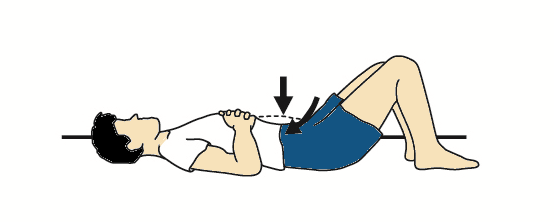
How to do
- Position yourself on your back, bend both knees, and place your feet securely on the floor.
- Press your back against the floor and make a small movement to push your navel into your spine to tighten your core.
- Contract your abdominal muscles in this way for thirty seconds, then release them.
- Repeat one to three times after taking a brief pause.
Suggestion: Take calm, deep breaths as you work out. If 30 seconds is too long, start with 10 to 15 seconds and work your way up.
Leg drops

How to do
- Lie flat on your back, extend both legs vertically upward, and keep your arms relaxed alongside your body.
- Lower your legs slowly toward the floor, then raise them back up just before they touch the floor.
- Maintain a solid lower back position on the floor.
- Perform 1–3 sets of 10–16 repetitions.
Advice: If your lower back starts to lift off the ground, stop there and put your legs back where they were. Try putting your hands under your sitting bones in a triangular shape for more support. Where these bones are located
Hip lift
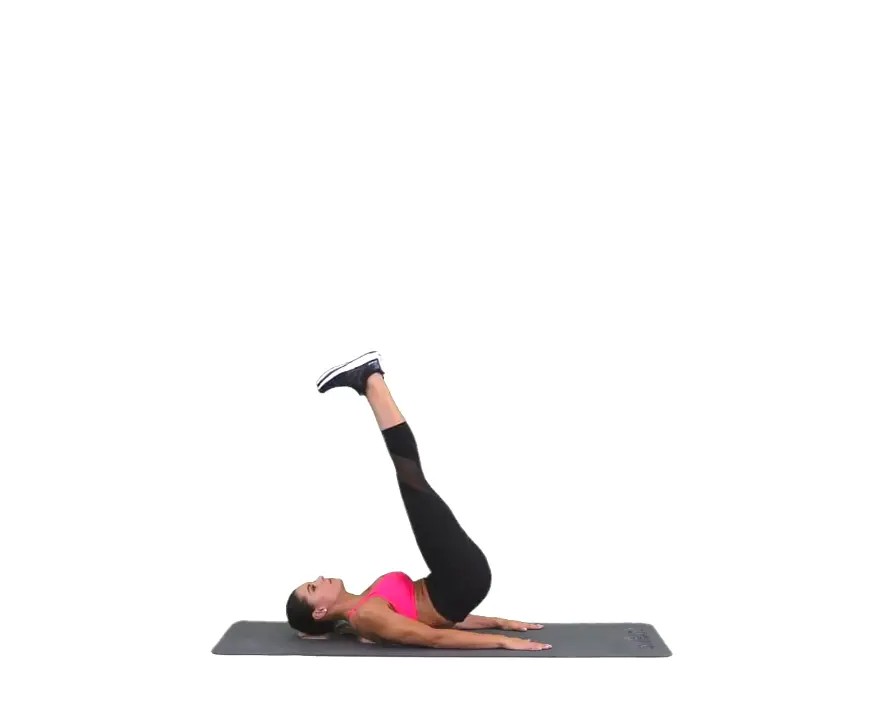
How to do
- Rest in a supine position with both arms extended comfortably alongside your torso.
- Lift your legs to a vertical position.
- Press your feet up against the ceiling to raise your hips off the floor.
- Gently bring your hips down until they touch the floor, then perform the movement again.
- Perform 1–3 sets of 10–15 repetitions.
Advice: For this exercise, it’s important to engage your lower ab muscles rather than your momentum. After every lift, release your breath and keep your hips under control.
Navasana (Boat Pose)
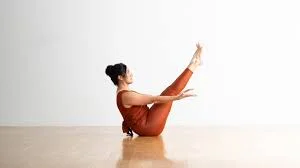
How to do
- Take a seated position with both knees bent and your soles resting firmly on the floor.
- Roll back onto your sitting bones and stretch your legs to a 45-degree angle to create a “V” shape.
- Stretch your arms parallel to the floor with your hands facing up.
- Hold this position for no more than a minute.
- Repeat one or two times after taking a rest.
Suggestion: Use your lower abdomen to embrace your spine. Lift your chest. You can try supporting yourself with your hands on the floor behind you, keeping your knees bent, or just raising your feet to knee height.
Mountain climbers
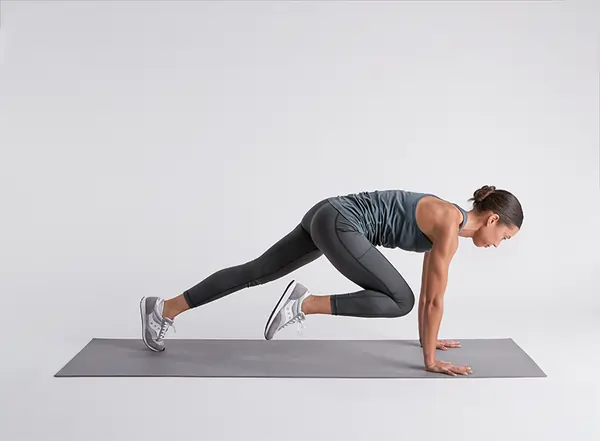
How to do
- Put your hands beneath your shoulders and assume a high plank stance.
- Flex your right leg and gently draw your knee closer to your chest.
- While extending your left leg, return your right knee to its starting position.
- Continue this motion for no more than a minute.
- Repeat one or two times after taking a rest.
Rocking plank
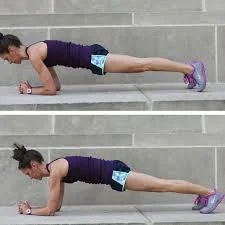
How to do
- Do a low (forearm) plank with your elbows under your shoulders.
- Move your body forward and backward while rocking on your toes.
- Continue making this motion for a minute.
- Repeat one or two times after taking a rest.
Advice: Maintain a straight neck, spine, and hips. Concentrate on using your lower abs.
Scissor kicks
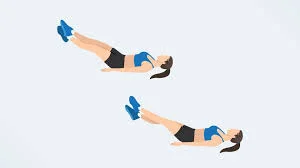
How to do
- Make a 90-degree angle with your body while lying on your back with your arms by your sides and your legs straight up to the ceiling.
- Slowly bring your right leg back down while maintaining the elevated position of your left leg.
- As you raise your right leg back up, gradually lower your left leg.
- Continue alternating between raising and lowering your legs.
- Perform 1–3 sets of 10–16 repetitions.
Advice: If your lower back starts to lift, try to lower your leg at a 45-degree angle.
The hundred
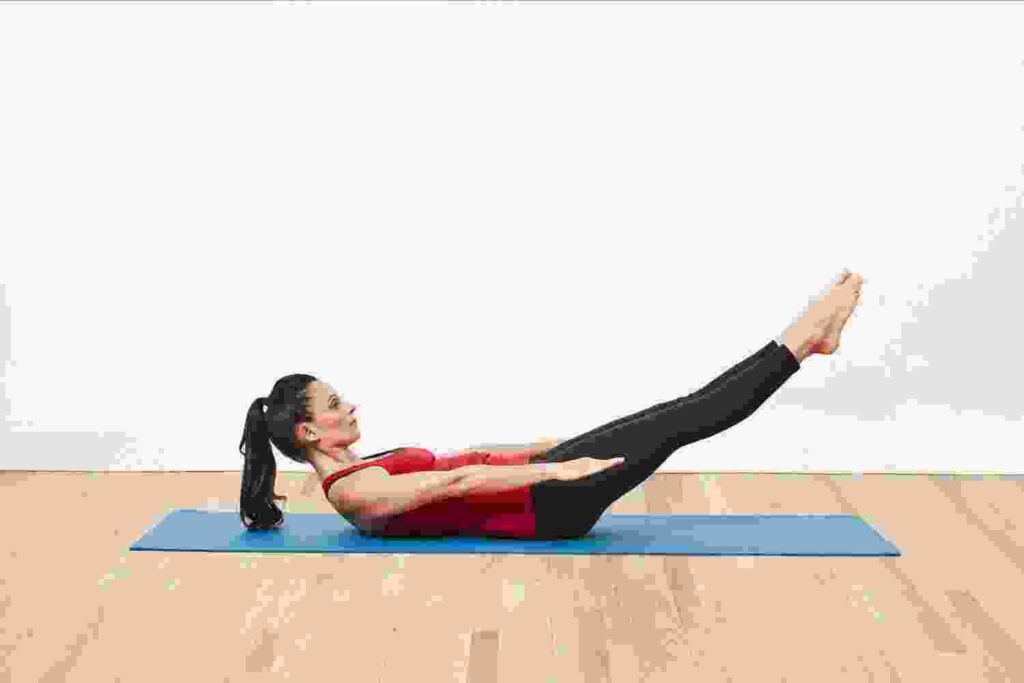
How to do
- Lie on your back and place your knees close to your chest.
- Rotate your shoulders, neck, and head.
- Move your arms in tandem with your body.
- Straighten your legs to a 45-degree angle.
- Breathe in 5 times and exhale 5 times as you raise and lower your arms.
- Perform 10 sets of 10 breath repetitions or 100 presses.
Advice: Breathe in through your nose and out through your mouth. For variation, pull your knees closer to your chest and bend them to a 90-degree angle
Bicycle crunches

How to do
- Lie on your back with your fingers linked to support the base of your skull.
- Bend your knees to a 90-degree angle.
- Extend your right leg straight out while twisting your right shoulder and elbow toward your left knee.
- Return your right leg to a 90-degree angle after extending your left leg and twisting your left shoulder and elbow toward your right knee.
- Continue this action while swapping sides.
- Do a total of twelve to eighteen repetitions in one to three sets.
Suggestion: To keep your core braced, draw your navel into your spine.
Flutter kicks
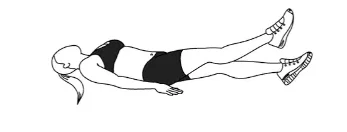
How to do
- With your arms by your sides, lie on your back.
- Raise your legs until your feet are roughly six inches above the ground.
- Simultaneously raise your left leg slightly while gradually bringing your right leg closer to the floor.
- Slowly raise your right leg while lowering your left leg slightly, alternating their positions in a controlled movement.
- For a maximum of one minute, keep up this motion.
- Take a break and repeat one or two times.
Advice: Maintain your lower back in contact with the ground. Put your hands under the sitting bones for support to help with this.
Plank

How to do
- Place your hands directly beneath your shoulders and begin on the ground in a quadrupedal position.
- Put yourself in a plank position by stepping back one foot at a time.
- Use your feet to extend your stance for greater stability.
- Keep your gaze on the floor while maintaining a straight line from your heels to the top of your head. You should keep your neck in a neutral position.
- For the period mentioned above, contract your glutes, quadriceps, and abs.
- That is one rep.
Glute Bridge
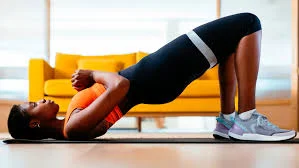
How to do
- With your knees bent and your feet hip-width apart on the ground, lie on your back.
- In order to create a straight line from your knees to your shoulders, contract your glutes and raise your hips off the ground.
- For good measure, pause at the top and give your glutes a little more squeeze.
- Before repeating, carefully lower yourself back to the beginning position and tap your hips on the ground.
- One rep is that.
Split Stance Hinge With Reach

How to do
- Step your right foot back two steps behind you while standing with your feet hip-width apart.
- To balance on the ball of your foot, raise your right heel so that it resembles high heels.
- Stretch your arms forward until your biceps are near your ears and hinge forward at your hips with a flat back until your torso is parallel to the floor.
- Go back to standing with composure.
Staggered Leg Lower

How to do
- With a looped resistance band around your ankles, lie on your back with your hands by your sides, and your legs outstretched.
- Make a 90-degree angle with your torso by raising your legs straight to the ceiling.
- Lift your shoulders, head, and neck off the mat so that your eyes are on your thighs.
- Straighten your legs and apply pressure to the resistance band, but keep your heels apart such that your right heel is slightly lower than your left.
- Keep your feet apart while lowering both legs to the ground.
- Reverse the motion to get back to the beginning once the right foot is slightly off the ground.
- Lead with the other foot and repeat.
Bird Dog

How to do
- With your hands directly beneath your shoulders and a resistance band wrapped around the balls of your feet, begin in a quadrupedal position.
- Raising your right arm and left leg until they are completely extended and in a straight line with your body, draw your navel in toward your spine.
- Bring your elbow and knee together to tap beneath your navel while maintaining a solid torso and an active core.
- Stretch out again.
- Perform each repetition on the same side, then switch sides and repeat.
Deadbug

How to do
- With your shoulders and legs bent to a 90-degree angle (knees above hips), lie on your back with your arms extended in line toward the ceiling.
- Extend and drop the right leg and left arm (overhead) slowly until they almost touch the floor while pressing the lower back into the floor and using the abs.
- Pause, then go back to the beginning and repeat on the other side.
Frog Crunch
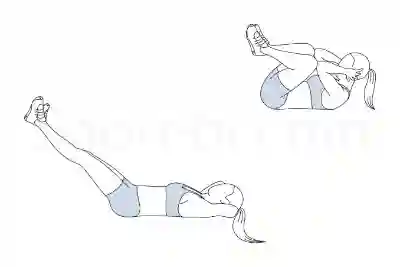
How to do
- With your arms out by your sides, lie on your back.
- Press your heels together and place your feet on a tabletop.
- Keeping your heels close together, extend your legs diagonally.
- Draw your heels in toward your butt while bending your knees.
- Extend your legs once more.
Hollow Hold
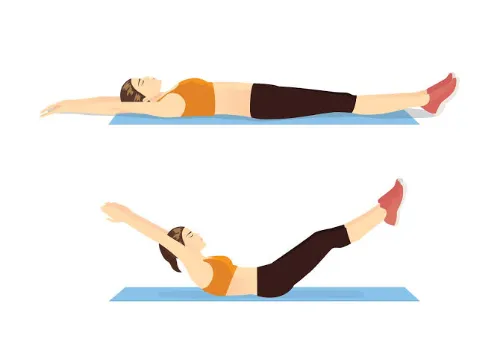
How to do
- With your arms outstretched and your legs straight, lie on your back on the floor.
- Lift your arms, head, shoulders, and legs a few inches off the ground by using your core.
- Make sure you only feel your abs working by keeping your lower back firmly pressed against the floor.
- After 30 to 60 seconds of holding the position, take a break, and repeat.
Lying Leg Raises
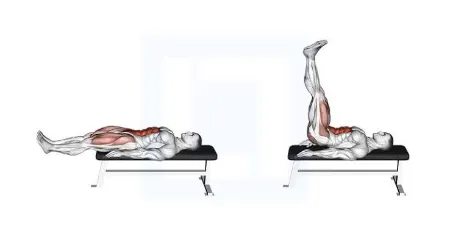
How to do
- Extend your legs and place your hands under your hips, just below your butt, while lying on your back.
- Flex your stomach and raise your legs toward the ceiling until they reach a 90-degree angle while maintaining a straight and engaged gait.
- Lower your legs slowly, pausing to keep them a few inches off the ground. Keep your lower back from arching off the ground.
- Do this five to fifteen times.
Alternating Leg Drops
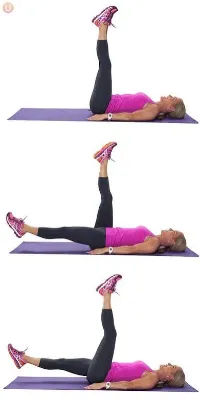
How to do
- Lift your legs straight up at a 90-degree angle and begin on your back.
- With your heel pointed toward the ground, slowly bring one leg down to the floor.
- Before swapping legs and moving back and forth, stop just before your heel reaches the ground and elevate your leg back to the beginning position.
- For optimal core involvement, repeat for 12 to 15 repetitions while pressing your back into the floor.
Safety precautions for lower ab exercises
When engaging in any workout routine, it is important to keep certain safety guidelines in mind. This applies to lower abdominal exercises as well. Before beginning a lower abdominal workout, you may find it helpful to follow these safety tips:
- If you have any health conditions, it is advisable to consult with your doctor before starting a new exercise program.
- Begin each exercise session with a few minutes of gentle movements to prepare your body for physical activity.
- Pay attention to your form during each exercise.
- Perform only as many repetitions as you can while maintaining correct form.
- If you experience any pain, it is best to stop immediately.
If you need assistance in creating a lower abdominal workout plan that suits your needs, you might consider speaking with a personal trainer for professional guidance.
FAQs
Which workout works best for lower abdominal muscles?
Exercises that work the lower abdominal muscles include mountain climbers, leg raises, and scissor kicks. However, your mobility and level of fitness will determine which activity is ideal for you.
Is it difficult to gain lower abs?
Everybody has muscles in their abdomen. Concentrate on reducing your overall body fat percentage through sustainable lifestyle and nutritional modifications to make them more noticeable for aesthetic reasons.
Why am I experiencing leg raises in my hip flexors rather than my abs?
When the back arches or the legs are overly straight, the hip flexors take over. Reduce the range, bend your knees, and curve your pelvis at the top. You can feel your abs first with reverse crunches.
Is Lower Ab Exercise Effective in Reducing Lower Belly Fat?
Not by themselves. The entire body loses fat. To reduce body fat, combine ab work with strength training, walking, and a small calorie deficit.
Is it possible to work out your lower abdominal muscles at home without any equipment?
Indeed. For the majority of beginners, at-home lower ab workouts like leg lifts, reverse crunches, dead bugs, and holds offer sufficient load. To keep moving forward, add tempo, pauses, or lengthier holds.
Refernces
- Aline (Ren) Dias. (2026). Lower Ab Workout: 10 Exercises for a Stronger Core. Healthline Media. https://www.healthline.com/health/exercise-fitness/lower-ab-workouts#safety
- Kristine Thomason and Cori Ritchey, C.S.C.S. (2025). Traditional Crunches Won’t Transform Your Lower Abs—But Here’s What Does. Women’s Health. https://www.womenshealthmag.com/fitness/g26676872/lower-ab-exercises/
- (n.d.). lower-ab-exercises-11943393. health.com. https://www.health.com/lower-ab-exercises-11943393
- (n.d.). 10 Of The Best Lower Ab Exercises. sweat.com. https://sweat.com/blogs/fitness/best-lower-ab-exercises
- Kristine Thomason. (2024). Build A Solid Core with These 10 Tried and True Lower Ab Exercises. Peloton Interactive. https://www.onepeloton.com/blog/lower-ab-exercises