
Bicycle Crunches
What are Bicycle Crunches?
The bicycle crunch is a great ab workout that targets the deep abs and obliques (the abdominal muscles on the sides of the torso) as well as the upper abdominal muscles.
This air bicycle manoeuvre is an excellent option if you want to strengthen your core. You can perform this beginner-level, no-equipment workout anywhere. Use it in conjunction with ab machine exercises to strengthen your core or incorporate it into a full-body workout.
Muscle Work During Bicycle Crunches:
- Core Muscles
- Rectus Abdominis Muscle
- Internal and External Oblique Muscles
- Quadriceps Muscle
- Hamstring Muscle
How to Perform Bicycle Crunches Video
Not Available
How to Perform Bicycle Crunches?
- To stabilise your spine, draw in your abdomen by contracting your core muscles.
- Use your hands to gently hold your head. Lift your feet off the ground by steadily raising your knees to a 90-degree angle while pulling your shoulder blades back.
- Breathe out and perform a bicycle pedal motion slowly at the start, raising one knee to your armpit and straightening the other leg, both of which should remain higher than your hips.
- Turn your torso such that your elbow touches the opposing knee as it rises.
- Draw that knee towards your armpit and extend the other leg till your elbow reaches the other knee as you twist to the opposite side.
- Aim for three sets of 12 to 20 repetitions.
Benefits:
The bicycle crunch is the best exercise for strengthening your upper abdominal muscle, the rectus abdominis, and the captain’s chair is the best exercise for strengthening your obliques.
Raising your legs also activates the transverse abdominis, the hard-to-target deep ab muscle. Bicycling works both your hamstrings and quadriceps, so you’ll be toning your thighs in addition to your abs.
You may be able to avoid lower back pain, maintain proper posture, and carry out your everyday chores more effectively if you have a strong core. Additionally, it is necessary to perform effectively in sports and physical activities. You can make sure you are using your muscles in diverse ways by performing a range of core and ab workouts.
Tips for Beginners:
If you’ve been avoiding bicycle crunches—possibly because you thought they didn’t work or because you felt uncomfortable doing them—you should now realise how beneficial and successful they are when performed correctly.
Fortunately, you can benefit from them without investing a lot of effort. Within a few weeks, a few daily sets done two or three times a week should be more than sufficient to build a stronger core. Even better, you can easily include them in a variety of exercise routines, such as your current ab circuit, full-body day, or other mat-based practices like yoga and mat Pilates.
Variations:
Bicycle Crunch with Feet Down:
Bring your right knee to your left elbow while keeping your feet on the mat with your knees bent. Then, return your foot to the floor and switch to the opposite side.
Standing Twisted Crunch:

- You can choose to perform a variation of this standing core exercise if a conventional, supine bicycle crunch is too taxing on your neck, back, or hips, even with good form:
- With your feet hip-width apart, take a tall, sideways position on your mat. With your elbows wide open, interlace your hands behind your head.
- Keeping your core active and supporting your weight on your standing leg, raise your right knee while twisting your left elbow down towards it.
- Before switching sides, get back up to a tall standing position.
Raise leg Bicycle Crunches:
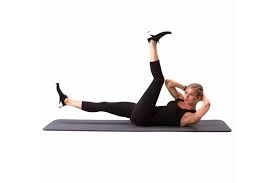
Your legs will be directed at a 90-degree angle towards the ceiling in this form of the exercise, but the fundamental motions are still the same. By increasing the pace, this can be made more difficult.
Advanced Bicycle Crunch:
- Holding each crunch for a few more breaths.
- Maintaining a small elevation of your straight leg over the mat.
- Putting weighted bands around your ankles or arms.
Precautions:
- Bicycle crunches should not be performed by pregnant women or anybody with spinal issues.
- People with herniated discs should avoid performing standing bicycle crunches.
- Pay attention to your posture and form. By doing this, stress and compression of the muscles are prevented.
- Never begin performing the bicycle crunch exercise without first learning how to do it correctly from a qualified trainer.
- If you are under stress, have a fever, or have the flu, stay away from bicycle crunches.
Common Mistakes:
Rotation of the Hips:
The entire rotation should be performed by your torso. You should drive your legs straight forward and backward instead of turning your hips. Throughout the exercise, keep your lower back firmly planted on the ground.
Straining of the neck:
Avoid bringing your head forward so that you may concentrate on rotating your torso. Simply rotate your torso as far as you can if you find yourself straining your head and neck to get your elbow to touch your knee.
FAQs
What is the bicycle crunch exercise?
A variation on the ab crunch, bicycle crunches work the core by rotating the upper body while pedalling the legs. In addition to strengthening the rectus abdominis and the internal and external obliques, this exercise can enhance stability and coordination.
What muscle groups do bicycle crunches work?
A dynamic core exercise, the bicycle crunch includes extending the opposing leg while twisting your torso to one side. You can work several muscle groups, such as the rectus abdominis, transverse abdominis, obliques, and hip flexors, by simulating a pedalling motion while lying on your back.
Do bicycle crunches burn belly fat?
While bicycle crunches can assist in toning the abdomen, remember that spot-reduction is a myth when it comes to losing fat. A bicycle crunch can help you tone and tighten your core muscles while strengthening your abdominal muscles.
What are the disadvantages of bicycle crunches?
Therefore, bicycle crunches spread your abs apart diagonally at the umbilicus (the belly button) in addition to bulging them forward, weakening the centre of your rectus abdominis, and stretching the connective tissue sideways.
Why are bicycle crunches so effective?
This week’s tip: Bicycles are physiologically more effective than crunches because they activate the rectus abdominus’s lower region when the legs are moving, the obliques when twisting, and the upper region of the abdominus while maintaining a steady crunch.
What makes a crunch different from a bicycle crunch?
Similar to a regular crunch, the bicycle crunch includes twisting your upper body to each side while rotating your legs in a cycling motion.
What’s better, bicycle crunches or planks?
Because they work the deepest layer of your ab muscles, planks are superior for strengthening your core. Crunches are more effective at enhancing definition because they primarily target the surface abs, or “six-pack” muscles. The best benefits for strength and visual ab tone, according to experts, come from a combination of planks and crunches.
References:
- Ms E. Q. (2023, May 26). How to do a bicycle crunch: fitness tips, variations, and common mistakes. Verywell Fit. https://www.verywellfit.com/bicycle-crunch-exercise-3120058
- Fit, C. (2022f, August 29). How to Do Bicycle Crunches: Steps, Variations, Benefits & Safety Tips. blog.cult.fit. https://blog.cult.fit/articles/how-to-do-bicycle-crunches
- Ross, M. (1970b, January 1). This is one of the most effective core exercises, according to science. https://www.onepeloton.com/blog/bicycle-crunches