6 Best Exercise for Guyon’s Canal Syndrome
Introduction
Exercise for Guyon’s Canal Syndrome involves gentle stretching and nerve gliding techniques to relieve ulnar nerve compression at the wrist. These exercises aim to reduce symptoms like numbness or tingling in the ring and little fingers while improving hand strength and flexibility.
Guyon’s canal syndrome, which is associated with ulnar nerve impingement, was covered in detail in this article. The little ring, the ring, and the fingers in particular may become numb, tingly, and weakened as a result.
Anatomy
The brachial plexus’s medial cord (C8-T1) gives rise to the ulnar nerve, which then goes via the axilla and the anterior compartment of the arm before piercing the intramuscular septum and going into the back compartment. After that, it passes via the cubital fossa, which is situated behind the medial epicondyle.
Causes
- Repetitive trauma
- Ulnar artery thrombosis or aneurysm
- Fractures or dislocations
- Inflammatory arthritis
- Carpal tunnel syndrome
- Hypothenar Hammer Syndrome
- Iatrogenic
- Anatomy difficult
- Ganglion cyst
Symptoms
- Along with wrist ache, the ring and tiny fingers throb and tremor.
- Hand muscular weakness that impairs grip and pinching power
- Handling of the little and ring fingers in severe circumstances.
- Lack or loss of sensation.
Depending on the severity of symptoms:
- Very mild
- Mild
- Moderate
- Severe
- Very severe
Depending on the Duration of symptoms:
- Acute (within one month)
- Sub-acute (two to three months)
- Chronic (more than three months)
Special test
- Gentle strokes should be used over Guyon’s canal, which is situated between the wrist joint’s ulnar side.
- The patient’s little and ring fingers should be tingly and painful.
- Positive outcomes feature ring and fingertips pain or burning.
- Inflammation and compression at the wrist joint.
Phalen’s Test
- Put your wrist joint in a passive flexion posture and keep it there.
- The recovery of symptoms in the ulnar distribution is a positive indication.
- Note: Usually used for carpal tunnel syndrome, although if Guyon’s canal is affected, it may still cause ulnar discomfort.
Wartenberg’s Sign
- Recommend that the patient bring all of their fingers together.
- Positive sign: Difficulty with finger adduction.
- The palmar interossei’s weakness (ulnar-innervated) is indicated.
Optional Diagnostic investigations:
- Nerve conduction studies (NCS)
- Electromyography (EMG)
- Ultrasound and MRI
Exercise for Guyon’s canal syndrome
Wrist flexion and extension
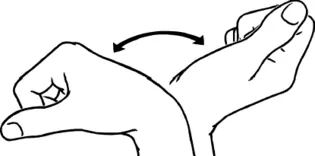
- Position: sitting or standing
- Hold a lightweight dumbbell or water bottle.
- Perform 10-15 reps for 2-3 sets.
Ulnar nerve stretch

- Position: sitting or standing
- Like you were holding a tray, extend your arm out to the side (shoulder height), elbow bending, palm up.
- To increase the length of the stretch, tilt your head away from that side.
Wrist extensor stretch

- Position: Sitting or supine
- With your opposite hand, lightly grab the outstretched arm’s fingertips.
- Two to three repetitions per session.
Wrist flexor stretch

- Position: sitting or standing
- Stretch your wrist flexor muscles actively.
- Make sure your elbow is completely extended (at 90 degrees).
Biceps curl

- Position: standing or sitting
- As you raise the dumbbells to your shoulders while bending at the elbow, maintain a relaxed posture and stable upper arms.
- Wrap your elbows tightly into your body.
- When you raise, exhale. Drop the weights back to where they were before.
- Perform the necessary reps while remaining within 3 to 5 reps of complete failure.
Grip strength

- Support Grip- clutching anything for time (e.g., shopping bags, pull-up bar).
- Hook Grip- Used in weightlifting (thumb wrapped under fingers).
Classifications
Zone One: situated close to the sensory integration and motor bifurcation.
In zone one, we took into consideration bone nonunion and malunion, as well as ganglion cysts and fracture conditions like hamate fractures.
Relates to the ulnar nerve’s major deep terminal motor branch; damage to it mostly causes primary motor symptoms, such as weakness.
This major inner branch of the ulnar nerve innervates all interosseous muscles, for example, the hypothenar muscles and the fourth or fifth lumbricals. (opponens digit mini, abductor digit mini, flexor digit mini brevis), and the adductor pollicis.
Zone two and zone three
The superficial sensory terminal branch of the ulnar nerve is squeezed in this location, resulting in sensory complaints such as numbness, tingling, and burning sensations.
A major ulnar artery aneurysm and/or thrombosis are among the causes.
Physical Examination
For a physical examination, you should look for signs of hypothenar or interossei atrophy, difficulty crossing fingers, lumbness in the wrist joint, and the location of the wrist joint’s claws.
When a patient is asked to hold a piece of paper between his thumb and fingers as the examiner tries to pull it, a weakness in the adductor polices muscle (Instead of adduction, the patient compensates by flexing his thumb), which is supplied by the ulnar nerve. This is known as Froment’s sign. The over-abducted position of the little finger at rest is Wartenberg’s sign.
Orthosis
Orthosis types include:
Wrist splints: These immobilise the wrist to lessen ulnar nerve tension.
Ulnar Gutter Splint: Reduces compression by supporting the hand’s ulnar side. Soft braces allow for mobility while offering a small amount of support and compression.
Custom-made orthoses are made to fit certain requirements, particularly in extreme situations.
Advantages of Wearing an Orthotic:
- The reduction of nerve compression is achieved by keeping your wrist in an equilibrium position.
- Prevents the recurrent tension brought on by prolonged cycling or grasping.
- Aids in healing following nerve irritation or surgery.
Physical Therapy Management
- Physiotherapy includes patient education and limb movement before surgery. According to the patient’s needs and preferences, nerve gliding exercises and ultrasound (US) may be included.
- Patient recommendations for ergonomic adjustments and activity adaptations include avoiding recurrent stress on Guyon’s canal, such as weight bearing or cycling, and modifying bicycle handlebars. Stay careful of repeated activities or static postures that might lead to mechanical stress, such as lying on the palm of your hand or extending your wrists while hammering.
- Wearing a resting hand splint will help the patient maintain a neutral wrist posture.
- As seen here, use the Butler notion for the ulnar nerve in your nerve gliding workouts—shoulder abduction, depression, pronated forearm, wrist extension, elbow flexion, and glenohumeral lateral rotation. As the symptoms subside, strengthening exercises are progressively added.
Surgical Decompression
- By cutting roofing materials or other elements that are compressing the nerve, the surgical treatment reduces the compression on the ulnar canal in Guyon’s canal.
- In the early post-operative phase (up to 10-15 days after surgery), the patient is urged to elevate his hand, give it proper rest, perform slow hand and wrist motions without resistance as tolerated, and avoid putting large loads on the hand or engaging in forceful activities.
- Following surgery, post-operative physicians advised hand and wrist mobilisation to manage scars and oedema, as well as ergonomic suggestions to lessen the mechanical effect on the nerve.
- Splinting is used for limb alignment. Doctors advise splinting following surgery, but it’s also recommended for severe conditions like limb burns.
- To improve nerve gliding and strengthen hand muscles, post-operative exercises are recommended for patients with reduced hand mobility in the event of hand oedema or for patients who are afraid to use their hands.
Home remedies
There are also some practical home treatments and lifestyle suggestions that might aid someone with ulnar tunnel syndrome.
Here are multiple suggestions so you can do it yourself, and helpful hints:
- Avoid placing your elbow on the desk or chair arms, as this might strain your nerves.
- Extra support can be obtained by wearing a wrist brace, particularly when using the hand or wrist.
- Additional support can be obtained by wearing a wrist brace, particularly when using the hand or wrist.
- Using ergonomic or cushioned instruments to lessen pressure on your wrist
- Aids in healing following nerve irritation or surgery.
- When cycling or lifting weights, put on cushioned gloves. To enhance circulation, keep your hands warm. Avoid exposure to vibrating instruments or use ergonomic ones instead.
Risk factors
- Repeated Motions of the Hand or Wrist
- Long-Term Stress on the Palm: Workplace Elements
- Wrist trauma and other wrist conditions.
- Inflammatory conditions or arthritis
- Diabetes or Additional Systemic Disorders
- Smoking, malnutrition, and prior surgeries in the region
FAQs
What is the healing period from Guyon’s Canal Syndrome?
Although each patient heals at a different rate, you will most likely need to attend our occupational or physical therapy sessions for six to eight weeks, with full recovery expected to take several months.
What determines a positive Phalen test?
In the event that the patient exhibits carpal tunnel syndrome symptoms, such as pain and paresthesia along the thumb, index finger, and middle finger, the test is positive (abnormal).
How do you test for the ulnar nerve?
Tests of the ulnar nerve assess how well the nerve, which runs from the neck down the arm and into the hand, is functioning. These tests evaluate whether the nerve is injured, compressed, or irritated, which can cause symptoms such as numbness, tingling, or weakness in the hand and arm.
What’s another term for Guyon Canal Syndrome?
The term Ulnar Tunnel Syndrome is also often used.
Handlebar palsy.
At the wrist, ulnar nerve compression.
Guyon’s Tunnel Syndrome.
What separates Guyon’s Canal and Cubital Tunnel Syndrome?
The Guyon canal allows the ulnar nerve to enter the hand, giving the fingers motor and sensory innervation. Although the most common site of ulnar nerve injury is cubital tunnel syndrome, which is more common near the elbow, the ulnar nerve is more likely to experience damage.
How to release the ulnar nerve?
To “unblock” the ulnar nerve, which is a medical phrase for relieving nerve compression or irritation, a combination of nonsurgical therapies such as exercises, physical therapy, and medication is usually used, with surgical techniques being used in more severe situations. Nerve gliding exercises are an important part of therapy, since they help increase nerve mobility and alleviate compression.
Which muscles are affected by Guyon’s Canal Syndrome?
Both intrinsic (palmaris brevis, flexor digiti minimi, hypothenar adductor) and extrinsic (flexor digitorum superficialis, abductor digiti minimi, flexor digiti minimi, flexor carpi ulnaris, palmaris longus) muscles have been reported to be abnormally present around Guyon’s canal.
References
- Dhameliya, N. (2023, September 10). GUYON’S CANAL SYNDROME. Mobility Physiotherapy Clinic. https://mobilephysiotherapyclinic.net/guyons-canal-syndrome/
- Ulnar nerve glide. (n.d.). [Video]. Hingehealth. https://en-gb.hingehealth.com/resources/articles/ulnar-tunnel-syndrome/