
Top Exercises for Upper Cross Syndrome
Introduction:
Upper Crossed Syndrome (UCS) is a condition where the muscles in your shoulders, neck, and chest are out of balance, with some being too weak and others excessively tight. The condition’s name comes from the way these muscles appear to form an X when viewed from the side of the upper body. The consequences of your shoulder, neck, and chest muscles not cooperating properly can be highly apparent and uncomfortable.
What is Upper Cross Syndrome?
When the muscles of the neck, shoulders, and chest become malformed, usually due to bad posture, it is known as upper crossed syndrome (UCS).
The back muscles of the shoulders and neck, the levator scapula and upper trapezius, are usually the most impacted. They first become quite tense and hyperactive. The major and minor pectoralis muscles, which are located in the front of the chest, then shorten and tighten.
The surrounding countermuscles grow weak and underutilised when these muscles are overworked. An X shape may then form as a result of the hyperactive and underactive muscles overlapping.
Muscle Involved in the Upper Cross Syndrome:
Weak muscles:
- Lower and middle trapezius muscles
- Deep neck flexor muscles
- Serratus Anterior muscle
Tight Muscles:
- Upper trapezius muscle
- Levator scapulae muscle
- Suboccipital muscles
- Sternocleidomastoid muscle
- Pectoralis major and minor muscles
Causes:
The majority of UCS instances are caused by persistently bad posture. In particular, prolonged standing or sitting with the head thrust forward.
Individuals frequently take this stance when they are reading, watching TV, riding a bike, or using a laptop, computer, or smartphone while driving.
Symptoms:
UCS sufferers have rounded, hunched shoulders and a bowed neck. The surrounding joints, bones, muscles, and tendons are strained by the malformed muscles. Most people get symptoms like these as a result of this:
- Headache and neck pain
- Tension at the back of the neck
- Weakness in the front
- Shoulder and upper back pain
- Chest discomfort and constriction
- Jaw discomfort
- Weariness
- Lower back discomfort
- Difficulty sitting down to watch TV or read
- Difficulty driving for extended periods of time
- Pain, numbness, and tingling in the upper arms; limited movement in the neck and shoulders; and decreased movement in the ribs
Tips To Avoid for the Future:
Start by maintaining proper posture, being careful to stay out of postures that cause pain or numbness. Specifically, avoid allowing slouching to develop into a habit.
To improve your posture, consider these additional strategies:
- Keep an eye on your weight.
- Put on supportive shoes.
- Raising a book or screen at eye level is preferable to lowering your head to look at it.
- To achieve good posture, adjust the height of your desk or chair.
- Remember to occasionally take a break and stretch if you spend a lot of time sitting down.
- When standing for extended periods of time, use a short, strong object to support one foot.
- Use pillows of that size or rolled towels to support your lower back and neck while you’re in bed.
- At least two or three times a week, work out your chest, shoulders, and neck muscles.
- Try to work out your back, abdomen, and core muscles every day, even if it’s just a quick stroll.
Exercises:
Thoracic Twists:

- With your butt in contact with the heels of your feet, drop to both knees.
- Place one hand on the back of your head and extend the other on the floor for support.
- Try to contact the elbow of the arm resting on your head with the extended arm by twisting your body in that direction.
- Now, open your upper back by twisting your body in the opposite direction and looking up as your elbow rises.
- Ten repetitions per side should be your goal.
One Arm Chest Stretch:

- As you get closer to a wall, extend one arm behind you and place the palm on the wall.
- Lean forward now, a little away from the outstretched arm.
- Your chest should feel stretched.
- Hold for thirty seconds.
- Continue on the opposite side.
Levator Scapulae Stretch:
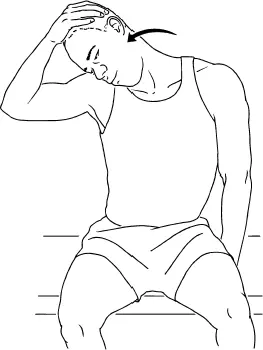
- Starting while seated, place your left hand on the back of your head and your right hand on the bottom of your chair.
- Turn your head to look at your left underarm.
- Next, gently press your head down toward your left armpit with your left arm until you feel a tiny stretch along the right side of your neck.
- For 15 to 20 seconds, maintain this posture.
- Continue on the other side.
- Try to perform this stretch three times on each side.
Chin tucks:
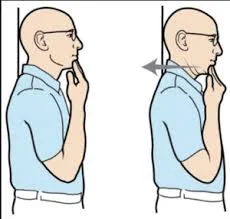
- Put two fingers on the base of your chin.
- Retract your head back and gently tuck your chin in. Simultaneously, keep your chin tucked in with your fingers.
- For three to five seconds, maintain the end position.
- Take a moment to relax your neck (let the neck come forward).
Prone Y Raises:

- You can perform this exercise while lying on your stomach on a large exercise ball, with your arms hanging straight down, or off the edge of a bed.
- Make a Y with your arms and torso by raising your arms to a 45-degree angle (with your thumbs up). Raise your arms only to shoulder height.
- Lower your arms to the beginning position now.
Cat and Cow Pose:

- Start on your hands and knees, placing your knees beneath your hips and your wrists exactly beneath your shoulders.
- Create a curvature in your spine by arching your back, lifting your tailbone, and turning your head toward the ceiling as you inhale (Cow Pose).
- Tuck your chin into your chest and curve your spine toward the ceiling as you release the breath (Cat Pose).
Cobra Pose:
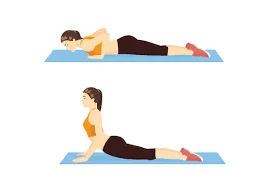
- To begin, lie on your stomach.
- Outside your shoulders, place your palms flat on the ground.
- Tuck your chin in and raise your head and chest by pushing with your palms as you inhale.
- Draw your shoulder blades together, bend your elbows, and return your head and chest to the floor as you exhale.
- Do this six times.
- Raise your head and chest once more while applying pressure with your palms. Inhale and hold for six breaths.
Child’s Pose:

- To begin, put your big toes together while kneeling straight.
- Inhale while raising both arms above your head.
- As you exhale, fold your hips forward, dropping your forehead toward the floor, stretching your arms forward on the floor in front of you, and bringing your pelvis back into your heels.
- Place your head against the floor after turning it to one side.
- Alternate which side you turn your head to as you repeat six times.
FAQs
What is the best exercise for upper cross syndrome?
Do a chin tuck while resting on your back. From this tucked posture, carefully raise your head three to four inches off the floor, bed, or other surface. After five seconds of holding this position, go back to the beginning. Start with 10 repetitions and work your way up to 20–30 times.
How long does it take to reverse upper cross syndrome?
Yes, the majority of cases improve in three to six months when postural exercises, tight muscle stretching, weak area strengthening, and spinal alignment correction are combined. Success rates are determined by consistency.
How long does it take to correct UCs?
Corrective exercises lasting eight weeks can help control upper-quadrant musculoskeletal issues in UCS by balancing muscular activity. Shoulder angles, hyperkyphosis, and forward head posture all significantly decreased in patients who exercised.
What muscles are weak with upper cross syndrome?
When you are bent over all the time, you develop upper-body cross syndrome. The upper trapezius and levator scapula muscles become strained and taut, whereas the muscles of the upper back, shoulders, and neck—especially the middle and lower trapezius muscles—tend to become long and weak.
Can you cure upper cross syndrome?
A more persistent slumped posture is the hallmark of upper cross syndrome. Additionally, it frequently causes stress and soreness in the shoulders, chest, and neck. Lifestyle changes can be beneficial, which is excellent news. You can retrain your posture and reduce upper cross syndrome pain with exercise.
References:
- What is Upper Crossed Syndrome? – 2023 – WebMD Editorial Contributor/www.webmd.com/a-to-z-guides/what-is-upper-crossed-syndrome
- Upper Crossed Syndrome – 2018 – Young/www.healthline.com/health/upper-crossed-syndrome
- Upper crossed syndrome exercises – 2023 – Turetsky, Turetsky/backintelligence.com/upper-crossed-syndrome-exercises/
- Yoga for Upper Cross Syndrome: 7 poses for fixing the slouch in your neck – 2023 – Passalacqua/breathingdeeply.com/yoga-therapy-for-that-darn-neck/