
Eka Pada Koundinyasana I (One-legged Sage’s Pose)
What is Eka Pada Koundinyasana I?
Eka Pada Koundinyasana I is a challenging pose that calls for both balance and body twisting. In this pose, the legs are separated in the final position, and the body is raised on the side of the upper arm.
The practice of Bakasana (Crane Pose) and Parsva Bakasana (Side Crane Pose) can help you develop the skills needed to practice this pose.
Meaning:
One of the poses named for the wise yogi Koundinya is Eka Pada Koundinyasana. Pada means foot, while Eka means one.
Kaundinya was a scholar in King Suddodhana’s royal court. After achieving enlightenment, he once foretells the birth of Siddhartha, who would go on to become the Buddha. Consequently, Eka Pada Kondinyasana leads practitioners to enlightenment.
Muscle Work During Eka Pada Koundinyasana:
- Biceps and Triceps Muscles
- Core Muscles
- Hamstring Muscle
- Hip Muscles
How to Perform?
- Begin by coming into a squatting stance and then turn on any side to face the side of the mat. Maintaining your ball-of-the-foot position, lean forward until your hands are flat on the floor.
- Position your feet so that your left knees are facing you. Then lean forward while maintaining an upright posture.
- Next, create a shelf by bending your elbows to a 90-degree angle and pressing into your palms at the same time.
- Then, place the side of your right knee on the shelf created with your left hand. Now, move your weight forward by elevating your feet to get ready.
- Now exhale to straighten your left leg and move your right leg forward. Throughout the pose, maintain your feet flexed and feel the stretch in your groin. Keep your eyes focused on the front.
- Return after a while by letting your palms relax and dropping your legs. Then repeat the same action on the opposite side.
Benefits:
- Enhances Sense of Balance: The legs and core muscles, which support your upright posture, are strengthened while you balance in this pose.
- Revitalize the digestive tract: Squeezing the sideways torso compressed the abdomen. As a result, the muscles of the digestive system receive more blood. Our food is massaged along the digestive tract as a result. Thus, the digestive organs are revitalized.
- Makes the spine stronger: In the Eka Pada Koundinyasana, twisting entails a little flexion and extension of the spine. This develops the muscles that support the spinal column, especially when combined with the mild weight-bearing of the upper body in this pose. Consequently, this enhances posture and encourages balance.
- Makes the Manipura Chakra Active:
When the torso twists and squeezes, the consistent practice of Eka Pada Koundinyasana awakens and stimulates prana flow at the naval area. As a result, the Manipura (Navel) chakra gets activated. is performed under the supervision of a qualified yoga instructor and combined with the right alignment and breathing methods. - Boost your standard of living:
Eka Pada Koundinyanasana improves cardiovascular and respiratory health by increasing muscular strength and body flexibility. Additionally, it improves general well-being and quality of life, aids in addiction recovery, and lowers stress, anxiety, depression, and chronic pain in addition to improving sleep patterns. - Enhances Upper Body Strength:
The Eka Pada Kondinyasana requires arm balance. The upper body is under tremendous pressure as a result. This enhances blood flow, which further ensures better growth of the local muscles and bones. This also improves posture, weight loss, strength, balance, and appearance.
Therapeutic Benefits:
Alleviates Lower Back Pain:
Eka’s Practice in Koundinyasana. Lower back discomfort can be prevented and alleviated by strengthening the lower back. Additionally, it fortifies the arm, leg, and core muscles. However, increasing blood flow to the injured area reduces back stiffness and speeds up the healing process.
Aids in Migraines and Headaches:
Endorphins, the body’s natural analgesics, are released as you perform Eka pada koundinyasana I. Additionally, it eases tension, which improves practitioners’ quality of sleep. Actually, the two things that cause migraines are stress and not getting enough sleep.
Beginner’s Advice:
- Because the posture requires a lot of strength and flexibility, beginners should avoid jumping right into it. Bakasana (Crane Pose) and Parsva Bakasana (Side Crane Pose) are good ways to warm up your body before doing this. This will facilitate the opening of the hamstrings, hips, and core before performing eka pada koundinyasana.
- Beginners who have a history of asthma or migraines should enter the posture slowly. Because Eka Pada Koundinyasana requires twisting the torso. Breathing may become challenging due to the constriction of the chest and abdomen. As a result, forcing the stance in any way is inappropriate.
- Maintain a 90-degree angle with your elbows. This will provide the position with steady stability. To keep the elbows from wobbling while in the posture, a strap can also be wrapped around them. This is the primary cause of the head hitting the ground as a result of losing equilibrium.
Preparatory Pose:
- Utthita Hasta Padangushthasana (standing Big Toe Hold)
- Hanumanasana (Monkey Pose)
- Parsva Bakasana (Side Crane Pose)
Variations:
Eka Pada Koundinyasana II (The Hurdler Pose):

This version of the Eka Pada Koundiyasana I has both legs spread apart and the body balanced on the palms.
From Chaturanga Dandasana, place one leg on the ridge of the corresponding side hand, stretch the other back, and bend your chest forward to enter this posture.
Eka Pada Galvasana (Flying Pigeon Pose):
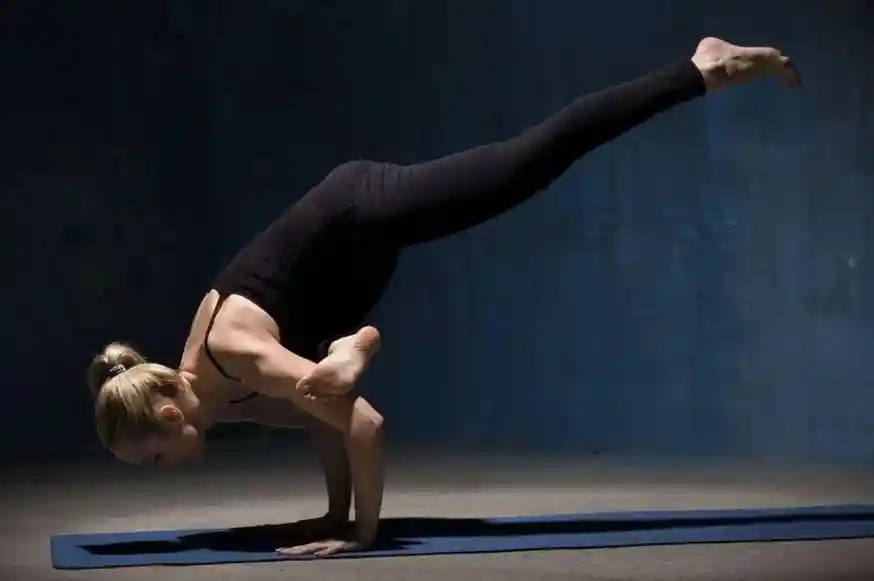
The upper body is positioned similarly to the base pose in the second form of Eka Pada Koundiyansana. Additionally, as you enter the pose, you must circle your lower back like in a cat stretch.
From chaturanga dandasana, one leg is extended backward, and the other is tucked under the torso on the ridge created by the opposing arm to enter this pose.
Precautions:
- As you raise your body in this position, make sure your elbows and shoulders line up to prevent your sternum from collapsing forward.
- Avoid jerking out of the pose: The twisted position causes the weight to be distributed unevenly on the palms, so avoid jerking back into it. Shoulder and wrist injuries could result from this.
- Avoid placing your knee solely on your elbows, as this could cause you to tumble off the set of folded legs and onto the floor. Instead, position your knee carefully on your elbows. Practitioners ought to maintain them on the ridge that forms or as high above the elbow as feasible. This guarantees that the pose is entered and exited correctly.
Conclusion:
For people of all ages who have a firm grip of hand balancing, the Eka Pada Koundinyasana is a powerful yoga pose that tones the upper body, stimulates the internal organs, and promotes a feeling of balance.
Because it’s a difficult pose, beginners don’t practice it directly. Before practicing posing, one should always warm up and pay attention to their physique.
FAQs
What is the meaning of Eka Pada Koundinyasana 1?
In Sanskrit, “Eka” means “one,” and “Pada” means “leg.” These terms describe how the body is aligned in the pose, with one leg extending to the side and the other behind. While “Asana” merely means “posture,” “Koundinya” honors the sage Koundinya, a significant figure in yogic writings and stories.
What makes Eka Pada Koundinyasana 1 and 2 different from one another?
You will begin at Side Crow to enter Eka Pada Koundinyasa 1. You will next reach your bottom leg straight out to the side and extend your top leg straight back. To stabilize, raise your chest and face front. With your left leg raised, begin Single Leg Downward Dog to enter Eka Pada Koundinyasa 2.
What are the benefits of Eka Pada Koundinyasana?
In addition to relieving headaches, anxiety, sleeplessness, and exhaustion, the pose is supposed to revitalize the body and mind. Uttanasana can aid in better digestion by rubbing the abdominal organs. It maintains the length and flexibility of the spine and its nerves.
Is Eka Pada Koundinyasana good for core strength?
The split-legged arm balance pose Eka Pada Koudinyasana 2 strengthens the legs, shoulders, and core. It is recommended to warm up with hip-opening positions prior to entering the pose because it also calls for open hips.
What are contraindications for Eka Pada Koundinyasana?
Any hip or lower back injuries should be avoided. Shoulder, arm, or wrist arthritis should be avoided. Arm balancing necessitates knowledge of the body’s range of motion and its limitations; hence, this position should not be performed before the body is prepared.
References:
- Eka Pada Koundinyasana I: Steps, Benefits, Precautions – Fitsri Yoga. https://www.fitsri.com/poses/eka-pada-koundinyasana-1
- One-legged Sage’s Pose Yoga Pose (Eka Pada Koundinyasana 1). Tummee. https://www.tummee.com/yoga-poses/Eka Pada Koundinyasana 1


