

15 Best Exercise for Wrist Pain
Introduction
Wrist pain is a very prominent condition. It can result from a variety of factors, including injury, repetitive movement, arthritis, and nerve impingement. It might trigger soreness or pain when typing, lifting, or picking up objects. The wrist is a complex joint with several bones, ligaments, and tendons, making it vulnerable to various injuries and disorders.
If you have wrist pain, it is critical to determine the source and get proper therapy. RICE (rest, ice, compression, and elevation) can assist with mild injuries, but more serious situations may require medical treatment.
Causes of wrist pain
Any cause of wrist pain can cause soreness or pain, reduce the range of motion in your wrist and hand, and reduce the strength of your wrist muscles. The injury may result from:
Arthritis:
- Osteoarthritis (Degenerative changes)
- Rheumatoid arthritis (Damage to joints)
Injuries:
- Sprains and Strains (Ligament tear)
- Fractures (Bone fractures)
- Dislocations (Accident)
- Repetitive Motion Conditions:
- Carpal Tunnel Syndrome (Compression of the nerve)
- Tendinitis (Inflammation of the tendon)
- De Quatrain’s Tenosynovitis
- Nerve-related Issues:
- Nerve impingement
Other Conditions:
- Ganglion Cysts (Development of a fluid lump along a tendon or joint, mostly in the wrist, foot and ankle)
- Kickback’s Disease
- Lipoma (Tumour)
Symptoms of Wrist pain
Wrist discomfort can present with many symptoms depending on the underlying cause. Here are some exact symptoms for particular conditions:
- Dull or severe pain in the wrist.
- Pain gets worse with movement or exercise.
- A throbbing feeling with repeated usage.
- Significant swelling at the wrist joint.
- Redness, especially in the context of inflammation or sickness.
- Decrees the range of wrist joints.
- Stiffness (Mostly seen in the morning).
- Decrease the endurance of the wrist muscles.
Exercise for wrist pain
Wrist flexors stretch

- Position: Sitting or supine
- Flex your wrist downward, and keep your hand and thumb straight.
- You will feel the stretch.
wrist extensor stretch

- Position: Sitting or supine
- Turn your palm down toward the floor.
- Extend your wrist downward.
- Your forearm should feel mildly to moderately stretched.
Weighted wrist extension

- Position: Sitting
- Hold the dumbbell with your weekend hand.
- Slowly do the wrist extension with weight, and then relax.
- Do three sets of ten repetitions.
Tendon glides
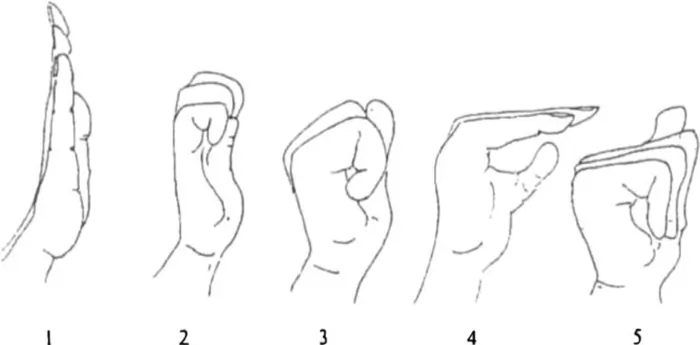
- Position: Sitting
- Raise your hand in a high-five posture.
- This exercise utilises the metacarpal, carpal, distal, and proximal phalanges.
- Hold the bent position for five seconds.
- Return your fingers to the initial position.
- Do three sets of ten repetitions.
Weighted wrist flexion

- Position: siting
- Hold the dumbbell with your weekend hand.
- Flexed your wrist upwards, then straightened.
- Gradually increase the weight of the dumbbell that you’re carrying.
Wrist radial deviation strengthening

- Position: sitting (keep a rolled towel under the wrist)
- For example, if you’re exercising your right hand, make sure the palm is pointing left.
- Holding a 200 g weight cuff or dumbbell, raise your wrist upward and then lower it again.
Finger spring

You require an elastic loop and wrap it.
Do finger movements with enough pressure (against the rubber band to stretch it)
Do two sets of ten repetitions.
Opposition stretch

- Position: Sitting or supine
- Place your hand on the surface.
- Make contact between the tips of your thumb and pinky fingers.
- Hold the stretch for six seconds.
- Return your fingers to their original positions.
- Repeat the manoeuvre ten times.
Grip strengthening

- Position: Sitting
- To do grip-strengthening exercises, you will need a rubber ball to hold in your hands.
- Squeeze the ball and hold the squeeze. Do three sets of ten repetitions.
- Stick to three times each week to have enough recovery and avoid overtraining,” he recommends.
Prayer Stretch

- Position: Sitting position or standing position
- Apply pressure gradually with your palm while keeping your hand straight.
- The shoulder should be relaxed
- The elbow is 90 degrees flexed.
- Your eyes should be closed.
- Hold for 15–30 seconds.
- Perform two to four repetitions.
Median Nerve Glide

- Position: Sitting
- 90-degree shoulder abduction with wrist flexion.
- At the same moment, tilt your head towards the opposing shoulder. Pause for a few seconds.
- That’s one rep. Complete all repetitions, then swap hands.
Ulnar Nerve Glide

- Position: Sitting
- The patient’s arm should be at 90 degrees, and the patient should keep his arm on his head.
- Hold your arm out to the side, forearm at 90 degrees, and the patient’s palm facing up.
- At the same moment, tilt your head toward the opposing shoulder. Stop for a few seconds.
- That’s one repetition.
Radial Nerve Glide

- Position: Sitting
- Turn your wrist toward the ceiling behind you.
- Tilt your head left.
- At the same moment, tilt your head towards the opposing shoulder. Pause for a few seconds.
- That’s one rep. Complete all repetitions, then swap hands.
Reverse Prayer Stretch

- Position: sitting
- Apply pressure with your palm and maintain your hand straight.
- The patient’s shoulder should be relaxed, elbow should be 90 degrees flexed.
- Keep your hands together and slowly pull them down toward your tummy.
Finkelstein Stretch

- Position: sitting position
- Make a fist with your arm 90° abducted.
- Patients should move first downward direction so they can feel the stretch outer aspect of the wrist.
- Hold, then repeat with the opposite hand for one set.
Risk factors
- Sports commitment: Wrist injuries are frequent in a variety of sports, including those involving contact and repeated wrist stress. Football, bowling, golf, gymnastics, skiing, and tennis are examples of such activities.
- Repetitive work: When you do repetitive activities, your wrists and hands must be involved. Even crocheting and cutting hair, if done firmly and frequently enough, can cause substantial wrist pain.
- Specified conditions or disorders: Carpal tunnel syndrome of the wrist occurs in such conditions as pregnancy, diabetes, obesity, rheumatoid arthritis, and gout.
Prevention
Improve ergonomics:
- Adjust your workstation: To decrease typing strain, use a wrist pad or an ergonomic keyboard.
- Maintain proper posture: by keeping your wrists in a neutral position when working or using electronics.
- Use supporting tools: Consider braces or splints if you do repeated tasks.
Strengthen and stretch:
- Stretching: Wrist flexors and extensor stretches help maintain the elastic properties of the wrist muscles and increase the range of motion. Frequent mobility exercises can improve the patient’s muscle strength.
Grip training:
- Wrist muscle strength: may be maintained by gripping and strengthening exercises.
- To reduce repetitive strain: Take regular rests and avoid extended wrist activities.
- Alternate hand movements: To avoid overuse, replace hands or change the actions.
- Modify techniques: To minimise tension, change how you handle items or perform tasks.
Lifestyle Adjustments:
- Maintain a healthy weight: Excess weight might cause joint tension throughout.
- Stay hydrated: Proper hydration promotes joint health.
- Avoid excessive strain: Be careful of activities that can overexert your wrist.
Use protective measures:
- Wear wrist supports: When participating in sports or hard work, wrist protectors can help avoid injuries.
- Warm up before activities: Strengthen your wrist muscles to deal with unexpected tension or pressure on the muscles. Avoid prolonged pressure: Avoid resting your wrist on rough surfaces for lengthy periods.
How can wrist pain be identified?
A doctor may also use the following methods to identify wrist pain and the underlying problem following a physical examination and evaluation of symptoms:
- Medical imaging scans: X-ray, CT, and MRI scans are among the imaging tests that a physician may request.
- Arthroscopy: A small incision is made on the wrist during this surgery. A surgeon will subsequently implant a tiny camera attached to a small gadget via the incision. The pictures produced will enable medical specialists to evaluate and pinpoint the source of wrist pain.
- Studies on nerve conduction: quantify the speed at which nerve impulses go through the hand, wrist, and forearm.
Orthosis for wrist pain
- Wrist Sleeves:
Targeted support from a wrist sleeve helps the body’s natural healing process while diminishing pain and inflammation.
Sleeves, such as the Incredible Wrist Sleeve, are constructed of breathable, moisture-wicking fabric and are used to increase blood flow, relieve pain, and minimise swelling. - Wrist Wraps:
Using Velcro straps, wrist wraps provide customisation support and are simple to put on and take off.
In order to promote scar development, absorb stress, and reduce pain, it also has a moulded gel pad that is infused with vitamin E mineral oil. - Rigid Wrist Braces:
The best amount of immobilisation and support is provided by rigid wrist braces. For further support and mobility limitation, they usually have a hard plastic or metal component (stays) incorporated within a supporting fabric. - Thumb Stabiliser Brace:
The thumb stabiliser brace was designed to immobilise the thumb after an injury (base of the palm), allowing you to move all of your fingers effortlessly. Typically, it is utilised for thumb conditions.
A thumb brace effectively relieves pain and offers stability without getting in the way of daily tasks.
Indications for wrist orthosis
- Rheumatoid arthritis
- Carpal tunnel syndrome
- Wrist immobilization
- Distal radius fracture
- Strain or sprain
- Tendonitis
- Cast healing
- Gamekeeper’s Thumb
A Note from Home Physiotherapy Exercises
Wrist pain occurs in people’s daily routines or activities. So don’t panic. You should contact a doctor and then acquire a good pain relief strategy. Painkillers and exercise were used to treat wrist pain (exercise for wrist muscle mobility and strength). In this article, we described the best and most beneficial exercises for wrist pain.
FAQs
How do you get rid of wrist pain?
How to relieve yourself of wrist pain
Take Rest
For swelling = Ice pack
Gentle wrist exercise
For support, you can add an orthosis
What deficiency causes wrist pain?
Chronic pain can be caused by two separate yet frequent clinical manifestations: vitamin D insufficiency and carpal tunnel syndrome (CTS). The purpose of this study was to assess the relationship between electrophysiological data and pain severity in individuals with mild CTS and 25 (OH) D insufficiency.
The best exercise for wrist pain
Wrist pain exercises include:
Passive wrist movement: Wrist flexion, Wrist extension, wrist rotation
Wrist flexors stretch
Wrist Extensor stretch
Ball squeeze
Gripper strength
Wrist curls
Can vitamin B12 cause wrist pain?
The most typical signs of vitamin B12 insufficiency are muscular weakness and neuropathy symptoms (tingling and numbness). It may manifest as pain, tingling, numbness, loss of sensation, reduced motor function, or decreased muscle mass, depending on the kind of nerve associated.
What are the best home remedies for wrist pain?
Rest: Avoid any activities for a period.
Cold and heat therapy: Depending on your preferences, you should use heat or cold compression.
Massage: a gentle massage using oil or lotion. Reduce stiffness and improve blood circulation.
Take painkillers.
Is wrist pain serious or not?
Wrist pain can be significant, but not usually; it is determined by the reason, severity, and duration of the pain. If you notice pain, irritation, or a limited range of motion around your wrist joint. So it’s not serious. If there is a fracture, a history of falls, or a deformity, the condition is deemed serious.
How to massage wrist pain?
To massage wrist pain, begin by making circular strokes with your thumb or fingers, focusing on the wrist joint and surrounding regions. You may also use your knuckles or the side of your hand, depending on which feels more comfortable. After warming up the wrist, you may apply slightly deeper pressure to the joint region. Remember to move the wrist in all directions (flexion, extension, radial and ulnar deviation) and in circular motions to enhance mobility and pain relief. Massage the surrounding forearm and hand muscles.
Reference
- Zynex Medical. (2024, August 20). Wrist brace | Wrist and hand orthosis | Zynex Medical. https://www.zynex.com/products/zynex-pro-wrist-brace/
- Wrist pain – Symptoms and causes. (n.d.). Mayo Clinic. https://www.mayoclinic.org/diseases-conditions/wrist-pain/symptoms-causes/syc-20366213
- Cluett, J., MD. (2025, April 21). Wrist Pain Causes and How It’s Treated. Verywell Health. https://www.verywellhealth.com/wrist-pain-causes-symptoms-and-treatments-2549458
- Writer, O. (2024, September 3). How to choose the best wrist brace for your needs. Orthopedic Outfitters. https://orthout.com/blogs/news/wrist-brace-guide
- De Pietro Crt, M. (2023, December 21). Why does my wrist hurt? https://www.medicalnewstoday.com/articles/312070#ganglion-cyst
- Professional, C. C. M. (2024, October 21). Wrist pain. Cleveland Clinic. https://my.clevelandclinic.org/health/symptoms/17667-wrist-pain
- Clinic, C. (2025, April 22). 11 Exercises and stretches for wrist pain. Cleveland Clinic. https://health.clevelandclinic.org/wrist-pain-exercises
- Pt, B. S. (2024, November 5). 7 simple wrist strengthening exercises. Verywell Health. https://www.verywellhealth.com/wrist-strengthening-exercises-2696622
- Baum, I. (2020, August 19). A 20-Minute Kettlebell arm workout. Livestrong.com. https://www.livestrong.com/article/13728081-20-minute-kettlebell-workout-arms/


