Back Strengthening Exercises Using Resistance Bands
Introduction
Resistance band back strengthening exercises are a great way to improve your posture, build muscle, and relieve pain from home. They are flexible, lightweight, and easy on your joints. These exercises keep the tension constant, which works the lats, traps, and posterior deltoids better than just lifting weights.
Muscles worked during Back Strengthening Exercises
The latissimus dorsi (lats) are located below your armpits along the sides of your back; the rhomboids are located in the mid-upper back; the trapezius (traps) are located from your neck to your mid-back; and the erector spinae are located along your spine.
Back Strengthening Exercises Using Resistance Bands
Resistance band pull-apart
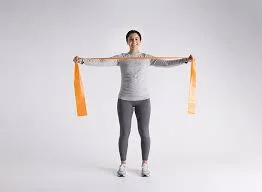
Why it’s on the list: The resistance band pull-apart is an easy yet powerful exercise to start your back workout. Select a resistance band that will enable you to perform 1-2 sets of 15–20 repetitions with proper technique.
Worked muscles: This exercise primarily involves putting your shoulder blades together, called scapular retraction. This aids in strengthening the trapezius, rear deltoids, and rhomboids, among other upper back muscles.
By strengthening the stabilizer muscles surrounding your shoulders, such as the rotator cuff, retraction exercises also contribute to better shoulder health.
Instructions:
Put your arms out in front of you. Using both hands, hold a resistance band stiff in front of you so that it is parallel to the ground.
Pull the band to your chest by extending your arms to the sides while maintaining a straight posture. Squeeze your shoulder blades together, start the exercise from your mid-back, and maintain a neutral spine. Repeat after slowly returning to the beginning position.
Do 1–3 sets of 8–12 repetitions.
Lat pulldown

Why it’s on the list: One of the most basic exercises for developing a strong back is the lat pulldown. A lat pulldown can be performed with a resistance band or on a machine in the gym.
Worked muscles: Lat pulldowns primarily target the latissimus dorsi, a major muscle in the center and lower back. The trapezius, rotator cuff, posterior deltoids, rhomboids, biceps, and forearms are also worked during this exercise.
Instructions:
Place the pad so that it touches your thighs if you’re using a machine. Rise to your feet, grasp the bar with your hands wider than shoulder-width apart, and then return to your seat.
Bend your elbows and direct them toward the floor as you start to pull the bar down toward your chest. Throughout the exercise, use your mid-back and upper back. Don’t let yourself recline; instead, maintain a straight torso.
Perform 1–3 sets of 8–12 repetitions.
Seated row
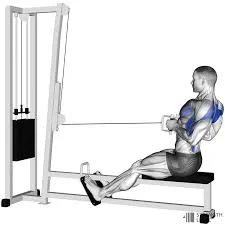
Why it’s on the list: Seated rows help develop a strong back by keeping your muscles tense throughout the entire workout.
Worked muscles: This exercise is excellent for strengthening your rhomboids and latissimus dorsi. Other muscles like the biceps and trapezius will also be targeted.
Instructions:
Make sure the handles on the cable row seat are at chest height.
Place your feet flat on the ground or on the foot supports while sitting upright.
Take hold of the handles and extend your arms in front of you.
Squeeze your shoulder blades and pull your elbows back to pull the handles closer to your chest. Elbows should remain close to the torso.
Move slowly and deliberately back to the beginning position.
Do 1–3 sets of 8–12 repetitions.
Bent-over row
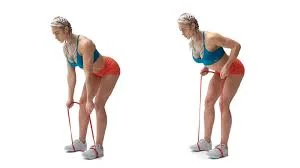
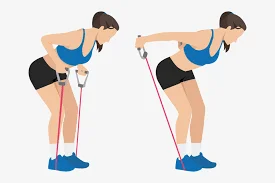
The best way to complete a bent-over row, an exercise suitable for all fitness levels, is with a band with handles. During this exercise, you will concentrate on the lats, traps, and a few other smaller muscles, such as the rhomboids.
To perform:
Grasp the resistance band’s handles, place two feet on the band, and then cross the handles.
With your arms outstretched and your knees slightly bent, hinge at the hips at a 45-degree angle.
Pull your elbows up and back toward the wall behind you while maintaining a neutral spine. Use your lats for moving the exercise.
Release back to begin after waiting at the top, being careful not to open your chest.
Reverse fly
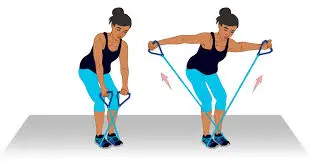
Use your hand-held band to target your rhomboids with a reverse fly. This move is beginner-friendly and can be scaled as you go because you can simply change your resistance.
To perform:
Place your feet shoulder-width apart as you stand. With your arms extended and in front of you, grasp the handles of your resistance band.
With your arms outstretched and your upper-mid back muscles leading the way, contract your core and pull the band apart.
Return to the beginning when your arms are straight out to your sides.
Deadlift

Although it’s not for beginners, deadlifting with a superband is a unique option for the exercise.
You’ll strengthen your traps and lower back muscles, but make sure your hamstrings are engaged during the exercise to avoid overstressing your lower back.
To perform:
Place a superband on the ground and place both feet shoulder-width apart on it.
Hinge at the hips, bend the knees, hold the band with each hand, and stand upright while maintaining a straight back. Roll your shoulders back and down while standing.
Once more, descend while maintaining a neutral spine and a stationary upper body, hinging at the hips and slightly bending the knee.
To begin and repeat, get back up.
Single-arm row

A single-arm row with bands can be performed in a variety of ways, but anyone of any fitness level can perform it simply and easily by using their foot as an anchor. Get your hand-held band and finish it.
To perform:
Holding one handle in your right hand while letting the other drop to the floor, place both feet on your band. Step back with your left foot.
Allow your extended right arm to drop while pulling at the hips.
Using your lat, raise and lower your bent elbow as you pull your working arm into a row.
Repeat after extending your arm downward. Switch arms once you’ve completed the required number of repetitions.
FAQs
How do you strengthen a weak back?
To make a weak back stronger, you need to do gentle exercises that work the core, glutes, and lower back muscles on a regular basis. Some examples are bridges, bird-dogs, knee-to-chest stretches, and pelvic tilts. Do these 3 to 5 times a week, focusing on form over intensity to improve stabilization, avoid injury, and ease daily stress.
Important Back Exercises to Make It Stronger
Bird Dog: Get on all fours and stretch one leg back while reaching forward with the other arm at the same time. To avoid dipping, keep your spine straight.
Pelvic Tilts: Get on your back with your knees bent. Tilt your pelvis up a little to tighten your stomach muscles and flatten your back against the floor.
Knee-to-Chest: Lie on your back and gently pull one or both knees toward your chest to stretch your lower back.
Superman: Lie on your stomach and lift your arms and legs off the floor at the same time. This will work your lower back and glutes.
Modified Side Plank: Get on your side with your elbows under your shoulders and your knees bent. To strengthen the muscles on the sides of your back, lift your hips so that there is a straight line from your head to your knees.
Important Tips for a Healthy Back
Strengthen the Core: A strong core supports the front end, which takes some of the weight off your back.
Better posture: Don’t slouch; keep your spine straight.
Lift Safely: Use your leg muscles (with your knees bent) instead of your back muscles when you lift.
Stay Active: Walking every day keeps your back muscles in shape.
Support Sleep: Put a pillow under your knees if you sleep on your back or between them if you sleep on your side to ease the strain.
What is the 3-3-3 rule in the gym?
The 3-3-3 rule is a simple, long-lasting, and very effective way to train that helps people stay consistent and feel less scared. It’s popular with both beginners and busy people. It helps you stick to a routine by having three workouts a week, three exercises per session, and three sets per exercise.
Here are some common uses of the 3-3-3 rule:
Minimalist Split (Strength Focused): Three times a week, you do only three compound movements, such as squats, push-ups, and rows.
Circuit Method (Focus on Efficiency): Doing three sets of three exercises in three rounds to make the most of your time.
Full-Body Routine: A routine that usually includes three sets of compound movements, like three sets of Chest Press, three sets of Pull Downs, and three sets of Rows, to work a lot of different muscle groups.
Weekly Schedule: 3 days of strength training, 3 days of cardio, and 3 days of rest or active recovery (like walking or yoga). The 3/3/3 definition can change to include 3 days of complete rest.
Similar Words and Phrases:
3×3 Exercise
Training with a minimalist approach
Routine 3-3-3
Structure of 3-3-3
The 3-3-3 Rule has these benefits:
Sustainability: It cuts down on fatigue because it’s not too hard.
Efficiency: Makes workouts that are quick and effective.
Beginner-Friendly: Gives a clear structure without needing a lot of knowledge.
What causes a weak back?
Absence of exercise. Sedentary lifestyles result in low mobility, weak muscles, and incorrect posture. Lower back discomfort is a result of all of these symptoms. Your back, hips, glutes, and core muscles are unable to properly assist your spine when they are weak.
Is 3 hours at the gym ok?
Suggests two strength training sessions and 75–150 minutes of aerobic activity per week. That equates to around three hours of exercise per week, assuming the strength training sessions last 20 minutes each.
How to tell if a muscle is overtrained?
Typical indicators of overtraining consist of:
chronic joint pain and muscle soreness. reduced stamina, strength, and speed. increased blood pressure, heart rate, and even palpitations at rest.
What organ affects the lower back?
The kidneys, colon, appendix, liver, gallbladder, pancreas, and reproductive organs are among the organs that may cause lower back pain.
What weakens your back?
Many harmful health problems are linked to prolonged sitting. Your lower spine is put under additional strain when you spend hours bent over a desk, car seat, or couch. It weakens the core muscles that support your back and tightens your hip flexors.
What happens when your back muscles are weak?
Pain and discomfort are more likely to occur in back muscles that are deconditioned. Weak muscles may find it difficult to maintain the spine enough, which puts more strain on the surrounding tissues, such as the ligaments and vertebral discs.
How to tell if your back is weak?
People with a weak or strained back often have pain in the lumbar region that is dull or sharp, stiffness, a limited range of motion, and trouble standing up straight. Muscles may spasm or feel tight, especially if you haven’t been moving around or lifted something the wrong way. Pain may spread to the buttocks or legs, and it may also cause numbness or tingling.
Signs that your back is weak
Pain Characteristics: A dull, aching pain in the lower back or a sharp, stinging pain that gets worse when you move.
Stiffness: Trouble moving, walking, or straightening the back, especially after sitting for a long time.
Muscle spasms are strong, uncontrolled contractions of the muscles.
Problems with posture: not being able to stand up straight, which causes a bent or “crooked” posture.
Radiating Pain: Pain that travels down to the glutes, legs, or toes, which usually means that nerves are involved.
Weakness in the muscles: numbness, tingling, or weakness in the legs or feet.
When to Get Medical Help Right Away
If you have back pain and any of the following, call a doctor:
Not being able to control your bladder or bowel movements (incontinence).
Feeling numb in the groin or “saddle” area.
Leg weakness that comes on suddenly and is very bad.
Pain that comes from a bad fall or accident.
Weight loss or fever that can’t be explained.
What sleeping position helps L4 L5?
Lying on your side with your knees supported by a pillow
The pillow between your knees is an essential component of this pose. It helps maintain appropriate spinal alignment and lessen lower back pain.
Which body type is hardest to gain muscle for?
In contrast to endomorphs, ectomorphs frequently find it difficult to gain muscle and weight. This body type is frequently called a “hardgainer” due to the difficulties involved in gaining muscle.
What are the signs of overtraining muscles?
Muscle pain and stiffness.
Unexpected weight loss or weight gain.
Anxiety.
Poor sleep, or waking up feeling tired.
Getting sick more often with minor issues like colds.
References
- Author: Michelle Kenway, Pelvic Floor Physiotherapist. (2019, July 8). 4 Upper back strengthening exercises with resistance tubes. Pelvic Exercises. https://www.pelvicexercises.com.au/back-strengthening-exercises/?srsltid=AfmBOopcWWqI7TwkXe99vbG_lZj1vqnTtXFdBCTnchJHzVmnT636AnSY
- Blanton, K. (2025, October 27). 7 Resistance band back exercises trainers say actually work. Prevention. https://www.prevention.com/fitness/workouts/a69159596/back-exercises-with-resistance-bands/
- Davis, N. (2021, June 9). 10 Back Exercises with Bands to Counteract Work-from-Home Posture. Healthline. https://www.healthline.com/health/fitness/back-exercises-with-bands
- Markos, H. (2026, March 13). Resistance bands. British Heart Foundation. https://www.bhf.org.uk/informationsupport/heart-matters-magazine/activity/resistance-bands
- Pilon, R. (2023, July 12). 12 best back exercises with resistance bands (+ sample workout). GYMREAPERS. https://www.gymreapers.com/blogs/news/back-exercises-with-resistance-bands?srsltid=AfmBOopMlr1_Pqp3Fm8p1RG7pt74EKx0AkiaHF-oLAIqpmJhY5dbHrQ-
- Straight-Arm Pulldowns. (n.d.). [Video]. Hingehealth. https://www.hingehealth.com/gb/en/resources/articles/resistance-band-back-exercises/