10 Best Lower Abs Exercises for Core Strength at Home
Introduction
Maintaining a strong core is important because it helps stabilize your entire body, strengthens your lower back, and boosts your posture. Since the core is the starting point for almost all bodily motions, strengthening these muscles will improve your range of motion and help prevent injuries when performing daily tasks.
Of course, some people struggle to achieve their six-pack targets but want washboard, flat abs for cosmetic reasons. It’s important to vary your practice because standard crunches are insufficient to obtain complete definition.
Some people attempt to target the lower abdominal region, sometimes known as the “lower abs,” with training. However, you can’t always isolate the “lower abs” during a workout because they’re not a muscle group. The rectus abdominis, a muscular sheath that extends from the bottom of the rib cage to the pubic symphysis, is essentially the lower portion of the abdomen. The entire rectus abdominis muscle, not just the top or lower ends, is worked when you work it.
However, you may still push yourself by training the rectus abdominis in various ways, as well as the other three abdominal muscles: the deep transverse abdominis, the internal, and external obliques. Exercises for the legs and hip flexors may fall under this category. You may notice an increase in activity in the lower abdomen when performing these exercises.
Start with these ten exercises that strengthen your entire core while focusing on the area.
What are abdominal muscles?
Your abdominal muscles are situated in the front of your body, between your pelvis and ribs.
Strong bands of muscles called abdominal muscles line the walls of your abdomen, which is your body’s trunk. They are situated between your ribs and pelvis, in the front of your body. Your abdominal muscles support your trunk, facilitate movement, and hold your organs in place, among many other vital functions.
The two vertical muscles are:
Rectus abdominis.
This pair of muscles runs from your ribs to the front of your pelvis on either side of the center of your abdomen. The linea alba muscle divides them into two pieces. When someone has a trim, fit abdomen, or “abs,” the rectus abdominis may develop bumps that are frequently referred to as a “six-pack.”
Pyramidalis.
This is a tiny, triangle-shaped vertical muscle. It is situated at the base of your pubic bone. It connects to your linea alba and rests in front of your rectus abdominis. Maintaining internal pressure in your abdomen is aided by your pyramidalis. Twenty percent of people lack the pyramidalis muscles.
The three flat muscles are:
External obliques.
Two muscles on either side of your rectus abdominis are called the external obliques. They are located at the bottom of the stack and are the biggest of the flat muscles. They travel from your body’s sides to the center. Your trunk can twist from side to side thanks to your external obliques.
Internal obliques.
Just within your hip bones, on top of your external obliques, are a pair of muscles called internal obliques. Compared to your external obliques, they are considerably smaller and thinner. They go from the sides of your trunk toward the middle of your rectus abdominis, just like your external obliques. They enable you to twist and turn your trunk by working with your external oblique muscles.
Transversus abdominis.
Layered on top of your internal obliques, your transversus abdominis is the deepest of the flat muscles. These muscles support internal abdominal pressure and trunk stability.
What are the functions of your abdominal muscles?
Your abdominal muscles perform several crucial functions:
- Maintain constant internal pressure in your abdomen while keeping your trunk stable. These muscles control pressure as necessary, such as during breathing, bowel movements, coughing, vomiting, and birthing.
- Aid in the mobility of your body between your pelvis and ribs so that your trunk can move continuously. When you walk, sit, stand, or twist from side to side, this helps support your trunk and spine.
- Protect and hold your inside organs in place. Your stomach, intestines, pancreas, liver, gallbladder, and other organs fall under this category.
- Keep your posture straight and support your core.
Lower Abs Exercise
V-Sits

The V-sit ab workout challenges your balance while strengthening several parts of your core. This workout involves lifting your torso off the ground and extending your legs upward to make a V shape with your body.
If you’re a beginner, you can adjust this exercise by performing a knee tuck by bending your legs slightly at the knee or using your hands for support.
- Step-by-Step Instructions
- Start by sitting with your hands and feet on the ground.
- Make a 45-degree angle with your body by slowly raising your legs to an extended posture while clenching your core.
- As long as it is comfortable for your body, extend your arms straight forward or up toward your shins. Throughout the exercise, be sure to keep your shoulders from rounding and to maintain a strong spine and proper core posture. Holding your breath is normal, but don’t forget to breathe.
- Hold this position for a few seconds until your body starts to fatigue. You will be able to maintain the position for longer as you get used to the movement.
- Maintaining the strength of your abdominal muscles, carefully return to your starting posture.
- Before letting your body fall to the ground, pause and maintain the pose for a few seconds.
- Do this 20–25 times.
Reverse Crunches

A variation on the classic abdominal crunch exercise is the reverse crunch. As you tense your abs and bring your legs closer to your chest, your upper body stays on the mat.
This exercise works the entire rectus abdominis muscle, targeting the difficult-to-reach lower abs. This exercise is an excellent complement to any core training because it only requires body weight.
- Step-by-Step Instructions
- As you lie face up, bend your knees and stack your legs above your hips to create a tabletop position. Bend your elbows so they point out to the side with your hands behind your head, or place them on the floor next to your torso for more support. To raise your shoulders off the ground, contract your abs. This is where you will begin.
- Pull your knees in toward your chest and gradually raise your hips off the ground while keeping your abdominal muscles taut.
- Return your legs and hips to the beginning posture with caution.
- Do this 20–25 times.
Pilates Scissors
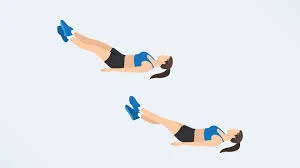
This Pilates scissors exercise is excellent for working the obliques, as well as the upper and lower abs best workout. Your hip flexors and hamstrings will also be well-stretched by the crisscross motion.
- Step-by-Step Instructions
- Place your feet on the floor and begin on your back with your knees bent. Take a deep breath and press the backs of your arms and shoulders against the mat.
- To create an upside-down position with your body’s weight resting on your shoulders, pull your knees toward your chest and lift your hips off the mat. With your elbows directly below your hips, place your hands on the back of your pelvis.
- Keep your legs together while you extend your hips and legs. As you sustain yourself in this inverted position, picture yourself extending your body.
- Make sure your chest is open, and your neck is long. If you must adjust, lower your shoulders so that the backs of your upper arms can provide more support.
- Make a scissoring motion with your legs as you spread them apart. Keep the overhead leg from being overextended.
- Pulse the legs twice while they are open, then swap them. Don’t forget to maintain a stable pelvis.
- For each set, perform the scissor motion six times.
Double Leg Lifts
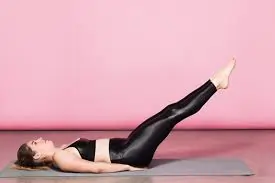
Your hip flexors and upper and lower abdominal muscles are worked in this complicated double-leg raise exercise. Additionally, you’ll work the muscles in your buttocks (gluteal) and front of your thighs (quadriceps).
In order to perform this exercise correctly, you must inhale deeply toward your sides and back.
- Step-by-Step Instructions
- Start by extending your legs toward the ceiling while lying flat on your back. Point your toes while rotating your legs slightly, keeping your heels together. Make sure your chest is open, and your elbows are broad while keeping your hands behind your head.
- Take a deep breath. Pull your abdominals to the floor as you exhale. You will curl your upper body off the floor and press your lower back into the mat. This is where you start.
- Lengthen your legs from your hips and slowly drop them while keeping your back pressed against the mat and your abdominals drawn in. You can drop the legs in three steps as a modification. Recall that it should take longer to lower than to lift.
- Pause after lowering your legs as far as you can without losing alignment.
- Keeping your abs taut, exhale and raise your legs straight.
- Make sure your chest is open and your elbows are wide by checking your posture.
- Do this exercise six or eight times.
Bicycle Crunches

The bicycle crunch is a good way to work the obliques and lower abdominal muscles. All you need for this basic activity is an exercise mat.
Throughout the entire workout, you are using your deep ab muscles because your legs are lifted.
- Step-by-Step Instructions
- Start by placing your hands behind your head with your elbows bent and pointing out to the sides while lying face up with your legs in a tabletop position. Use your abs to lift your shoulders off the floor. Here’s where you begin.
- Straighten your right leg while twisting your body to bring your right elbow to your left knee.
- Next, raise your left elbow to your right knee by twisting and straightening your left leg.
- You may feel your abs working when you move slowly, focus on the muscle, and manage the twist.
- Aim for three or four sets of fifteen to twenty repetitions.
Bird-Dogs

The bird-dog is a bodyweight exercise that works the glutes, lower back, and abdominal muscles. Since you will be using your own body weight as resistance during the exercise, all you need is a mat.
Anywhere there is a comfortable spot for your hands and knees and a little additional space to extend your arms and legs, you can perform bird-dogs.
- Step-by-Step Instructions
- Start with your hands pressed against the mat about shoulder-width apart and your knees hip-width apart. Tighten your abdominal muscles.
- Lift one hand and its opposing knee about an inch off the ground while balancing on the other hand and knee to obtain a sense of the motion. Put your weight on the center.
- Stretch one arm straight in front of you and the other leg behind you once you feel stable enough for a full range of motion. Your hips should be square, and you should try to create a straight line from your hand to your foot. To keep your lower back from drooping, contract your abs.
- After a few seconds of holding this position, get back to your hands and knees. Change sides.
- Throughout the entire exercise, keep your abdominal muscles active. Steer clear of leveraging momentum to finish the reps; slow down as necessary to keep your technique correct.
- Perform ten repetitions every set, five on each side. Aim for a total of three sets.
Dead Bugs

Its unique name, the dead bug exercise, is a great way to strengthen your core. You can practice this bodyweight exercise while lying on your back with just a mat.
In order to challenge your stability by keeping your body from rocking back and forth, you will stretch and retract your opposing arms and legs while keeping your chest motionless, and your abdominal muscles clenched.
- Step-by-Step Instructions
- Make a perpendicular angle with your body by extending your arms straight above your chest while lying flat on the mat. Raise your feet off the floor by bending your hips and knees 90 degrees. Next, make a straight angle between your thighs and shins and between your torso and thighs. This is where you start.
- Maintaining your lower back pressed into the mat, tighten your core. Throughout the exercise, make sure your spine remains neutral and stable.
- Next, extend your right knee and hip at the same time as you extend your right heel toward the floor, slowly reaching your left arm above your head and toward the floor. Take calm, deep breaths as you extend. Steer clear of twisting or moving your hips and abs. Just before your arm and leg touch the ground, stop moving.
- Return your right leg and left arm to their initial positions to switch the exercise.
- As you exhale, move slowly.
- Apply the identical motions to the opposing sides, extending your right arm and left leg while maintaining their stability.
- Three sets of five to ten repetitions on each side should be your goal.
Mountain Climbers

Mountain climbers are performed from a plank posture by raising one leg to the chest and then lowering it again, accelerating each time. You will feel as though you are running against the ground during the activity. This exercise gives your workout a cardiac boost and trains almost every muscle group in the body.
- Step-by-Step Instructions
- Start with your hands shoulder-width apart (or wider), your shoulders stacked over your wrists, and your palms flat on the floor in the high plank position.
- Your core will be active while your legs are extended.
- Bring your right knee to your chest while tightening your core.
- Bring your left knee to your chest as soon as you return to the beginning position.
- Repeat this action in an alternate pattern while moving quickly.
- To engage your core, keep your back flat and avoid curving it. Moving more slowly is OK if you want to keep good form.
- To engage the oblique muscles, this exercise can also be done with a twist version.
- Aim for 15 to 20 consecutive mountain climbers if you’re just starting. For more experienced individuals, aim for sets of 25 to 30.
Pilates Hundred
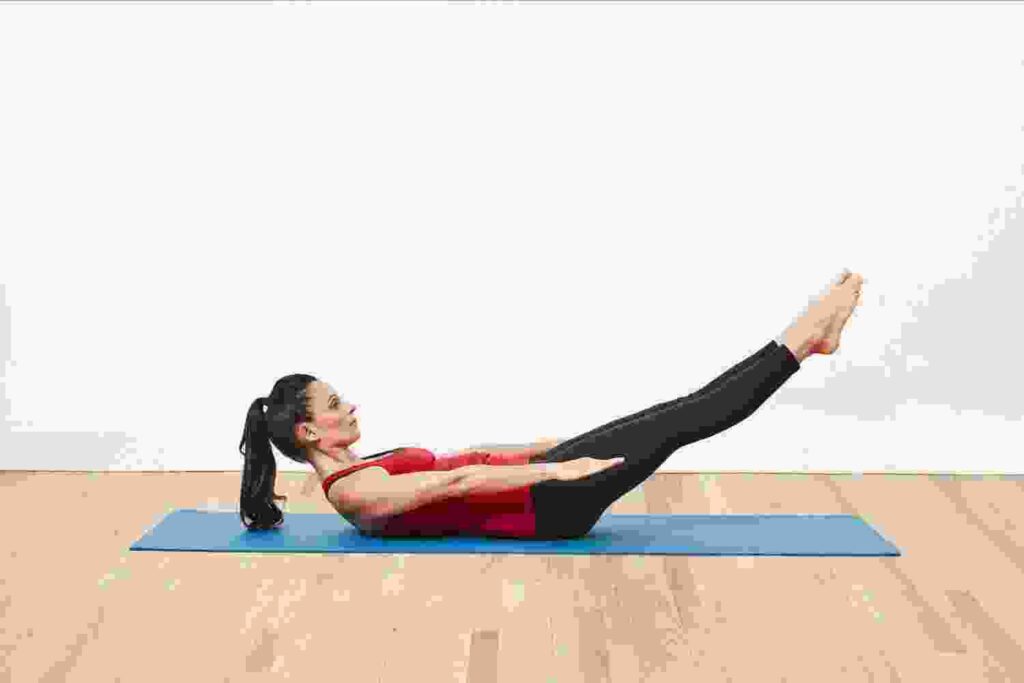
The name of this traditional Pilates hundred exercise comes from the 100 arm beats you will make throughout the set. The exercise is done on a mat with your head and shoulders raised and your legs stretched.
- Step-by-Step Instructions
- Lie flat on your back to start. The tabletop position is then formed by raising your legs and bending them at the knee. Your ankles and shins will be parallel to the ground.
- Inhale deeply, then release the breath.
- Point your chin down while raising your head. Curl the top portion of your spine up off the floor to the base of your shoulder blades using your abdominal muscles. In the back, keep your shoulders active. Inhale while scooping your abs in.
- At the same time, deepen the abs’ contraction and exhale. Stretch your legs and arms. For more difficult core exercises, lower your legs as much as you can without shaking or lifting your spine off the surface. You can change it by raising your legs.
- With your fingertips pointed straight out toward a far wall, extend your arms until they are only a few inches from the ground.
- Maintain the posture while inhaling and exhaling five brief breaths (inhale through your nose and exhale through your mouth). Controllably pulse your arms up and down at the same time.
- Keep in mind that you should relax your neck and shoulders so that your abdominal muscles can work.
- Perform ten complete breaths in a cycle. Five brief inhalations and five brief exhalations comprise each cycle. Keeping your back flat against your mat and your abs tucked, pulse your arms in time with your breath.
- Make sure your breaths are deep and keep your head down. Inhale into your back and side. Spend some time learning more about lateral breathing if you’re not sure how this should feel.
- Finally, draw your knees in toward your chest while maintaining a curved spine. Return your head to the floor, hug your knees, and ease your upper back.
- Inhale deeply, then exhale.
Yoga Boat Pose (Navasana)
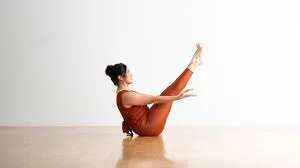
Navasana, or boat pose, is a yoga pose that emphasizes strengthening the abdomen. This exercise will engage several different muscle groups, just like many other yoga poses.
By strengthening muscles that typically weaken with daily activities like sitting at a computer, it will also assist you in improving your balance.
- Step-by-Step Instructions
- To begin, take a straight seat with your feet flat on the ground and your legs bent.
- Lift your legs off the ground gradually while pressing them together until they make a 45-degree angle with your body. Engage your core and balance your weight on your tailbone while maintaining a flat back.
- You are welcome to keep your knees bent if you are a beginner. Straighten your legs to make it more difficult.
- Keeping your arms parallel to the ground, extend them in front of your body. Put your hands on the floor, right beneath your hips, for more support.
- Hold the pose for ten to twenty seconds, then progressively extend the hold period until you reach one minute.
Benefits of Lower Abs Exercises
Although lower ab exercises can help you gain muscle in this area, they might not reduce your tummy as much as you would like. Spot-reduction in the lower abdomen is physically impossible. The body uses more than just one part of its body to obtain energy. We must consider nutrition, lifestyle, and general activity level if your goal is to reduce.
However, lower ab exercises can offer several significant advantages, not the least of which are better posture and increased core stability, both of which are critical for preventing injuries.
Enhanced Core Stability
It makes it obvious that your core muscles would be more constant if they were stronger. This also implies that you are less likely to get hurt when exercising or simply going about your daily life. Individuals who routinely worked out their lower abdominal muscles had better core stability and fewer injuries overall.
Improved Posture
There’s more to the increased core stability you obtain with lower ab exercises: improved alignment. Participants’ posture improved as a result of core exercises that targeted deep abdominal muscles.
Maximizing Effectiveness in Lower Abs Workouts
Proper Engagement Techniques
Breathing
Using a breathing method to help you relax and tighten your muscles. Try this: Squeeze the muscles you employ as you inhale. Instead of just drawing those muscles inward, try drawing them upward. After that, let go as you breathe.
It’s helpful to imagine it as working similarly to a corset: the abdomen flattens, and the waist narrows slightly when the lower, middle, and upper fibers contract.
Form and Alignment
Lying on your back with your feet flat on the floor and your knees bent will help you link your breathing to your posture. Put your fingers between the top of your hip bones and your belly button on your stomach. Breathe deeply, then use your pelvic floor muscles to pull your lower abdomen down and away from your fingers as you exhale.
In order to maintain the pelvis and cooperate with all other core muscles, pelvic floor muscles must ultimately act together. (Yes, this implies that before performing any specific lower ab workouts, or any core exercises for that matter, you must work on improving this engagement.)
Overcoming Common Challenges
Given all the advantages of building strong core muscles, there are a few things to be aware of. The primary goal is to protect your back, particularly if you already have back problems and are attempting to strengthen your core.
Avoiding Lower Back Strain
It’s simple to strain the supporting muscles of your back when your abdominal muscles are under so much tension. Certain abdominal exercises, like planks, are not recommended if you have back problems, according to research, but other exercises, like bird-dog, are both safe and helpful if you are managing back discomfort.
Adjusting for Fitness Levels
Naturally, lower ab exercises can include both simple and complex exercises. Moves that you feel comfortable performing should always be your first choice. If an ab exercise seems too difficult, try a reduced version or switch to a different ab exercise that you feel more at ease with.
FAQs
What workout should I do to work my lower abs?
Raise your legs until your feet are roughly six inches above the ground. Lift your left leg a few inches and slowly lower your right leg a few inches at the same time. Lift your right leg a few inches and lower your left leg a few inches as you slowly change direction. For a maximum of one minute, keep up this motion.
What core exercises should a person with scoliosis avoid?
Crunches and Repetitive Flexion: Crunches are a popular workout in which the upper back is rounded, applying compressive pressures on the spine. This may increase pressure on your spine if you have scoliosis, which may cause pain and discomfort.
Can AB workouts fix diastasis recti?
When your rectus abdominis muscles—also known as your six-pack ab muscles—separate due to stretching during pregnancy, it is known as diastasis recti. Months or years after your last child, the separation may cause your belly to protrude or swell. With certain exercises that aid in closing the gap, you can fix it.
Is the lower abs harder to get?
Because the lower abs are frequently used to store fat, especially in men, they are challenging to grow. Strong muscles remain concealed under fat unless the body fat percentage is reduced through diet and exercise.
What exercise is best for the lower abs?
The best lower ab exercises are about bottom-up spinal flexion, bringing the lower body to the torso. Important movements are Reverse crunches, Hanging leg raises, Scissor kicks, Flutter kicks, nd Mountain climbers. These exercises aim to work the lower abdominal area by keeping the upper body stable as the hips are lifted and the legs lowered.
Top Targeted Lower Ab Exercises:
Hanging Leg/Knee Raises: Hang from a bar and raise your straight legs or knees to your chest.
Scissor Kicks & Flutter Kicks: Lie on your back and do small, controlled vertical or alternating horizontal kicks with straight legs.
Cross-Body Mountain Climbers: From plank, bring your knees to the opposite elbow to hit the lower abs and obliques.
Dead Bug: Lie on your back and slowly extend opposite arms and legs, maintaining contact between your lower back and the floor.
How to Make the Most of It:
Control the Movement. Avoid momentum, think about lifting with your lower abdominal muscles,s not your hip flexors.
Keep Back Fl. When doing lying exercises, keep your lower back pressed into the mat to avoid back pain and to keep your abdominal muscles engaged.
Routine Structure: 2. Each exercise or 3 sets of 10 to 15 reps, to 30 to 60 seconds.
Consistency: Do these exercises 2-3 times a week and have a healthy diet to help lower overall body fat to make your abs more visible.
Can I work out abs every day?
Yes. But not necessary or optimal for growth. Light core exercises can be done every day, but intense ab training requires rest days to allow the muscles to recover and repair. Generally speaking, the ideal frequency for strength and definition is 2-3 times per week.
Important things to keep in mind when you do ab exercises every day:
The Real Thing: Recovery is just like any muscle group; abdominal muscles need time to recover, or they can become overtrained, leading to fatigue and decreased performance.
Exercise Intensity: It is safe to do low-intensity exercises (e.g., planks, dead bugs, bird dogs) on a daily basis, but high-load, intense exercises (e.g., weighted sit-ups) should not be done.
Muscle Growth vs Endurance: Often, daily training turns into endurance training. If the goal is “hypertrophy” (larger, more defined muscles), you must add resistance and allow recovery.
Diet and Fat Loss: Visible abs are created by strengthening the core and reducing body fat through a calorie deficit.
Best Practices:
Include crunches (flexion), leg lifts (lower abs), and planks (isometric).
Hear Your Body: If you’re sore all over, take a rest day to avoid overtraining injuries.
Focus on Compound Movements: Squat, deadlifts, and other compound movements also strengthen the core.
Is the plank ok for scoliosis?
Once more, maintaining the spine’s natural alignment and curvature is not solely its responsibility. Its neighboring muscles are also responsible for it.
Why can’t I see my bottom 2 abs?
Having a low body fat percentage is the most crucial factor in getting your abs to show. All people have abdominal muscles that can be trained to become more noticeable, but in order to show your abs, you must have 10% body fat or less (18% for women).
Can I do lower ab exercises every day?
Most people shouldn’t do ab exercises more than six times a week. Your entire body needs a break, not just your abs. If you don’t take at least one day off each week, you aren’t allowing your body to recover from the workouts you put it through.
What causes lower belly fat?
Lower belly fat is mainly due to a calorie surplus, where the calories you consume are higher than those you burn, leading to fat storage, which is often influenced by genetics, age, and hormonal changes. High stress ( cortisol ), poor diet (refined carbs/sugar ), lack of exercise, lack of sleep, and low estrogen levels during menopause are some of the key factors.
Main Reasons for Lower Belly Fat:
Caloric Surplus & Diet: Weight gain happens when you consume more calories than you expend, and fat tends to accumulate in the lower abdomen. High-calorie processed foods, sugary drinks, and alcohol all contribute.
Hormonal Fluctuations:
Cortisol: If you’re constantly stressed, your body produces more cortisol, which makes it easier to store fat around your midsection.
Estrogen: Low estrogen levels (common during menopause) can lead to fat moving away from the hips and thighs and into the lower belly.
Aging: As we grow older, our metabolism slows, and we lose muscle mass. This makes it easier to gain weight and harder to lose weight, especially in the lower belly.
Genetics: A person’s genes determine where they are more likely to store fat.
Physical Inactivity: When a person leads an inactive life, the body does not burn off extra calories. They also lose muscle, which lowers the metabolic rate.
Sleep deprivation affects hunger hormones (ghrelin and leptin), increasing appetite and belly fat accumulation.
Poor Posture: Flabby abs can cause a “pooch” effect, where the lower abdomen looks more prominent.
Food intolerances: Bloating in the abdomen can be caused by digestive problems and food intolerances (like gluten or dairy).
How long does it take to see abs?
Depending on your starting body fat, it may take a year or more to see noticeable abdominal definition. With a consistent diet and exercise, it usually takes 3 to 6 months. Visible abs usually require dropping to about 10-14% body fat in men and 16-20% in women.
Key Considerations and Timelines:
3–6 Weeks: If already lean, can see initial tightening or definition.
3-6 Months: Typical time period for results to be visible with strict diet and training.
6-12+ Months: Most likely needed if starting at a higher body fat percentage.
How To Speed It Up:
Calorie Deficit: The first step to losing the fat that covers your abs is to consume fewer calories than you burn.
Targeted Training: 3-4 times a week, perform weighted ab exercises to increase ab muscle size.
Consistency: Results are based on daily nutrition & exercise habits.
Fat Loss Rate: A safe and sustainable goal is to lose about 1% of body fat per month.
References
- Bueckert, S. (2022, August 18). Best lower abs workouts to exercise your core. Sunny Health & Fitness. https://sunnyhealthfitness.com/blogs/health-wellness/lower-abs-workouts-core-muscle-exercises?srsltid=AfmBOopkreY5yuVb_G02c62qsZk3sHCnmDNruMuyiMRdtgIZUeR1BpGu
- Cameron, K. (2025, January 16). Exercises to burn belly fat. WebMD. https://www.webmd.com/fitness-exercise/top-exercises-belly-fat
- Dias, A. (2024, April 24). 10 lower AB exercises to add to your fitness routine. Healthline. https://www.healthline.com/health/exercise-fitness/lower-ab-workouts
- Hayes, A., & Neudecker, K. (2024, June 25). Strengthen Your Lower Abs with This Lower Ab Workout & 10 Killer Moves. Men’s Health. https://www.menshealth.com/uk/building-muscle/a28675050/best-exercises-lower-abs/
- Website, N. (2025, July 23). Abs workout video. nhs.uk. https://www.nhs.uk/live-well/exercise/strength-and-resistance/body-blast-abs/