
7 Medicine Ball Exercises
Introduction:
Medicine ball exercises are a great way to improve strength, power, balance, and core stability. By adding a medicine ball to your workout, you can make traditional exercises more dynamic and functional.
In physical therapy settings, it is frequently utilised to encourage stability and facilitate healing. This popular workout aid tones and strengthens the core, shoulders, arms, back, and more. You can also use a medicine ball at home.
These 7 weighted medicine ball workouts will help you tone and sculpt your arms and shoulders while strengthening your lower body and core.
General Benefits of Medicine Ball Exercise:
Multi-Plane Movements to Improve Functional Fitness:
For training in the frontal, sagittal, and rotational planes, medicine balls are ideal. This diversity is essential for improving performance in everyday activities and sports as well as functional fitness. Your obliques and core muscles are worked during rotational workouts like Russian twists, which improve your rotational strength and stability.
Chest passes and other sagittal plane exercises concentrate on increasing your power and upper body strength, which is crucial for sports involving pushing or throwing. Exercises in the frontal plane, such as lateral throws, improve your coordination and agility, improving your ability to move from side to side.
Increase mobility and avoid injuries:
Improving mobility is essential to preserving general health and avoiding accidents. You can significantly improve your mobility with medicine balls. Your joints’ range of motion can be increased with dynamic stretches using a med ball.
This results in increased hip and shoulder flexibility, which lowers your chance of injury and allows you to do exercises with better form.
Enhance Muscle Potential and Activation:
Your muscles can be efficiently prepared for more strenuous workouts by using a medicine ball for activation and potentiation exercises. Exercises that stimulate and engage your muscles for action include medicine ball glute bridges, planks, and squats.
Your neurological system is stimulated, and your muscles are more sensitive when you perform potentiation exercises, which include explosive movements like split squat leaps, med ball pogos, and squat hops.
For Explosive Strength, Apply Power Training:
A powerful tool for power training is a medicine ball. They enable you to engage in powerful, high-intensity exercises that strengthen your fast-twitch muscle fibres. Exercises like rotating slams, chest passes, and overhead throws call for quick force production, which increases power and speed. For sportsmen like sprinters, jumpers, and martial artists who need to improve their explosive strength, these exercises are very helpful.
HIIT & Intensive Cardio Workouts:
If you want to boost your cardio and HIIT activities, medicine balls are the best option. They can turn routine exercises into full-body, high-intensity workouts. Exercises that increase heart rate and promote cardiovascular fitness include burpees, thrusters, and med ball smashes.
Medicine Ball Exercise:
Medicine Ball Exchange:

The medicine ball exchange is a reliable method to raise your heart rate and a fantastic warm-up for your arms and shoulders. As you strive to keep proper posture throughout this strengthening exercise, you’ll also feel the burn in your abdomen.
- Maintain an erect posture, whether sitting or standing, while using your core.
- With your arm by your side, move the medicine ball to your right hand.
- Take the ball with the opposite hand while drawing your right arm above.
- Using the ball, circle your left hand down to your side.
- Relying more on strength than velocity, keep circling the medicine ball overhead while switching arms and keeping a consistent tempo.
- For added intensity, add a toss at the end of the exercise.
- Perform 1–3 sets of 15–20 repetitions.
Medicine Ball Curl and Press:
The biceps, shoulders, and lats are the focus of the medicine ball curl and press. As you maintain stability with an upright spine, the workout will help strengthen your abs. You can perform this while standing or while seated, as demonstrated.
- Engage your abdominal wall while standing or sitting to maintain an upright, neutral spine.
- Put the medication ball by your side in your right hand.
- Curl your arm into a biceps curl while maintaining balance with the ball in your hand.
- Engage the shoulder girdle by pushing your arm up and out at the peak of the exercise.
- Lower the arm to its initial position and bring the ball back down.
- Repeat one to three sets of ten to twelve repetitions, swapping sides each time.
Knee Lifts with a Medicine Ball:

Knee raises using a medicine ball combine strength and stability from the upper and lower bodies. This exercise will definitely make you sweat as you increase your heart rate and build endurance.
- Using both hands, hold a weighted ball that weighs between two and eight pounds, depending on your level of fitness.
- While lowering the arms and bringing the weight to the knee, raise the right knee to waist level.
- Lift the left knee, then return the medicine ball to the knee as you raise the weight again and switch sides.
- During the med ball exercise, maintain an erect torso and avoid arching or curving your spine.
- This movement will get more severe the faster you move. Faster isn’t always better; ensure you move at a speed that keeps you in control of the weighted ball and maintains proper technique.
- For 30 to 60 seconds, repeat.
Medicine Ball Triceps Extension:

A weighted ball workout that resembles conventional dumbbell arm extensions is the medical ball triceps extension. After extending your arms, toss the ball to your exercise partner to up the effort. This powerful exercise improves hand-eye coordination while strengthening the arms and shoulders. You can do the exercise with your partner while they are seated across from you.
- Whether you’re sitting or standing, contract your abs to keep your spine straight.
- Raise your arms above your ears while holding a medicine ball in each hand.
- Instead of shrugging your shoulders up by your ears or jamming them down your back, let them naturally rise to accompany the extension of your arms.
- As you drop the ball behind your head, bend your elbows until they form 90-degree angles.
- To straighten your arms and raise the ball once more, contract your triceps.
- Perform 1–3 sets of 10–16 repetitions.
Medicine Ball Squat and Sweep:

A fantastic full-body exercise that improves the upper and lower bodies in a single dynamic move is the medicine ball squat and sweep. Use this to raise your heart rate during aerobic activities or as a warm-up for other lower-body exercises.
- Hold a heavier weighted ball while standing with your feet hip-width apart.
- If you can, touch the ball to the floor while squatting as low as you can while keeping your back neutral and sending your hips back.
- As you rise back up, sweep the weight up and overhead while applying pressure through your heels and maintaining a neutral spine.
- Lower and repeat, keeping control of the weight while moving swiftly. For added intensity, finish with a toss.
- For 30 to 60 seconds, repeat.
Medicine Ball Squat and Swing:
Except for taking a large stride to the side, the medicine ball squat and swing is comparable to the squat and sweep. Additionally, as you go from side to side, it works the glutes, hips, thighs, arms, and core, sculpting the entire body. If you’re just starting or are still warming up, use a lighter medicine ball; if you’re ready for increased intensity, go to a heavier one.
- With your feet together, grasp a medicine ball weighing four to ten pounds in both hands.
- Swing the medicine ball between your knees as you step out to the side into a squat.
- With your knees behind your toes and your abs active, sit back with your hips.
- Swing the medicine ball overhead while stepping the foot back in.
- Swing the medicine ball between your legs as you move to the opposite side.
- Repeat one to three sets of eight to sixteen repetitions by stepping back together and swinging the weighted ball back up.
Medicine Ball Circle Squat:
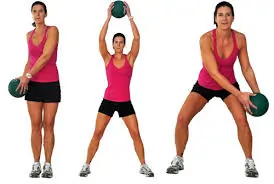
The medicine ball circular squat works the lower body and core while strengthening the arms and shoulders. This workout is an excellent complement to any cardio or strength-training regimen because it will also raise your heart rate. This low-impact exercise will increase your fitness while protecting your joints.
- Hold a weighted ball in both hands on your right side, close to your hip, while standing erect with your feet hip-width apart.
- Step sideways with your left foot, circling the medicine ball overhead and a little ahead of you.
- Lower yourself into a squat as you continue to circle the ball to the left and down. The ball should be between your legs at the bottom of the squat, at the bottom of the circle.
- As you stand up again, step your left foot back in and circle the ball back to the right.
- Do this ten to sixteen times. For ten to sixteen repetitions, switch sides and perform the same motion in reverse.
- For one to three sets, repeat.
Safety & Precautions:
Experienced athletes can add overhead medicine ball slams to their workout regimens with relative safety. To do them well, though, you need a solid core and good coordination.
Proceed cautiously if you have shoulder or lower back pain. To determine whether the exercise is comfortable for you, start with a lighter medicine ball and decrease your range of motion.
Gradually increase the weight, sets, repetitions, or length of the exercise because keeping good form is essential for preventing injuries, and form tends to worsen as you become tired. If you feel any discomfort or sharp or shooting pain in your lower back, stop right away and move on to another exercise.
Common Mistakes:
- Don’t Overdo It: Using an excessively heavy ball can impair your form and cause injury.
- Don’t Rush: You run the danger of being hurt if you rush through each exercise.
- Don’t Ignore Recovery: Give your muscles enough time to recover and mend in between sessions.
- Don’t Stick to One Routine: Change up your workouts and routines to keep pushing your body.
FAQs
What are the benefits of medicine ball exercises?
They are a simple method to incorporate weight training into your abdominal exercises. They are an inventive method to modify your strength training regimen.
Why does a medicine ball help?
Medicine balls are perfect for producing explosive power, speed, and endurance because they are made to be tossed around without the possibility of injury or property damage. Even powerful exercises like kettlebell swings require deceleration when the exercise comes to a conclusion when using free weights.
Is a medicine ball good for your back?
Stability ball exercises stimulate the core and stabilising muscles in ways that regular exercises frequently overlook. These exercises will support your spine and increase mobility, whether your goals are to improve posture, reduce back discomfort, or increase general strength.
Can medicine balls build muscle?
Many medicine ball exercises work several muscle groups at once rather than just one. Functional training develops strength that you can utilise outside of the gym and enhances balance, coordination, and core stability.
How heavy a medicine ball should I use?
An 8 to 12-pound medicine ball can offer an excellent blend of resistance and control for full-body exercises like wall balls or rotational throws. Going up to 15 or even 20 pounds might be beneficial if you’re performing explosive power exercises like ball slams or chest passes, provided your form remains precise.
References:
- 14 Medicine Ball Exercises to Strengthen Arms, Abs & Glutes – 2024 – Cpt/www.verywellfit.com/medicine-ball-exercises-1231106
- Ultimate Guide to medicine ball training: Benefits, tips, workouts – 2024 – Vkim, Vkim/www.muscleandfitness.com/workouts/workout-tips/ultimate-guide-to-medicine-ball-training-benefits-tips-workouts
- How to do medicine ball slams: Proper form & tips – 2024 – Z/www.trxtraining.com/blogs/news/medicine-ball-slams?