
Compound Exercise
What is Compound exercise?
Exercises known as compound exercises target several muscular groups simultaneously. Squats, for instance, are a complex exercise that strengthens the calves, quadriceps, and glutes.
Additionally, you can target even more muscles by performing complex exercises, which combine two workouts into one movement (e.g., a lunge with a biceps curl).
Compared to exercises done alone, compound exercises are different—they work one muscle group. A solo exercise designed to strengthen the biceps is the classic biceps curl.
In physical therapy, isolation exercises can be useful for strengthening specific muscles or for recovering from injuries.
Benefits of compound exercise
Perhaps the most significant advantage of compound workouts is that they are a time-efficient activity. Compound exercises are the best option if you have limited time for exercise because they will help you gain greater strength and work more muscles.
Other benefits:
- burning more calories
- improving intramuscular coordination
- elevating heart rate
- improving flexibility
- improving strength
- gaining more muscle mass
Examples of compound exercise
1. Deadlift
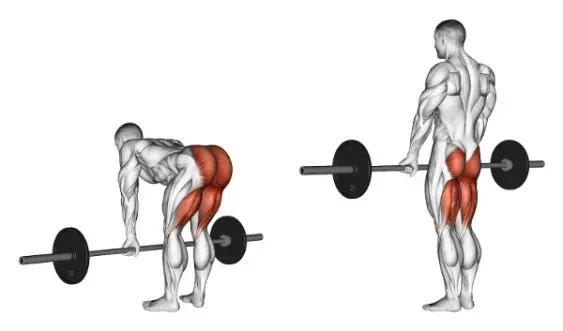
Equipment required: barbell (optional; for added challenge, you can add weights to the barbell)
- Toes under the bar, feet hip-width apart, and barbell on the floor.
- 2. As you squat down, push your hips back while maintaining a square core and a neutral spine. Don’t bend your back; keep it flat.
- Raise your hands to the bar. Make sure your hands are a little broader than your thighs on the bar.
- Start lifting with your knees relaxed and push through your heels.
- As you lift, hold the bar close to your body and pull it up so that both your hips and the bar rise simultaneously.
- At the top, squeeze your glutes and finish in a tall stance.
- Hinge at the hips as you slowly lower the bar to the floor.
- Between sets, pause for at least 30 to 60 seconds and do 10 to 12 repetitions. Complete up to three sets.
2. Reverse lunge to balance with bicep curl
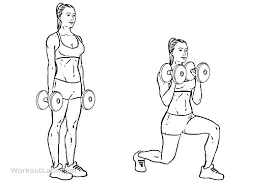
Equipment needed: a set of dumbbells
- Both hands should be carrying a dumbbell while you stand with your feet hip-width apart.
- Make sure your palms are towards your body as you extend your arms downward.
- Put your right foot back and lower your legs and hips into a lunge.
To go back to standing, plant your left foot firmly on the ground and push your right foot up. - Make sure your left foot remains balanced at the peak and keep your right foot off the ground.
- Do a simultaneous bicep curl with both arms.
- Put the dumbbells parallel to your body and lower your arms back down to put your right leg back into the lunge position.
- After 6–8 repetitions on the right leg, go on to the left.
- Take a break for 60 to 90 seconds after finishing the left side—complete 2 to 3 sets.
3. Squat

- Toes turned slightly out, start with feet that are just a little wider than hip-width.
- Keep your chest raised and out, contract your abdominal muscles, and drive your hip back while shifting your weight back into your heels.
- Once your thighs are parallel to the floor or almost so, lower yourself into a squat. You should continue to line your knees over your second toe.
- To go back to where you started, push through your heels while maintaining a tight core and an outstretched chest. At the top, compress your glutes.
4. Front lunge with twist
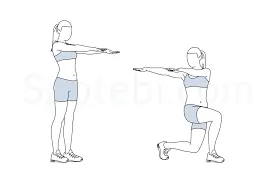
- With your feet shoulder-width apart and your arms out in front of you, take a proud stance.
- While maintaining your arms extended, take a step forward with your right foot to form a lunge. A 90-degree angle should be formed by your front leg, and your knee should not go past your toes. Additionally, your rear leg will make a 90-degree angle.
- Your upper body should twist to the right and then back to the centre while you are in the lunge position.
- Lunge forward to repeat the movement with the left leg after returning the right leg to its initial position.
- Do eight to ten lunges on each leg. Work on up to three sets.
5. Dumbbell shoulder press on exercise ball
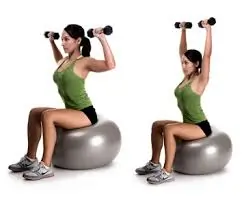
Equipment required: a workout ball, abs, or a set of dumbbells
- Start with your core active while seated on an exercise ball. A dumbbell should be held in each hand.
- Starting with dumbbells on your thighs, raise the dumbbells to shoulder height with your thighs to assist you in maintaining a 90-degree angle, elbows to the sides, and dumbbells looking forward.
- Until your arms are straight overhead, press the dumbbells straight up.
- Return your arms to a 90-degree angle slowly, keeping your elbow at shoulder height. Avoid lowering yourself below this point, as it may put strain on your shoulder joint.
- Complete 12–15 repetitions. Work on up to three sets.
6. High plank T-spine rotation

- Start by placing your arms beneath your shoulders and using your core to perform a push-up. This exercise requires the legs to be roughly hip-width apart.
- Keeping your right hand firmly planted on the floor, squeeze your thighs and glutes.
- Raise your left arm, then rotate your shoulders and hips to the left, pressing them up towards the ceiling.
- Lower the left arm to the floor and “anchor” the left hand directly to the ground.
- Twist and alternate to raise the right arm into the air.
- Do eight to ten repetitions on each side. Work on up to three sets.
Safety tips:
- A certain technique is necessary for compound workouts, such as deadlifts, in order to keep you safe and prevent damage.
- Perform these exercises under the guidance of a trainer or fitness expert, particularly if you have never done the motion before. They can watch you to ensure that your technique is sound.
- After a while, you might be able to do the techniques securely by yourself. But it’s always a good idea to have a workout partner who can see you.
- If you’re new to the gym, speak with a trainer or other fitness expert. You can use these to determine which weights to begin with. Starting with a small weight that you can easily perform 10 to 15 repetitions in a single set is a smart idea.
- In the second and third sets, raise the weight if you feel secure and comfortable. You should never feel unstable, but you should “feel the burn” during the final few repetitions.
- Drink water in between sets, and if you feel sick or lightheaded, stop working out.
FAQs
What is Compound exercise?
Exercises known as compound exercises target several muscular groups simultaneously. Squats, for instance, are a complex exercise that strengthens the calves, quadriceps, and glutes.
Additionally, you can target even more muscles by performing complex exercises, which combine two workouts into one movement (e.g., a lunge with a bicep curl).
Compared to solitary workouts, compound exercises are different—they work one muscle group. A solo exercise designed to strengthen the biceps is the classic bicep curl.
In physical therapy, isolation exercises can be useful for strengthening specific muscles or for recovering from injuries.
What are the benefits of compound exercise?
Perhaps the most significant advantage of compound workouts is that they are a time-efficient activity. Compound exercises are the best option if you have limited time for exercise because they will help you gain greater strength and work more muscles.
Other benefits:
burning more calories
improving intramuscular coordination
elevating heart rate
improving flexibility
improving strength
gaining more muscle mass
What are the examples of compound exercises?
push ups
Barbell deadlift. Forearms, lats, glutes, hamstrings, core, upper, mid, and lower back muscles are the muscles that are targeted.
Use a twisting front lunge and a reverse lunge to balance while curling your biceps.
dumbell shoulder press on an exercise ball. Muscles targeted: abs, deltoids, pectoralis major, triceps brachii.
Plank, and High plank T-spine rotation. Great exercises for core strength, the core is the glue that holds your upper body and lower body together.
Chin-ups. Primarily target the lats and biceps
Squat. Muscles targeted: quadriceps, glutes, and calves.
Jumping ropes
Dips
How to perform the deadlift exercise?
Equipment required: barbell (optional; for added challenge, you can add weights to the barbell)
Toes under the bar, feet hip-width apart, and barbell on the floor.
2. As you squat down, push your hips back while maintaining a square core and a neutral spine. Don’t bend your back; keep it flat.
Raise your hands to the bar. Make sure your hands are a little broader than your thighs on the bar.
Start lifting with your knees relaxed and push through your heels.
As you lift, hold the bar close to your body and pull it up so that both your hips and the bar rise simultaneously.
At the top, squeeze your glutes and finish in a tall stance.
Hinge at the hips as you slowly lower the bar to the floor.
Between sets, pause for at least 30 to 60 seconds and do 10 to 12 repetitions. Complete up to three sets.
How to perform the dumbbell shoulder press on an exercise ball?
Equipment required: a workout ball, abs, or a set of dumbbells
Start with your core active while seated on an exercise ball. A dumbbell should be held in each hand.
Starting with dumbbells on your thighs, raise the dumbbells to shoulder height with your thighs to assist you in maintaining a 90-degree angle, elbows to the sides, and dumbbells looking forward.
Until your arms are straight overhead, press the dumbbells straight up.
Return your arms to a 90-degree angle slowly, keeping your elbow at shoulder height. Avoid lowering yourself below this point, as it may put strain on your shoulder joint.
Complete 12–15 repetitions. Work on up to three sets.
How to perform the high plank T-spine rotation
Start by placing your arms beneath your shoulders and using your core to perform a push-up. This exercise requires the legs to be roughly hip-width apart.
Keeping your right hand firmly planted on the floor, squeeze your thighs and glutes.
Raise your left arm, then rotate your shoulders and hips to the left, pressing them up towards the ceiling.
Lower the left arm to the floor and “anchor” the left hand directly to the ground.
Twist and alternate to raise the right arm into the air.
Do eight to ten repetitions on each side. Work on up to three sets.
References:
- Chertoff, J. (2019, November 13). How to add compound exercises to your workout routine. Healthline. https://www.healthline.com/health/fitness-exercise/compound-exercises#schedule
- Icohen, & Broser, E. (2020, August 25). The 10 best compound Exercises for strength. Muscle & Fitness. https://www.muscleandfitness.com/workouts/full-body-exercises/top-10-compound-lifts-maximum-size-and-strength/


