
Katichakrasana: Complete Guide for Beginners
What is Katichakrasana?
Katichakrasana (Standing Spinal Twist Pose) is a simple yet powerful yoga asana that involves gentle twisting of the spine while standing. It helps improve spinal flexibility, tones the waist and abdominal muscles, enhances digestion, and relieves stiffness in the back and hips.
It is a straightforward but effective technique that has several advantages. However, it can be done as a warm-up exercise before and after a demanding asana to help practitioners relax their bodies.
Because it effectively addresses stiffness and exhaustion caused by excessive use of the trunk, neck, and shoulder muscles, this pose can also be scheduled as “classroom yoga” or “office yoga.”
Muscle Work During Katichakrasana:
- Thighs Muscles
- Hip Flexors
- Deep Abdominal Muscles
- Calves Muscle
How to Perform?
- Begin with a straight posture, feet together, and an upright spine, similar to that of basic tadasana. Here, evenly distribute your weight across both feet.
- Now, extend your arms forward in front of your chest while inhaling, keeping your legs shoulder-width apart. It is in the middle.
- Here, the hands should be parallel to the floor, shoulder-width apart, and palms facing each other.
- With a soft exhale, twist your trunk from the waist to the right from the centre position. Keep your eyes fixed on your right shoulder and continue to rotate while exhaling.
- Here, keep your hips facing forward and maintain the space between your hands.
- Inhale, release the twist lock, and return to the centre position after completing a right-side twist.
- Once again, exhale, repeat to the left, and then inhale to return to the centre.
- Repeat each side of the katichakrasana stance at least ten times, holding it for twenty seconds on each side.
- Unlock the twisted waist and carefully make your way back. Look from the back to the front at the same time. Breathe easily and maintain a straight posture.
Benefits:
- A study has shown that practicing Katichakrasana in conjunction with other yoga poses might lessen signs and symptoms of work stress.
- Regular practice of this asana improves flexibility and strength in those with stiff back and abdominal muscles by loosening up the tissues.
- Strong emotions and psychological stress can occasionally cause the autonomic nerve to inflate and constrict the bronchi. The practice of katichakrasana helps to alleviate bronchial asthma by replenishing the pranic energy that has been drained and inhibited.
- Katichakrasana aids with “frozen shoulder” by softening and supplying the stiff shoulder joints and increasing their range of motion. Additionally, it facilitates various bending and twisting poses that require a supple shoulder.
- Katichakrasana practice is beneficial for controlling weight and its related issues. On the other hand, being overweight may increase your risk of developing high blood pressure. One study claims that this asana practice has a positive impact on blood pressure and weight.
- It strengthens and releases weight from the lower back. Constipation is also addressed by the swinging motions. Additionally, it enhances respiratory indices and blood circulation in the trunk.
- The Manipura Chakra, which is principally in charge of digestion, is stimulated by the regular and suitable practice of this asana. enhances digestion as a result.
Beginner’s Advice:
- Beginners’ ability to twist is limited by back stiffness. To get around this, try twisting like a free swing while keeping your toes firmly planted on the mat. The better the foot grip, the better the twist will be.
- Instead of inhaling while twisting, try exhaling and pulling your navel back towards your spine. Your abdominal muscles will twist more readily if they are more relaxed.
Preparatory Pose:
- Half Spinal Twist Pose (Ardha Kati Chakrasana)
- Half wheel Pose (Ardha Chakrasana)
Props and Modifications:
- Gently push a rubber block in the middle of your palms. It will now assist you in keeping a space between your arms while you twist.
- A variation of Katichakrasana can be used if the shoulder is tight. Keep your arms down in their natural position for this. Swing your hands freely while twisting your waist. Avoid bending your arms. In these motions, take them wherever they can.
- Return to the centre position gradually after that.
Variations:
Ardha Kati Chakrasana:
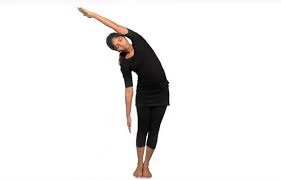
It is known as Ardha Kati Chakrasana, or half spinal twist, since, in contrast to Katichakrasana, the waist only twists half of it.
Enter Tadasana first. Inhale now, then raise the right hand vertically upward with the biceps touching the right ear and the palm facing the left. Keep your left hand down by your left side.
Breathe out and tilt your trunk to the left. The left palm moves down the thighs. Maintain a straight right elbow and both knees. Now, hold this stance while taking calm breaths.
Hands down, inhale gently while returning to the centre or raised position, and exhale in Samasthiti. Continue in the same manner on the opposite side.
Precautions and Contraindications:
- Avoid jerking quickly when twisting to avoid overstretching your knees.
- Katichakrasana should not be performed quickly by those who have high blood pressure.
- Avoid doing Katichakrasana if you have sciatica, a spinal injury, or are pregnant.
FAQs
What are the benefits of the spinal twist pose?
Stretches, Strengthens, Lengthens: The lower back and spine are stretched.
Range of Motion and Flexibility: This pose increases range of motion and flexibility in the back muscles.
Chest, Diaphragm, and Breath: The upper back is straightened, and the shoulders are gently opened in this pose.
What are the common mistakes in Katichakrasana?
Over-twisting the lumbar area, collapsing the chest during the twist, and rotating from the pelvis rather than the spine are common errors in Katichakrasana practice. Some practitioners cause their posture to become unstable by shifting their weight unevenly between their feet.
Does Katichakrasana improve flexibility?
The flexibility of the waist and spine may be enhanced with katichakrasana. It might improve the strength of the lower back, abdominal, and spinal muscles. It might improve mental wellness and lessen stress. It might aid in the treatment of postural issues.
What are the precautions for the Standing Spinal Twist Pose?
If you have any problems with your back, spine, heart, shoulder, or spondylitis, you should avoid this pose. Only with a doctor’s approval and under the supervision of a qualified yoga instructor may pregnant women perform the katichakrasana. On an empty stomach, perform the yoga pose.
What are the contradictions of Katichakrasana?
Injury and Surgery: Students should avoid this twist if they have any injuries to the ankles, hips, pelvis, rib cage, spine, shoulders, neck, arms, or hands, or if they have had surgery or an injury to the muscles, ligaments, or tissues associated with the aforementioned areas or joints.
References:
- Katichakrasana (Standing Spinal Twist Pose): Steps, Benefits, & Precautions – Fitsri Yoga. https://www.fitsri.com/poses/katichakrasana
- Standing Spinal Twist Pose Yoga Pose (Katichakrasana). Tummee. https://www.tummee.com/yoga-poses/Katichakrasana.