12 Yoga Poses for Posture Improvement
Introduction:
Yoga poses for posture improvement focus on aligning the spine, opening the chest, and enhancing core stability. By incorporating these poses into your routine, you can develop better posture habits, reduce pain, and support long-term spinal health.
Poor posture has become increasingly common due to long hours of sitting, screen use, and a sedentary lifestyle.
By addressing the underlying causes of poor posture—muscle imbalances, stiff spines, and a lack of body awareness—yoga can greatly improve posture.
One of the best and most natural ways to improve bad posture is through yoga. It relieves pain and increases flexibility while retraining your body to hold itself upright, strengthening weak muscles and releasing tense ones.
Causes For Poor Posture:
- Slouched backs, rounded shoulders, and forward head posture are caused by desk work and screen use.
- A slumped upper torso is frequently the result of parenting duties like nursing or carrying children.
- The hips are stiff, and the spine is compressed, whether driving, sitting on the couch, or using a phone.
- Stress can physically draw the body in, causing the muscles used for shallow breathing and the chest to contract.
How does Yoga work for Posture Correction?
- Tension and tone are rebalanced through breath-focused movement.
- Daily routines are retrained by mindful awareness.
- Poses improve long-term strength and restore the spine’s natural curves.
Benefits:
Strengthening of the Back and Core:
The core muscles that support the spine are engaged and strengthened by a variety of yoga positions, including Plank Pose, Cobra Pose, and Boat Pose. A strong core promotes proper posture throughout the day, reduces the load on the spinal discs, and helps prevent lower back pain.
Improved Joint Health and Flexibility:
Yoga’s emphasis on flexibility relieves chronically tense muscles, especially those in the hips, shoulders, and chest. Poses like Warrior II and Downward Dog help the body recover to its natural posture and release tension that has accumulated from extended sitting by extending these muscles.
Enhanced Awareness of the Mind and Body:
Yoga promotes mindfulness by teaching us to pay attention to how we hold our bodies and how our posture impacts our mood and breathing. Long-term benefits in alignment and health result from developing this awareness, which makes us more mindful of our posture outside of the classroom.
Balance of the Nervous System and Decreased Stress:
The “fight-or-flight” stress reaction brought on by bad posture is countered by yoga breathing techniques, or pranayama, which promote a “rest-and-digest” state. This change lowers cortisol, improves relaxation, and strengthens emotional fortitude.
Yoga Poses:
Mountain Pose (Tadasana):

Mountain Pose (Tadasana) steps:
- Distribute your weight evenly while standing with your feet parallel and hip-width apart.
- Without locking your knees, contract your thigh muscles.
- To balance the pelvis, draw your tailbone gently inward and downward.
- Lift through the top of your head and extend your spine upward.
- Allow your arms to naturally rest next to your body, palms facing forward, and roll your shoulders back and down.
- Make the back of your neck long by gently tucking your chin in.
- Shut your eyes and concentrate on placing your hips over your ankles, shoulders over your shoulders, and ears over your shoulders.
Cobra Pose:
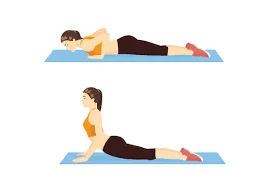
- Stretch your legs straight back and press the tops of your feet onto the mat while lying flat on your stomach.
- With your elbows pressing tight to your body, place your palms beneath your shoulders.
- Press the tops of your feet and thighs against the floor by engaging your legs.
- Breathe in and use your back muscles, not your arms, to gently raise your chest off the surface.
- Don’t lock your arms; instead, keep your elbows slightly bent.
- Draw the shoulder blades down the back and together.
- To prevent crunching, keep your neck neutral and look slightly down and front.
Fish Pose:

- With your arms by your sides, palms down, and your legs outstretched, lie flat on your back.
- With your palms pressed into the ground, slide your hands beneath your buttocks.
- On raising your chest, apply pressure on your elbows and forearms.
- Lift the sternum toward the ceiling by arching through the upper back.
- Make a backbend in your upper spine by gently lowering the crown of your head toward the floor or resting it lightly.
- Keep your feet comfortable and your legs grounded and active.
Camel Pose:
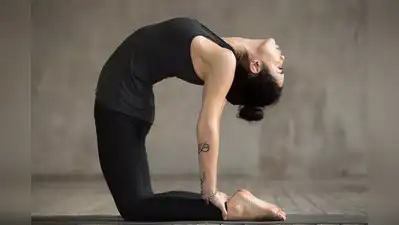
- With your feet flat on the floor and your knees hip-width apart, kneel on your mat.
- For support, place your hands on your lower back with the fingers pointed downward.
- Lift your chest toward the ceiling and push your hips forward.
- As you inhale, slowly lean back while maintaining a long spine and an elevated chest.
- If your flexibility permits, you can optionally reach your hands down to your heels while maintaining your hips over your knees.
- Only when there is no neck strain may the head be softly lowered; otherwise, maintain the chin slightly tucked.
Bridge Pose:
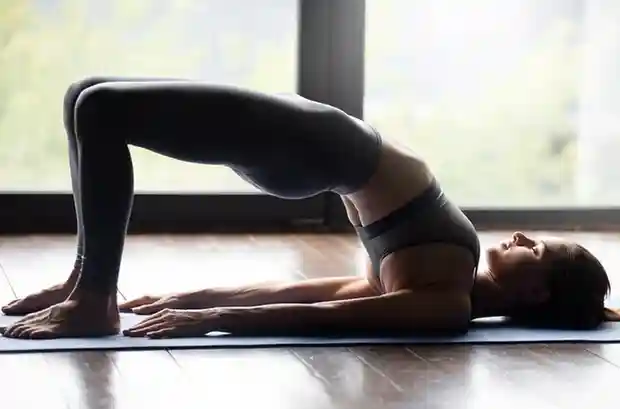
- Bend your knees, place your feet hip-width apart, and lie on your back near your sitting bones.
- With your palms down, place your arms by your sides.
- Press through your heels to raise your hips off the ground as you inhale.
- If at all feasible, interlace your fingers beneath your torso and roll your shoulders beneath it.
- Maintain a long neck while raising your chest toward your chin.
- To support the lift, use your thighs and glutes rather than just your lower back.
Thread the needle Pose:

Thread the needle pose steps:
- Place your shoulders over your wrists and your hips over your knees as you begin on all fours (the tabletop position).
- Take a breath, open your chest, and extend your right arm toward the ceiling.
- Breathe out, lower your right shoulder and ear to the mat, and slide your right arm under your left.
- For a deeper stretch, extend the left hand aloft or leave it planted.
- As you twist through your upper spine, keep your hips stacked over your knees.
Plank Pose:

- To create a straight line from head to heels, begin on all fours and step your feet back one at a time.
- Spread your fingers wide for a solid platform and place your shoulders exactly over your wrists.
- Work the muscles in your thighs, glutes, and abdomen.
- Gaze slightly downward and forward while keeping your head in alignment with your spine.
- Keep your spine long and neutral; do not curve your upper back or droop your hips.
Side Plank Pose:

- Roll onto the outside of your right foot after shifting your weight to your right hand from the plank stance.
- Place your left foot on top of your right (or, for greater stability, stagger).
- Stack your shoulders and raise your left arm to the ceiling.
- Avoid sinking by using your glutes and pushing your hips upright.
- Keep your body in a straight line.
Cat and Cow Pose:

- Start on all fours, placing your knees beneath your hips and your wrists beneath your shoulders.
- Cow (Inhale): Sit bones up, raise your chest, and lower your tummy. Look ahead.
- Cat (Exhale): Round your back, draw your chin to your chest, and tuck your tailbone.
- Breathe in time with your movements as you move gently and deliberately.
- For five to ten complete cycles, alternate between the two stances.
Downward-facing dog Pose:

- Get on all fours to begin. Lift your knees off the mat and tuck your toes under.
- Make an inverted “V” shape by pressing your hips up and back.
- Press evenly across your hands while spreading your fingers wide.
- If necessary, keep your knees slightly bent while concentrating on extending your spine.
- Lift your sitting bones toward the ceiling by using your thighs.
- With your neck relaxed, let your head dangle between your arms.
Warrior I Pose:
- Step your left foot back three to four feet after taking a tall stance.
- Maintain a straight left leg while bending your right knee to stack over the ankle.
- Press into the outer border of your rear foot after turning it slightly (approximately 45 degrees).
- Draw your right hip back and your left hip forward to square your hips to the front.
- Keep your shoulders relaxed, raise both arms upward, and place your biceps next to your ears.
Child’s Pose:

- With your legs wide and your big toes touching, kneel on your mat.
- Return your hips to your heels.
- Stretch your arms out in front of you or place them next to your body as you fold forward.
- Place your forehead on a block or mat.
- Allow your spine to spontaneously decompress while softening your jaw and shoulders.
FAQs
How long does it take for yoga to improve posture?
Within one to two weeks, the majority of participants report improvements in postural awareness. With regular practice, noticeable improvements and pain alleviation usually appear in 4-6 weeks. Expect three to six months of consistent yoga practice for long-lasting structural alignment.
Can yoga fix years of bad posture?
Indeed! By strengthening weak muscles, enhancing spinal mobility, and retraining movement patterns, yoga can help restore years of bad posture. Deep imbalances, however, could require months of regular practice and occasionally more expert assistance.
What type of yoga is best for posture?
The best styles include Iyengar, Hatha, and Therapeutic Yoga. They are perfect for safely and successfully enhancing posture because they have an emphasis on alignment, gradual growth, and appropriate use of props.
Can yoga worsen posture if done incorrectly?
Indeed, improper alignment or hurrying into difficult poses can lead to discomfort or reinforce bad habits. Always begin with beginner-friendly instructions, and make any necessary adjustments or use props.
How does yoga improve posture?
Proper posture requires a strong core. The muscles in your back, pelvis, and abdomen are the focus of many yoga poses. For instance, the plank pose helps you maintain good posture by strengthening your core, which supports your spine.
References:
- Need perfect posture: Your 101 guide to the power of yoga – 2024 – Luke/www.lukecoutinho.com/blogs/exercise/yoga-for-perfect-posture
- Can yoga fix your posture? The Science behind Yoga for Postural Improvement – 2025 – MyYogaTeacher/myyogateacher.com/articles/yoga-for-posture