
Top 10 Yoga Poses for Core Strength
Introduction:
Building a strong core is essential for improving posture, balance, and overall body stability. Yoga offers a gentle yet effective way to activate and strengthen your core muscles through controlled movements and mindful breathing.
The torso muscles that support your spine, influence your posture, and integrate the functions of your upper and lower body are the focus of yoga poses for core strength. These muscles include the back, abs, and obliques. Yoga delves deeply into your stomach and develops functional strength, which is excellent for your long-term fitness, balance, and health, whereas many activities only target the abdominals superficially.
Many fitness-focused yoga programs teach a variety of variants on crunches and planks, but any position that enhances your balance will also strengthen your core. To ensure you’re getting the most out of every position, we’ll discuss how to access your deep core, highlight some of our best core-strengthening poses, and provide lots of alignment advice.
Benefits:
Better Posture: Maintaining an upright posture is made easier by having a strong core that supports your spine. Weak back and abdominal muscles frequently cause poor posture, which can result in back pain and slouching. You can stand higher and more easily if you regularly practise yoga because it improves these muscles.
Increased Flexibility: A lot of the yoga positions that strengthen your core also increase your hip, lower back, and hamstring flexibility. Increased flexibility enhances your range of motion during physical activities and lowers your chance of injury.
Improved Stability and Balance: To keep control of your body, balance positions like Tree Pose and Half Moon Pose call for core stability. Your balance and stability increase as your core gets stronger, which is advantageous for both your yoga practice and daily activities.
Functional Strength: Unlike isolated workouts like sit-ups, yoga builds functional strength, which improves your ability to do daily tasks. A strong core guarantees safe and effective motions, whether you’re twisting your body or lifting big objects.
Injury Prevention: Having a strong core lowers the chance of getting hurt, especially in the lower back. Yoga helps reduce lower back tension and strain by strengthening the muscles that support your spine. This helps avoid problems like herniated discs or strained muscles.
Decreased Stress: Yoga’s basic engagement calls for concentration and deliberate breathing, which soothes the mind and lowers tension. Your body will feel more at ease, and your breathing will become more regulated as you go through various poses.
Tips for activating Core Muscles:
Learning to reach the core muscles in your back, pelvis, and abdomen makes it easier to perform yoga postures, balance, and other physical activities.
Bring your consciousness to your center:
Simply focusing on your core muscles during your practice is the first step. Activation accompanies your consciousness wherever it goes.
Activate your navel:
Draw your navel gently in the direction of your spine. Use the Cat-Cow Stretches (Marjaryasana-Bitilasana) to practise this. Continue pulling in the navel even when your tummy is dropped in Cow Pose.
Raise your pelvic floor:
Consider this similar to a Kegel. This pose is known as the Root Lock, or Mula Bandha, in yoga.
Make use of your back muscles:
Avoid pressing onto your hands to raise your torso off the ground when performing Low Cobra (above). Your back muscles will strengthen, but you won’t likely rise as high.
Yoga Poses:
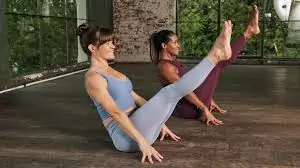
Boat Pose:

Boat Pose Steps:
- With your hands on the floor near your hips, your spine straight, your knees bent, and your feet on the floor in front of you, take a seat on a mat.
- As you raise your feet and balance on your sitting bones, keep your knees bent and lean back a little. According to Nico, try to keep your collarbone raised and your spine straight.
- Reach your arms forward with your palms facing one another as soon as you feel secure. Move your shoulders away from your ears by drawing them back and down. If at all feasible, straighten your legs while keeping your hips angled. Keeping your breath steady, draw your belly button up and in toward your spine to further activate your core.
- Hold for three to five breaths.
Plank Pose:

- Place your hands flat on the floor just behind your shoulders and begin in a tabletop position with your knees beneath your hips.
- Balance on your toes as you raise your knees off the ground and extend your legs behind you. From your head to your heels, your body should be in a single, straight line.
- Imagine raising out of your shoulder girdle, pushing away from the floor, and pulling your shoulders back and down without curving your spine.
- Hold for three to five breaths.
Side Plank Pose:

- Place your left foot on top of your right foot while lying on your right side with your legs straight. Put your right palm beneath your right shoulder on the ground.
- Press up into a side plank while resting on the outside of your right foot and your right hand or forearm, bracing your glutes and core. Raise your left arm to the ceiling.
- Repeat on the opposite side after holding for three to five breaths.
Floating Tabletop Pose:

- With your palms on the floor beneath your shoulders and your knees exactly beneath your hips, begin in the tabletop position. Make sure your spine, including your neck, is in a neutral position by tucking your toes and using your core.
- To raise your knees so they are slightly off the ground, press your palms and toes into the floor.
- Hold for three to five breaths.
Warrior 3 Pose:

- Stretch your left leg up and back to hip height while keeping your right leg slightly bent. Make your torso parallel to the floor by bringing your chest forward.
- Keep your hips square, your left foot flexed, and all five toes pointing downward. Make sure your biceps are near your ears by extending both arms forward.
- Squeeze your inner thighs together, tuck your hips and pelvis toward your center, and pull your lower abs against your spine to keep your balance.
- Repeat on the opposite side after holding for three to five breaths.
Cobra Pose:
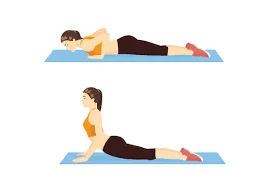
- To begin, lie face down on the floor with your feet hip-width apart, your legs long, and your toes untucked. With your elbows close to your ribs, place your hands on the floor beneath your shoulders.
- Breathe in to raise your chest off the floor by pressing your hands into the mat and squeezing your shoulder blades together.
- Pull your belly button softly in toward your spine while you extend your heart forward and contract your core. Press the tops of your feet into the ground and slide your shoulders back and down to draw them away from your ears.
- Hold for three to five breaths.
Locust Pose:

- Start by lying face down on the floor with your feet hip-width apart, your arms by your sides, your legs long, and your toes untucked. With your neck extended, let your forehead drop to the ground.
- Press your pubic bone into the ground and inhale as you slowly raise your head, chest, shoulders, arms, and legs off the ground.
- Maintain a long neck while looking at the floor approximately one foot in front of you. Consider stretching through your fingertips, pulling your shoulder blades back and down, and reaching from the top of your head to the balls of your feet.
- Hold for three to five breaths.
Bridge Pose:
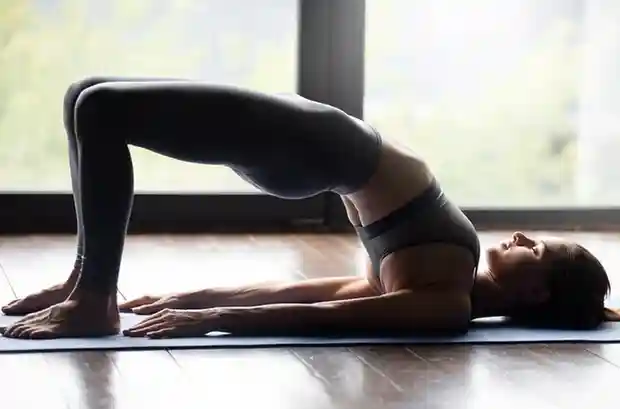
- With your feet flat on the ground, hip-width apart, and your knees bent, lie face-up. Put your palms on the mat and your arms by your sides.
- Take a breath and press into your feet to raise your hips off the ground while gently tucking your tailbone beneath. When your body is in a straight line from your shoulders to your heels, pause.
- You can keep raising your hips, expanding your ribs, reaching your hands beneath your body, and rolling your shoulders open to try to clasp them together if you prefer a greater backbend.
- Whichever form you choose, maintain a neutral neck, parallel feet and knees, and a ceiling-focused look.
- Hold for five breaths.
Easy Seated Twist Pose:

- With each foot beneath the opposing knee, take a cross-legged position on the floor.
- Put your left hand on the ground behind your left hip and your right hand on your left knee. On an inhale, lengthen your spine; on an exhale, rotate to the left while drawing your belly button softly toward your spine to engage your core.
- After three breaths, carefully untwist and repeat on the opposite side.
Crow Pose:

- With your feet close together and your knees broad, begin in Garland Pose (Malasana) or Yoga Squat. Place your palms shoulder-width apart on the floor in front of you while you extend your arms and chest forward. To grasp the mat, extend your fingers widely.
- Place your knees on your upper arms as far up (or as close to your armpits) as possible while shifting your weight forward into your hands and landing on the balls of your feet. Maintain a long neck and look at the floor directly in front of your hands.
- Continue transferring your weight to your hands until your feet start to feel lighter. Draw your heels to your glutes as you raise them one at a time.
- Squeeze your elbows with your knees, drag your belly button in toward your spine, and round your back to activate your core. You can either progressively straighten your arms or keep your elbows bent.
- Hold for two to five breaths.
Conclusion
Incorporating core-focused yoga poses into your routine can help enhance functional strength, reduce the risk of injury, and support better performance in daily activities and workouts.
FAQs
Does yoga improve core strength?
Yoga is a great way to improve your core, in fact. Apart from the aforementioned poses, flow yoga (vinyasa) is very beneficial for the core because it needs balance and agility to go from stance to pose.
What is the quickest way to use yoga to strengthen your core?
Over time, consistent yoga practice will strengthen your core. You might try incorporating dynamic movement to increase the intensity. For example, dropping your back knee toward the floor from High Lunge or softly transitioning from Boat to Low Boat.
What are the big 3 core exercises?
The bird dog, side plank, and modified curl-up are the three exercises. By concentrating on specific back and core muscles, each exercise helps to improve stability and reduce pain. However, the McGill Big 3’s advantages go beyond relieving back discomfort.
What are the common mistakes when engaging the core?
Overdoing the Abs.
When performing core exercises, arch your back.
Your pelvic muscles are not being used.
Ignoring injuries.
Holding your breath.
How can I tell if I’m properly using my core?
The broad flat muscle beneath your finger pads will tense when you use your transverse abdominis or deep abdominal muscles. The outer abdominal muscles are being worked if your stomach pooches or pushes outward, if you’re holding your breath, or if something is pushing away.
References:
- The 12 best yoga poses for core strength – 2026 – Cheung/liforme.com/blogs/blog/the-12-best-yoga-poses-for-core-strength?srsltid=AfmBOooCiSR9uMDWHJfDz0klmr56BVKXhvOQePi5mdOPrn1VmIaM62es
- Yoga for building core strength: Essential poses and techniques – The Yoga Institute – 2022 – the yoga institute/theyogainstitute.org/yoga-for-building-core-strength-essential-poses-and-techniques
- Why yoga is so great for core strength—and 10 poses that do the trick – 1970 – Mazzo/www.onepeloton.com/blog/yoga-for-core-strength


