Advanced Shoulder Mobility Exercises
Introduction
Exercises for shoulder mobility are crucial for preserving the complete range of motion and functional health of one of the body’s most complex and active joints. From reaching aloft to lifting, throwing, or stabilizing posture, the shoulder is engaged in almost every upper-body function and offers an exceptional range of motion in flexion, extension, abduction, adduction, and rotation.
Stiffness, muscle imbalances, and limited mobility can develop over time as a result of things like poor ergonomics, repeated strain, injury, and inactivity. Targeted mobility exercises aid in improving muscle coordination, restoring joint integrity, and avoiding compensatory habits that might cause dysfunction or discomfort. For long-term musculoskeletal health and performance, shoulder mobility exercises are essential, regardless of whether you’re an athlete, desk worker, or recovering from an accident.
Anatomy related to the shoulder
The Shoulder Complex’s bones
- The head of the humerus, which is the upper arm bone, forms the ball of the ball-and-socket joint.
- The acromion and coracoid process are two of the several muscles that are anchored by the scapula, or shoulder blade.
- The collarbone, or clavicle, stabilizes the shoulder girdle by joining the shoulder to the sternum.
Participating Joints
- The main shoulder joint, the glenohumeral joint, is quite flexible but not as stable.
- Between the clavicle and the acromion is the acromioclavicular (AC) joint, which permits overhead movement.
- The clavicle and sternum are connected by the sternoclavicular (SC) joint, which also aids with shoulder elevation.
- Although it is not a genuine joint, the scapulothoracic joint is essential for shoulder mechanics and scapular mobility.
Shoulder Mobility-Related Muscles
- Group Rotator Cuff: Supraspinatus: Starts the abduction process
- Teres Minor & Infraspinatus: Rotation from the outside
- The subscapularis Rotation within
- The primary mover for flexion and abduction is the deltoid.
- Elevates and rotates the scapula with the trapezius.
- Serratus Anterior: Prevents scapular winging, which is essential for overhead movement.
- Latissimus Power muscles for pushing and pulling are the Dorsi and Pectoralis Major.
Fuction
- The shoulder is prone to injury if it is not adequately conditioned since it is made for mobility rather than stability. Because of this, improved mobility work has to incorporate:
- Control of the scapula
- Mobility of the thoracic spine
- Activation of the rotator cuff
- Fundamental involvement
Indications
- Reversible Hypomobility of the Joints: Perfect for glenohumeral joints that are tight or limited in mobility.
- Recovery after surgery or injury: encourages the safe return of movement following dislocation, frozen shoulder, or rotator cuff repair.
- Spasm & Muscle Guarding: enhances neuromuscular coordination and lessens protective stress.
- Subluxations or Positional Faults: Minor joint misalignments can be fixed and functional placement restored with mobilization procedures.
- ROM’s Progressive Limitations: beneficial for conditions including degenerative joint changes or adhesive capsulitis.
- Bad posture brought on by a sedentary lifestyle: combats the thoracic rigidity and forward shoulder rounding that are typical among tech users.
- Pain in the upper back and neck: relieves compensatory tension caused by shoulder immobility in the cervical spine and trapezius.
- Enhancement of Athletic Performance: improves scapular control, throwing mechanics, and overhead strength.
- Limitations on Daily Activities: makes reaching, dressing, lifting, and other rotating or overhead operations easier.
- A decline in mobility associated with aging keeps one independent and lowers the chance of falling by maintaining upper-body function.
- The Neurophysiological Recurrence: promotes joint awareness and proprioceptive feedback.
- Immobility in Function: addresses impairments in movement brought on by extended immobility or inaction.
- Sternoclavicular and scapulothoracic dysfunction: Coordination throughout the shoulder girdle complex is enhanced by mobilization.
Exercises for shoulder mobility
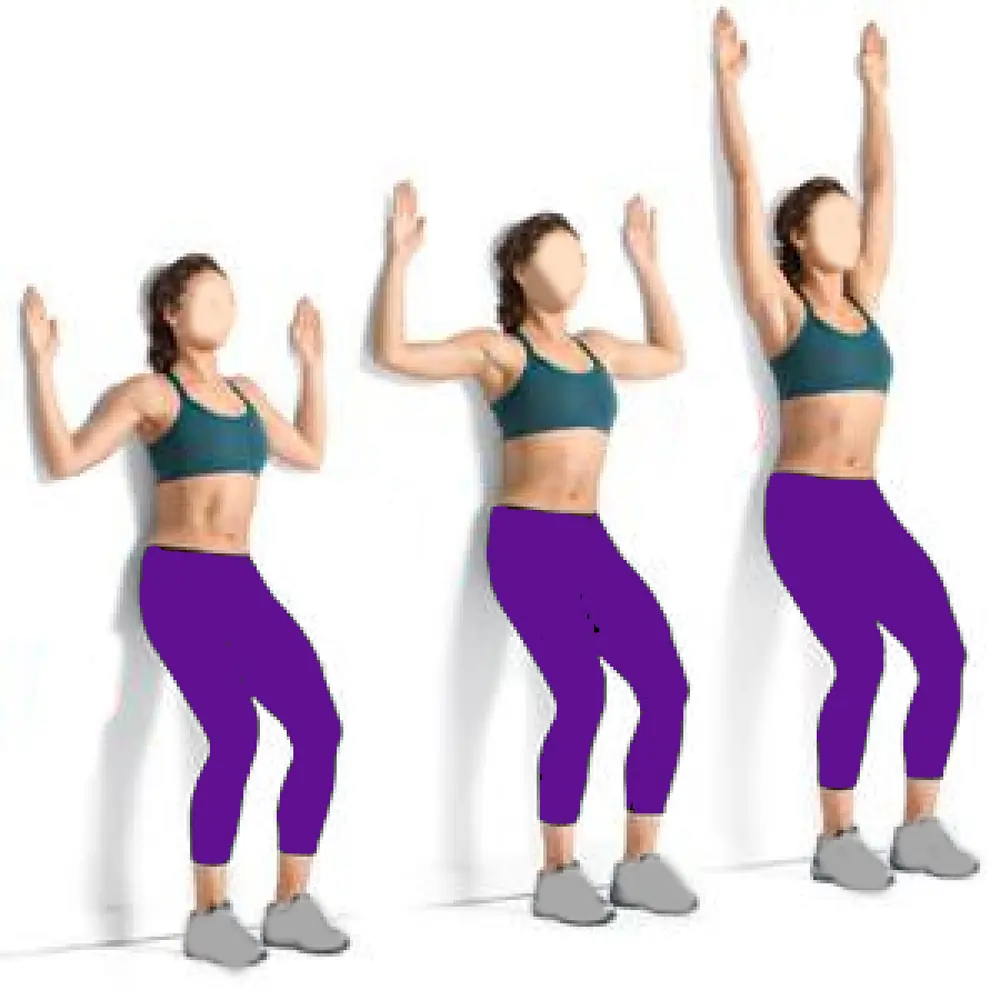
Wall angle with lift off
- Position: Standing position.
- Place your feet about 6 to 8 inches (15 to 20 cm) from the wall as you stand. Lean your head, shoulders, back, and butt against the wall.
- Draw your belly button toward your spine to try to start with a neutral spine. Feel the rear of your rib cage attach to the wall as you draw your ribs in and down, keeping your lower back just a little bit off the wall.
- Try to get the back of your head to contact the wall by tucking your chin in a little.
- After that, raise your arms straight up and place them on the wall over your head, making sure the backs of your hands make a “V” shape with the wall. Try moving your feet farther away from the wall to see if it fixes any alignment problems you may be having.
- After that, move your hands down the wall until they are just over your shoulders and start bending your elbows. Keep your butt, head, and trunk against the wall in the meantime.
Overhead Banded pull apart

- Position: Standing or sitting.
- Place your feet shoulder-width apart and stand firmly.
- Stretch your arms over your head while holding the band in both palms, facing up.
- Lower your arms to shoulder height and move your hands aside to pull the band apart. After a few seconds of holding the pose, raise your hands back up.
- Do 12–15 repetitions for two to three sets.
Shoulder-controlled articular rotation

- Position: Standing or sitting.
- With your arms by your sides and your feet shoulder-width apart, take an upright position and sit or stand. Tuck your chin in a little.
- Raise your shoulders near your ears first.
- Make short, gentle circles with your shoulders up, forward, down, and back while maintaining a straight back.
- Finish a set of four in a single direction.
- Put your shoulders back in the middle.
- Next, change the direction by turning your shoulders back and up.
- In each direction, aim for a set of four.
Behind-the-back internal rotation stretch

- Position: Standing position.
- With one hand stretching over your shoulder and the other from below, hold a towel behind your back.
- Stretch the lower arm into internal rotation by gently pulling upward with the top hand.
- For a clear example from the standpoint of sports medicine, see Internal Rotation Behind the Back with Towel Stretch.
Increasing Variations
- Internal rotation that lies sideways
- 90-degree elbow stretches
- Stretching a towel using postural cues
- These assist you in adjusting according to your present comfort level and range.
Thread the needle
- Get down on your hands and knees. Directly above the knees are the hips. The distance between the thighs, knees, calves, ankles, and feet is hip distance. The feet’s tops are planted on the ground.
- The arms and hands are separated by shoulder distance. Place the shoulders on top of the wrists and elbows. Root down through the thumb, index, and pinky fingers after spreading the fingers wide.
- Draw the naval in and up toward the spine to provide a small engagement to the belly.
- Raise your right arm toward the sky and shine your heart up as you take a breath. Look in the arm’s direction.
- To release, bring both arms out in front of you and walk back to tabletop position.
Scapular pull-ups

- Position: Standing position.
- Make sure you have a complete overhand grasp on the pull-up bar. Aim for a grip that is either slightly wider than your shoulders or shoulder-width apart. Stand on a sturdy flat bench or a plyometric box if you can’t reach the pull-up bar.
- Get out of the box and let your legs hang down. You should have long arms and legs. You should bend your elbows slightly. Tighten your quadriceps and glutes. Use your core. Your pelvis should be somewhat tucked in, and your ribs should be down.
- Squeeze your upper back muscles by pulling your shoulder blades down toward your waist and slightly together while keeping your arms extended. Only at the shoulder blades should there be movement. Hold this stance for a moment.
- As you slowly lower yourself back to the beginning position, keep your arms long and let your shoulder blades glide up and away from your waist. Your shoulder blades should be away from your spine, and your arms should be long with a small bend in the elbows.
Modifications:
Assisted scapular pull-up: An assisted pull-up can be a good place to start if this is your first time performing a pull-up. Before performing the exercise, place a foot inside the opposite end of the resistance band and wrap it around the pull-up bar to practice an assisted scapular pull-up. The band will support you during the upper portion of the workout and assist you in lowering yourself gradually.
Consideration points for shoulder mobility exercises
- Get Well Warmed Up: Make use of dynamic exercises such as scapular circles, thoracic rotations, and arm swings. This prepares your core, scapular stabilizers, and rotator cuff for safe movement.
- Be mindful of your range: Avoid pushing yourself into end-range postures, particularly when you’re overhead flexing or rotating internally. Tendon impingement may result from the subacromial space being compressed by limited internal rotation.
- Prior to mobilization, activate: Prior to deep stretches, activate stabilizers such as the rotator cuff, lower trapezius, and serratus anterior. This creates a solid foundation for secure joint mobility.
- Strike a Balance Between Strength and Mobility: If flexibility is overemphasized at the expense of strength, the joint may become unstable.
- Incorporate exercises for eccentric control, scapular retraction, and strengthening of the external rotation.
- Take Care of Your Scapula: The neck and upper traps compensate for poor scapular control.
- Pay attention to protraction mechanics, posterior tilt, and scapular upward rotation.
- Employ Core Engagement and Proper Breathing: Shoulder mechanics and thoracic mobility might be negatively impacted by breath-holding or bad posture.
- During drills, work on neutral spine alignment and diaphragmatic breathing.
- Avoid too much repetition, fatigue, and overuse.
- Avoid doing too much mobility work, particularly if you’re currently doing upper-body exercises.
- Alternate days of mobility with isometric holds and soft tissue exercises.
Special test
Tests of Impingement: used to identify the syndrome of subacromial impingement.
- Neer’s Test: Stabilizing the scapula while passively flexing the arm forward. Impingement is suggested by pain.
- Kennedy-Hawkins Test: Internally rotate after flexing the elbow and shoulder to 90 degrees. Impingement is indicated by pain.
Tests for Instability: Evaluate the risk of dislocation or shoulder joint laxity.
- Concern Test: Externally rotate the arm after abducting it; dread or concern suggests anterior instability.
- Relocation Test: During the apprehension test, provide posterior force; if symptoms subside, instability is confirmed.
- Sulcus Sign: An inferior instability is indicated by downward tension on the arm and a noticeable sulcus beneath the acromion.
Tests for acromioclavicular Joints: for pathology of the acromioclavicular joint.
- Cross-body Adduction Test: When the arm is passively adducted across the body, discomfort at the AC joint indicates a good result.
Labral Test: used to find labral tears or SLAP lesions.
- The O’Brien Test: 90° arm flexion, 10–15° adduction, and internal rotation (thumb down). Labral pathology may be indicated by pain that is resistant.
- Crank Test: When rotating the shoulder, an axial strain is given; clicking or discomfort indicates a labral tear.
What more is there to do?
It takes focused movement, stability, and strength to restore a complete, pain-free range of motion in the shoulders. Improving shoulder mobility is not simply about stretching. This is a thorough method that you may follow, with professional-led video tutorials to help you at every stage:
Evaluate Your Present Level of Mobility
- Determine your shoulder range before beginning any activities.
- How to Increase Shoulder Range of Motion (Stretches…) discusses how much range of motion you truly need for functional tasks and guides you through a self-assessment. It’s a fantastic place to start when figuring out your constraints.
Daily Routine for Mobility (10–15 minutes)
- The secret is consistency. Shoulder function can be significantly improved with a quick daily routine.
- To improve flexibility and control, the 10-Minute Shoulder Mobility Routine (Bulletproof Shoulders) incorporates dynamic exercises, including prone swimmers, wall angels, and shoulder flossing.
Strength & Control in Progress
- Without strength, mobility is unsteady. Control is developed through a complete range with these progressions.
- To improve shoulder stability and coordination, INCREDIBLE Shoulder Mobility Exercise Progressions… presents more complex exercises, including scapular circles and rotating sword motions.
Train Every Motion Plane
- There are several ways the shoulder may move; practice them all.
- Flexion, extension, abduction, adduction, and rotation are all covered in Exercises to Improve Shoulder Mobility with explicit examples. For developing a comprehensive shoulder protocol, this is perfect.
Deal with Impingement or Pain
- Start with corrective exercises if discomfort is preventing you from moving about.
- Five Shoulder Pain Reduction Exercises (No More Impingement) provides a combination of rotator cuff activation, postural strengthening, and stretching to reduce pain and safely restore mobility.
Benefits
- Increased Range of Motion: improves the shoulder’s range of motion, which is crucial for lifting, reaching, and turning.
- Decreased Stiffness and Pain: reduces stress brought on by sedentary lifestyles, repeated strain, and bad posture.
- Improved Posture: Shoulder mobilization expands the chest and helps prevent forward-slouched posture.
- Preventing Injuries: reduces the chance of impingement and rotator cuff injuries by strengthening stabilizing muscles and enhancing joint mechanics.
- Improved Comfort in the Neck and Upper Back: reduces compensatory tension brought on by restricted shoulder mobility in the cervical spine and trapezius.
- Better Control of the Neuromuscular System: improves the way stabilizers like the scapular group and shoulder muscles work together.
- Improved Sports Performance: enhances shoulder mechanics to support lifting, swimming, throwing, and overhead motions.
- Quicker recovery From Surgery or Injury: helps restore functional mobility and promotes safe rehabilitation.
FAQs
Shoulder pain is caused by which deficiency?
What are the reasons for shoulder pain on both sides?
Nutrient deficiencies, particularly a lack of vitamin D, have been related to shoulder pain and an increased risk of disorders like frozen shoulder, subacromial impingement syndrome, and problems with tissue recovery following surgery. Deficits in other nutrients, such as calcium and vitamin C, can also impact bone strength and tendon function, which can lead to musculoskeletal issues and discomfort.
What leads to limited shoulder mobility?
Not doing anything. Inactivity, rather than movement, is one of the most frequent reasons for low shoulder mobility. Since the shoulder is the most mobile joint in the human body and has a strong urge to move often, frozen shoulder is a constant worry.
What signs point to discomfort in the right shoulder?
Damage to the muscles, tendons, or ligaments, or to the peripheral nerves in those regions, is frequently the cause of pain in the right arm and shoulder. It could indicate a heart attack in some situations. The third most common muscle and bone complaint in the US is shoulder discomfort.
Which muscles are used in shoulder exercises?
The front, middle, and rear deltoids are the three heads of the deltoid muscle that should be worked in the finest shoulder workout; however, this alone is insufficient to complete the upper-body workout. The most effective shoulder exercises must also incorporate forceful action, overload, and appropriate shoulder activation.
How can shoulder muscles be strengthened?
Overhead lifts, dumbbell lateral raises, and workouts that work the rotator cuff and back muscles, such as the “W exercise” or resistance band exercises for external rotation, are good ways to build shoulder muscles. To prevent damage, start with smaller weights or bands and concentrate on form. Over time, progressively increase the weight, reps, or resistance while aiming for several sets of ten to fifteen repetitions.
References
- Mpt, T. E. P. (2021, May 26). Wall Angels: Benefits, Muscles Worked, and How-To. Healthline. https://www.healthline.com/health/fitness/wall-angels#how-to
- Davis, C. (2023, October 13). 15 Shoulder Rehab Exercises with Bands: Rotator Cuff Resistance Band Exercises. LIT Method. https://www.litmethod.com/blogs/boltcut-blog/shoulder-rehab-exercises-with-resistance-bands?srsltid=AfmBOoqqjIysFRCr6XCiyRoxBDz8l736HieSJevFlEsHTxh5VIzDTLg2
- Kazmi, W. (2022, October 13). Shoulder Exercises – Sports Injury & Pain Management Clinic of NYC. Sports Injury & Pain Management Clinic of NYC. https://www.sportspainmanagementnyc.com/self-care/shoulder/
- Thread the needle Pose Thread the Needle Pose the Yoga Collective. (2020, December 25). The Yoga Collective. https://www.theyogacollective.com/poses/thread-the-needle/