8 Best Gluteus Medius Exercises
The gluteus medius is a key hip muscle responsible for stability, balance, and proper movement during walking and running. Strengthening it can help prevent hip, knee, and lower back pain while improving athletic performance.
The Gluteus Medius Muscle: What Is It?
The gluteus medius is one of your gluteal muscles. You have one on either side of your pelvis. According to the National Academy of Sports Medicine (NASM), the glute medius aids with hip rotation, other hip movement, and trunk stabilisation when moving.
What is the location of the Gluteus Medius?
The gluteus medius derives its name from its location: It is located between the gluteus maximus and gluteus minimus muscles, which are the other two major glute muscles. It is not your glutes’ largest muscle (that is the gluteus maximus), hence it does not contribute much to the contour of your buttocks. The National Institute for Fitness and Sport says it’s a little higher up, closer to your pelvis.
How to activate the Gluteus Medius:
However, if your gluteus medius is weak or you do not utilise it frequently, you may need to activate it with specific workouts. According to Cantor, this is especially necessary before a lower-body workout that includes large motions such as squats and lunges.
Side-to-side movement is important because it involves the gluteus medius. A banded lateral walk is an excellent workout for activating your gluteus medius.
8 Best Gluteus Medius Exercises:
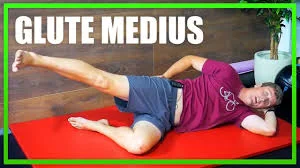
Side-lying leg lifts

- Lie on your right side, legs stacked and straight.
- Keep your left leg straight and elevate it towards the ceiling.
- Lower your left leg carefully back down, and repeat for the appropriate number of reps.
- Repeat on the opposite side.
Clamshells
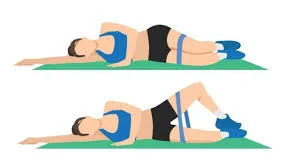
- Lie on your right side, with your legs stacked and your knees bent at roughly 45 degrees.
- Support your head with your right arm.
- Gently place your left palm on the floor in front of you.
- Keeping your heels together and your back steady, extend your left knee as far as possible.
- Bring your left knee back down and repeat for the appropriate number of repetitions.
- Repeat on the opposite side.
Standing Hip Abduction

- Begin standing with your feet together and your hands on your hips, core engaged.
- Transfer your weight to your right foot. Squeeze your left glute to raise your left foot up and out to the side while maintaining your body erect.
- Bring your left foot back to the centre, but do not let it contact the floor.
- Repeat for the appropriate number of repetitions and then swap sides.
Fire hydrants

- Begin on all fours, placing your hands just behind your shoulders and your knees firmly beneath your hips. Maintain a neutral spine and engage your core.
- Keep your right knee bent as you lift your right leg out to the side from your hip. Lift your knee to hip height and pause momentarily.
- Lower your right leg to its starting position.
- Repeat for the appropriate number of repetitions and then swap sides.
Hip thrusts
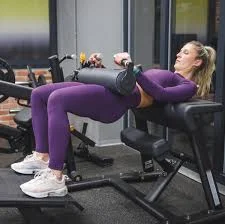
- Begin by placing your back and shoulders against a bench or box, knees bent, and feet flat on the floor.
- Set a barbell over your hips or a dumbbell on each hip bone. Gently keep the weight in place.
- Lift your hips by pressing through your feet until your body is in a straight line from your knees to your shoulders.
- Slowly drop your hips back to the ground.
- Repeat for the appropriate number of repetitions.
Donkey Kicks
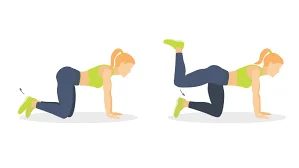
- Begin on all fours, placing your hands just behind your shoulders and your knees firmly beneath your hips. Maintain a neutral spine and engage your core.
- Keep your right knee bent and kick your right foot up. Consider pushing the sole of your foot towards the sky. Lift your knee to hip height and pause momentarily.
- Lower your right leg to its starting position.
- Repeat for the appropriate number of repetitions and then swap sides.
Side Plank with Leg Lift
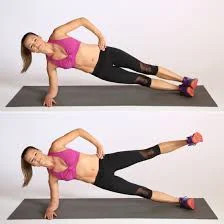
- Lie on your right side, stacking your left foot on top of your right foot.
- Brace your core and glutes, then drive up into a side plank while resting on the outside of your right foot and palm or forearm.
- Squeeze your glutes and elevate your left leg until your foot is at hip height. Take a little pause here.
- Lower your left foot till it touches your right foot, then repeat for the appropriate number of repetitions.
- Repeat on the opposite side.
Single-Leg Glute Bridge

- Lie on your back, knees bent, feet on the floor.
- Engage your core and stretch your left leg to the ceiling, precisely over your left hip.
- Tuck your hips slightly under and move your weight to your right foot.
- To elevate your hips off the ground, press through your right foot. Lift until your body creates a diagonal line connecting your right knee, hips, and shoulders. Take a little pause here.
- Slowly drop your hips to the ground.
- Continue for the appropriate amount of repetitions, then repeat on the opposite side.
Takeaway
The gluteus medius rotates your hip, moves it away from the centre of your body, and stabilises your torso. However, many people have weak glute medius muscles, particularly if they spend a lot of time sitting.
Strengthening the gluteus medius with specific workouts will help you maintain balance and avoid injury while running and leaping. Clamshells, fire hydrants, and side planks with leg lifts are three excellent gluteus medius workouts to attempt.
FAQs
What exercises target the gluteus medius?
Single-legged glute bridge. Performing a glute bridge with only one leg at a time works your gluteus medius more than a conventional bridge.
What symptoms indicate a weak gluteus medius?
Chronic muscular discomfort in the joints and groin region.
Internal rotation of the knees.
Weak abductor muscles cause abnormal movement patterns.
Muscle tightness occurs when the body adjusts to a loss of hip stability and control.
What is the primary function of the gluteus medius?
The gluteus medius works to keep the side of the pelvis that descends stable, allowing the other leg to swing forward for the following stride. The gluteus medius also supports the pelvis during walking, causing hip rotation with the help of the gluteus minimus and tensor fascia lata muscles.
Does walking exercise your gluteus medius?
Yes, when it comes to developing your glutes when walking, the gradient is key.
Are stairs or a treadmill better for glutes?
Yes, in fact, incline walking is a superior alternative for toning your glutes.
Referances
- Cpt, K. S. (2020, June 27). The best exercises to target the gluteus medius are. Healthline. https://www.healthline.com/health/fitness-exercise/gluteus-medius-exercises
- Klein, S. (1970b, January 1). Why you should be working your Gluteus Medius—Plus The best 8 exercises to target it. https://www.onepeloton.com/blog/gluteus-medius-exercises
- Otr/L, S. B. (2023, November 9). 10 Gluteus Medius Exercises for Stronger hips and buns. Verywell Health. https://www.verywellhealth.com/10-gluteus-medius-exercises-7968848


