Core Exercises at Home That Can Reduce Lower Back Pain
One of the most frequent reasons people seek medical attention, miss work, or restrict their physical activity is back pain. Weak core muscles are frequently a major contributor to back discomfort, while there are many other variables as well, such as injury, bad posture, and underlying medical disorders.
Fortunately, strengthening your core doesn’t have to be dangerous or uncomfortable. In actuality, a variety of mild, focused activities can improve spinal health and lessen persistent back pain.
Why Core Strength Matters for Back Pain
The abs, obliques, lower back, pelvic floor, and deep stabilizing muscles like the transverse abdominis and multifidus make up your “core,” which is more than simply your abdominal muscles. Together, these muscles stabilize your spine, enhance your posture, and facilitate effective movement.
Your back muscles and joints may be strained as a result of your body’s compensatory mechanisms when your core is weak.
Developing a stronger core can:
- Boost the alignment of your spine
- Minimize lower back strain
- Improve stability and balance
- Stop more harm or flare-ups
The Importance of a Strong Core for Back Health
- The holy tetrad that protects our backs—the rectus abdominis (the “six-pack” muscles), obliques, transverse abdominis, and erector spinae (lower back muscles)—is one of nature’s many wonders.
- Your spine is supported and stabilized during daily motions by these core muscles, which function as a natural corset.
- This frequently leads to chronic back discomfort, bad posture, and an elevated risk of injury.
- By adding concentrated effort, you can build a stronger, more resilient core that more efficiently distributes the pressures placed on your back and reduces excessive strain and compression on the spine.
- core-strengthening exercises to your regimen.
- Additionally, a strong core may correct poor posture and enhance spinal alignment, reducing back pain and averting subsequent problems.
How to prevent low back pain
Preventing back pain is easier than treating it. Thankfully, there are numerous ways to avoid this kind of discomfort:
- Lift correctly
- To lift yourself, contract your core muscles and activate your leg muscles.
- Bend at the knees without losing your back straight.
- Stand close to the object and hold it close to your body.
- Tighten your abdominal muscles and raise yourself using your leg muscles.
- Keep your posture correct
- When sitting or standing, try not to slouch.
- With your shoulders back and your head raised, take a proud stance.
- Get up and move about frequently if you work at a desk. Take regular breaks from sitting.
- Keep your weight in check
- Reaching and maintaining a healthy weight will reduce the strain on your back.
- Continue to be active
- Frequent exercise maintains the strength of your back muscles.
- Attempt to engage in at least 150 minutes of moderate-intensity aerobic activity per week.
- Get adequate vitamin D and calcium
- These nutrients maintain the strength of your bones and aid in preventing osteoporosis, which, if it affects the spine, can result in back pain.
- Give up smoking
- According to research, smokers experience back pain episodes more frequently than nonsmokers, and the risk increases with smoking frequency.
Exercises for strengthening and stretching to treat lower back pain
Seeing your doctor before starting any activity could be a good idea if you experience back pain. Certain exercises may exacerbate your discomfort, depending on what’s causing it. For instance, if you suffer from sciatica, several stretches or movements may make your situation worse.
Additionally, make an effort to get up frequently and move around as much as you can.
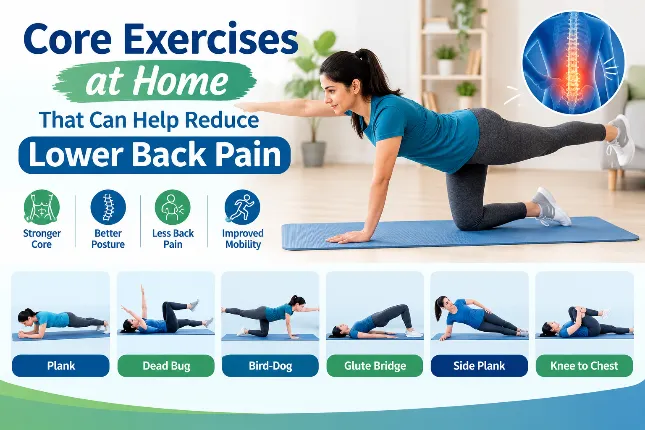
Core Exercises for Back Pain
- Seated trunk rotation
- Standing trunk rotation
- Standing lumbar extension
- High knees
- Standing side bends
- Standing back stretch
- Seated cat-cow
- Cat-cow
- Child’s pose
- Forearm Plank
- Knee rolls
- Bird dog
- Upward-facing dog
- Knee hugs
- Seated good mornings
- Good mornings
- Pelvic lift
- Standing trunk rotation with extended arms
- Superman
- Wall Sits
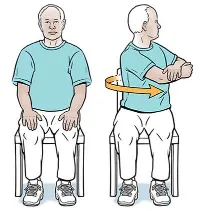
Seated trunk rotation
How to do
- Choose a solid chair, such as one for a dining table.
- Sit slightly forward so that your back does not press on the chair, bend your knees to a 90-degree angle, and place your feet shoulder-width apart.
- Your arms should be crossed over your chest.
- Always keep your hips looking forward.
- Rotate slowly to the right until it feels comfortable, then turn back to face the front.
- Rotate as far to the left as is comfortable, then turn back to the front.
- Ten times on each side, repeat the motion.
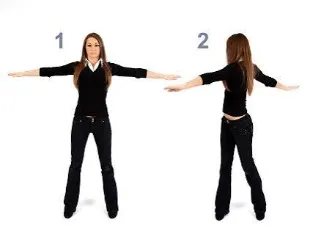
Standing trunk rotation
How to do
- Maintain a straight stance while slightly bending your knees and spreading your legs.
- Your arms should be crossed over your chest.
- Always keep your hips looking forward.
- Make a soft, comfortable left rotation, then turn back to the front.
- Ten times on each side, repeat the motion.
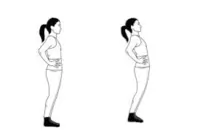
Standing lumbar extension
How to do
- Stand with your feet apart and place your hands on your lower back with your fingers pointing downward.
- Bend your body backward at the waist while keeping your legs straight and your hands supporting your trunk.
High knees

How to do
- Maintain a straight posture and a small gap between your legs.
- Raise your right knee as high as you can to a 90-degree angle, then lower it down to the ground.
- Raise your left knee to a 90-degree angle as high as you can, then carefully lower it back to the floor.
- With each leg, repeat the motion ten times.
Advice: If you have trouble staying balanced, grab onto the back of a chair or a desk. Consider asking a friend or relative to be nearby if you require further help.
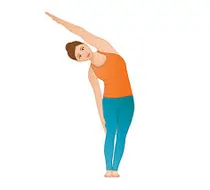
Standing side bends
How to do
- Place your legs shoulder-width apart and stand erect.
- Arms should be by your sides.
- Slide your hand down your leg to your knee as you slowly lower your body to the right while maintaining a straight posture
- Go as far as you feel comfortable.
- Return to a straight stance gently and repeat on your left side.
- Ten times on each side, repeat the motion..
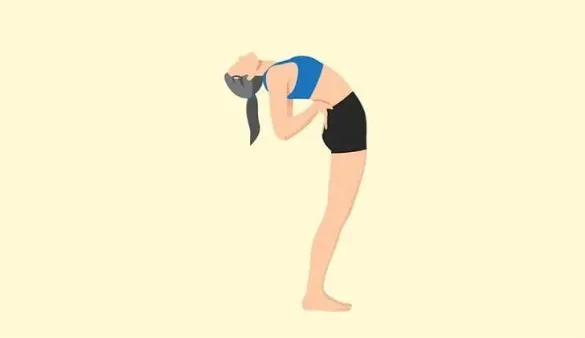
Standing back stretch
How to do
- Place your legs shoulder-width apart and stand erect.
- Gently bend forward, lower your shoulders, reach your fingers to the floor, and turn your back toward the ceiling.
- Relax your back muscles to give the impression that your upper body is hanging down.
- Return to a straight posture with gentleness.
- Do this five times.
Seated cat-cow

How to do
- Seek out a solid chair without arms, such as a dining table chair.
- Place your hands on your thighs, bend your legs at a 90-degree angle, sit upright 10 to 15 cm (4 to 6 inches) from the back of the chair, and place your feet slightly apart.
- As you release the breath, bend forward and gradually circle your back. Pull your tummy in while dropping your chin to your chest and extending your wrists past your knees.
- Reverse the action once you’ve held it for a second or two.
- As you take deep, relaxed breaths, sit back up straight.
- Then look up toward the ceiling, arch your back, and push your stomach out.
- You should move your hands up your thighs to bring them closer to your body.
- Restart after holding for one to two seconds.
Cat-cow

How to do
- Put your hands flat on the floor and get down on all fours.
- Maintaining your knees just below your hips, place your arms straight beneath your shoulders.
- Inhale while arching your back, lowering your stomach to the floor, and looking up at the ceiling.
- Hold the motion for one to two seconds, then reverse it.
- Pull your belly button toward your back, curve your back, and drop your head to the floor while exhaling.
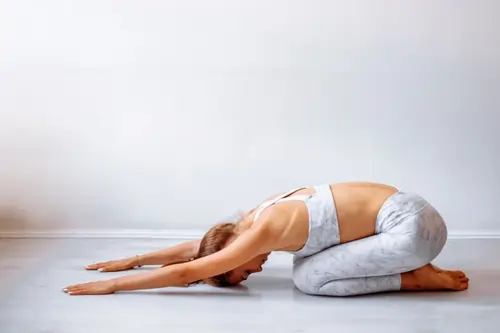
Balasana (Child’s Pose)
How to do
- As you press your butt back into your heels while on your hands and knees, keep your knees apart.
- Spread your arms over the floor above your head, lower your upper body between your knees, and rest your forehead on or close to the floor.
- For 20 to 30 seconds, maintain this posture.
Forearm Plank

How to do
- In the forearm plank posture, begin with your elbows precisely beneath your shoulders and your body in a straight line from head to heels.
- To keep yourself stable, contract your glutes and core.
- Depending on your stamina, hold for 20 to 60 seconds.
- Do this three times.
Knee rolls
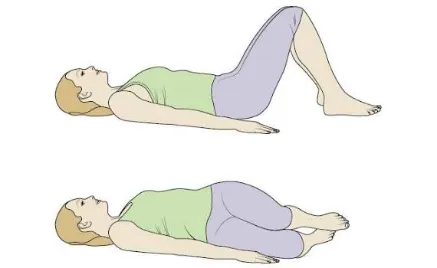
How to do
- Bend your knees while lying on your back with your feet flat on the floor.
- Extend your arms to the sides at a 90-degree angle to your torso.
- After exhaling, slowly move both knees to the right while maintaining your feet and legs together.
- Hold for one or two seconds.
- Take a breath and return your knees to the center gradually.
- On the left side, repeat.
Bird dog

How to do
- Get on all fours with your knees slightly behind your hips and your hands on the floor behind both shoulders.
- Raise your right arm forward and your left leg straight behind you until they are both parallel to the floor while keeping your head in line with your spine.
- After pausing, go back to where you were.
- Proceed with the left and right legs.
- Make sure your back is flat, your hips are level, and your abdominal muscles are taut throughout the exercise.
- Perform ten repetitions on each side.
Upward-facing dog

How to do
- Lying face down on your stomach, extend your legs straight out.
- Put your hands on the floor at your lower ribs and chest.
- Place your hands on the floor near your chest and lower ribs.
- In order to activate your core, inhale deeply and pull your belly button in the direction of your back.
- As you gradually exhale for three to five seconds, straighten your arms, press your palms into the floor, and elevate your head, neck, and back.
- Attempt to maintain your hips on the ground.
- Inhale, then lower yourself to the floor by bending your arms.
Knee hugs
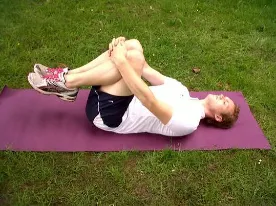
How to do
- Lying on your back, extend your legs straight.
- Bring your knees up to your chest.
- Holding your knees in both hands, slowly draw them into your chest like an embrace while exhaling.
- Hold for five seconds.
- Breathe deeply, let go of your hands, and straighten your legs as you return them to the ground.
Seated good mornings
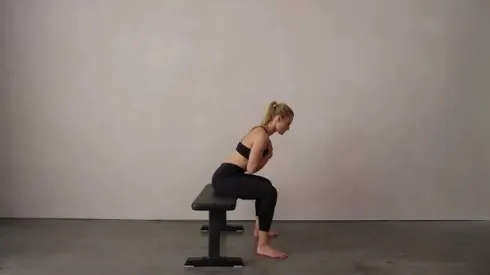
How to do
- Choose a robust chair without arms, such as a dining table chair.
- If it’s not too painful, sit upright with your feet slightly wider than shoulder-width apart on the floor and your legs bent at a 90-degree angle.
- Place your arms in between your legs.
- Maintaining a straight back and bending at the hips, slowly lower your hands to the floor.
- Try lowering as much as you can without experiencing any pain or bending your back.
- As you gradually return to sitting upright, keep your back straight at all times.
Good mornings
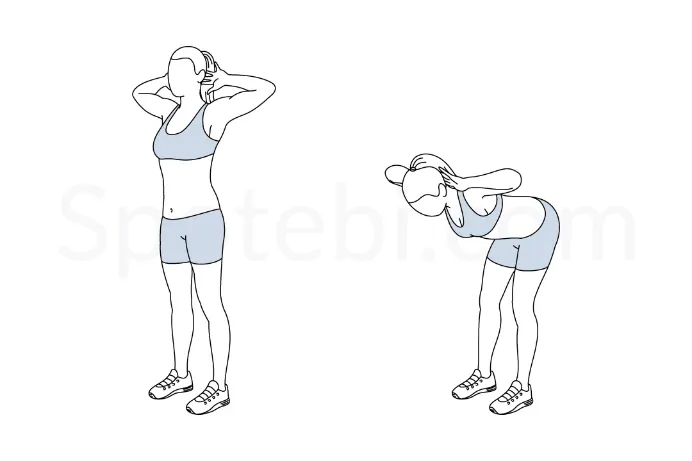
How to do
- Place your feet shoulder-width apart and stand upright.
- Stretch your elbows out and press your fingers on your temples.
- Pull your belly button up and toward your back to activate your core.
- Lower your upper body forward while keeping your back straight by hinging at the hips and bending slightly at the knees.
- To get horizontal (such that your body runs parallel to the floor), lower as far as you feel comfortable while maintaining a straight back.
- Carefully raise yourself back up to standing while keeping your back straight.
- Breathe in as you go down and out as you come back up to your standing posture.
Pelvic lift
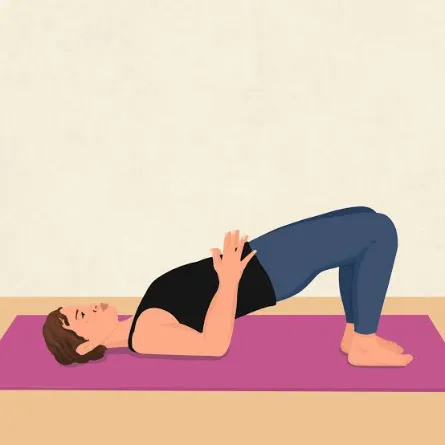
How to do
- Rest on your back with your legs bent and your arms by your sides.
- Inhale deeply.
- Squeeze your buttocks and engage your core by dragging your belly button up and in toward your back as you exhale.
- Raise your buttocks off the ground.
- From your shoulders to your knees, draw a straight line with your body
- Hold for one or two seconds.
- Inhale, then softly descend to the floor.
Standing trunk rotation with extended arms
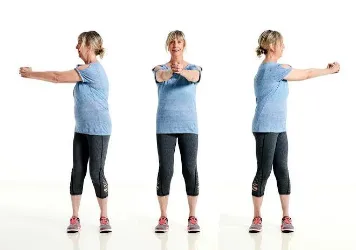
How to do
- Keep your legs slightly apart and keep your posture straight.
- Pull your belly button up and in the direction of your back to activate your core.
- Put your hands together and extend your arms in front of you to shoulder height or a height that suits you.
- Always keep your hips looking forward.
- Turn back to face the front after making a gentle, comfortable rotation to the right.
- Turn back to the front after slowly rotating to the left as far as it feels comfortable.
- While you’re back in the middle, take a breath; while you’re twisting, take a breath out.
- Twist only as much as is comfortable; your muscles should feel a little tug.
- You can add a modest weight to your hands as this becomes easier, such as a water bottle or a can of beans.
Superman

How to do
- Squeeze your buttocks firmly as you slowly raise your arms, shoulders, and legs off the ground after taking a breath
- Inhale deeply, then slowly return to the floor.
- If you struggle to maintain straight arms, stretch your elbows and place your fingertips on your temples.
Wall Sits

How to do
- With your back to the wall, place your feet shoulder-width apart and two feet away.
- down into a sitting position with your knees at a 90-degree angle.
- Hold for ten to thirty seconds.
Warning signs you shouldn’t ignore
A physical therapist advises calling your doctor immediately if you have lower back pain that radiates down one of your legs, if you have numbness, weakness, or tingling in one (or both) of your legs, or if you notice changes in your bowel or bladder function.
Compression of the spinal cord or nerves may be the cause of these symptoms. Seeing a doctor is advised if the discomfort lasts more than a week or keeps you from performing normal tasks.
FAQs
Which core-strengthening exercises are the greatest for relieving back pain right away?
Bird dogs, bridges, pelvic tilts, and mild trunk rotations are a few excellent choices. These work the core muscles
without putting undue strain on the back.
How can lower back pain be minimized with the best possible core exercises?
Pay attention to isometric holds that don’t involve spinal flexion or extension, such as planks. Avoid arching your back; proper form is crucial. Increase the duration and intensity gradually.
How often should you work out your core?
Aiming for two to three times a week can help your muscles recuperate in between workouts. If your pain worsens, pay attention to your body and take a few days off.
In what ways does strengthening your core contribute to the general health of your spine?
The spine is stabilized during movement by the core muscles that surround it. A stronger core lessens undue strain on the back and transmits load more efficiently.
What adjustments are possible for people who have significant back pain?
Use pillows or supports to support the back, concentrate on isometric holds, stay away from spinal flexion, and only work within a pain-free range of motion.
Refernces
- Jenette Restivo. (2024). Stretching and strengthening exercises to relieve and prevent lower back pain – Harvard Health. Harvard Health. https://www.health.harvard.edu/pain/stretching-and-strengthening-exercises-to-relieve-and-prevent-lower-back-pain
- Andrew Scard, Cardiac Rehab Specialist. (2026). Lower back pain exercises – 15-minute workout. British Heart Foundation. https://www.bhf.org.uk/informationsupport/heart-matters-magazine/activity/exercises-for-lower-back-pain
- drdan. (2025). The Three Best Core Exercises for Back Pain: A Research-Backed Approach – Central Ohio Spine and Joint. Central Ohio Spine and Joint. https://cospineandjoint.com/the-three-best-core-exercises-for-back-pain-a-research-backed-approach/
- valethealth. (2025). Back Pain & Core Strength: Exercises You Can Do Safely – North Lakes Pain Consultants. North Lakes Pain Consultants. https://northlakespain.com/back-pain-core-strength-exercises-you-can-do-safely/
- (n.d.). back-pain-here-are-8-exercises-you-can-do-at-home. kimssunshine.co.in. https://www.kimssunshine.co.in/blog/exercise-fitness/back-pain-here-are-8-exercises-you-can-do-at-home/