Crunches
Introduction
Crunches are a popular abdominal exercise that targets the rectus abdominis muscles, helping strengthen and tone the core.
A fundamental abdominal exercise, crunches are meant to tone and develop the rectus abdominis, also known as the “six-pack.” Crunches, which are performed by lying on your back with your feet flat on the floor and your knees bent, use your core to raise your shoulders and upper back off the ground while maintaining a stable lower back.
Crunches lessen the tension on the hip flexors and spine and more efficiently isolate the abdominal muscles than full sit-ups. This exercise is frequently included in fitness regimens to assist functional motions, improve posture, and strengthen the core. Crunches can be a safe and effective approach to strengthening your abdominal muscles if you do them correctly and with control.
Anatomy of Core Muscles
The abdominis
- Location: From the pubic bone to the sternum (chest bone), the rectus abdominis is a long, flat muscle that runs vertically down the front of the abdomen.
- Structure: In well-trained people, it has the distinctive “six-pack” look due to its segmentation by tendinous junctions.
- Spinal flexion serves the purpose of enabling forward waist bending. Posture Support: Keeping the lumbar spine and pelvis stable helps people maintain an upright posture.
- Force Transfer: Assists in transferring forces from the upper to the lower body when lifting, leaping, and sprinting.
- Relevance to Crunches: The main muscle used during crunches, particularly in the upper abdominal area, is the rectus abdominis.
External Obliques
- Location: Running diagonally from the lower ribs to the pelvis, on either side of the rectus abdominis.
- Structure: Fibres flow medially, or toward the body’s midline, and downward.
- Function: Lateral Flexion: Sideways waist bending. Rotating the torso to the left or right is known as trunk rotation. During dynamic motions, spinal stabilization helps preserve posture.
- Relevance to Crunches: For strength and toning, twisting crunches and bicycle crunches focus on the external obliques.
Obliques Internal
- Located just under the external obliques, the fibres travel medially and upward, perpendicular to the external obliques.
- Function: Trunk rotation serves the same purpose as external obliques on the same side. Side bending is aided by lateral flexion. Supporting the spine during lifting or twisting is known as core stability.
Trasverse abdominis
- The deepest layer of abdominal muscles, the transverse abdominis (TVA), is situated underneath the rectus abdominis and obliques.
- Structure: The horizontal fibres encircle the abdomen like a corset.
- Function: Spinal Stabilization: Supports the spine by compressing the contents of the abdomen, acting as a natural weight belt. When performing big lifts, core bracing is crucial for preserving intra-abdominal pressure. Low back discomfort and hyperlordosis, or an excessive lumbar curvature, can be avoided with posture support.
Erector spinae
- The erector spinae is a collection of muscles that extend from the pelvis to the base of the head along the length of the spine.
- Function: Spinal extension serves to straighten or arch the back. Side bending is aided by lateral flexion.
- Postural Support: Preserves erect posture during lifting, walking, and standing.
- Relevance: Lower back conditions are avoided, and the rectus abdominis is balanced by strong erector spinae muscles.
Multifidus
- Location: The lumbar spine’s deep, tiny muscles that run parallel to the vertebrae.
- Function: Spinal Stability: Gives each vertebra segmental support.
- Postural Control: Constantly stabilizes the spine while moving.
- Importance: Frequently disregarded, yet crucial for bolstering core workouts and avoiding back problems.
Pelvic floor muscles
- Location: Support the pelvic organs by forming the basis of the core.
- Function: Support of the reproductive, intestinal, and bladder organs.
- Core Integration: Maintains intra-abdominal pressure by working with the diaphragm and TVA.
- During lifting, jogging, and delivery, stability is essential.
- Exercises: Core strengthening exercises are enhanced by pelvic floor activation (Kegels).
Diaphragm
- Location: The dome-shaped muscle that divides the abdominal cavity from the thoracic cavity, which includes the heart and lungs.
- Function: Breathing: The main inhaling muscle.
- For core stability, intra-abdominal pressure cooperates with the pelvic floor and TVA.
- Core Connection: During crunches, planks, and other workouts, proper breathing technique improves core activation.
Exercises
Basic crunch
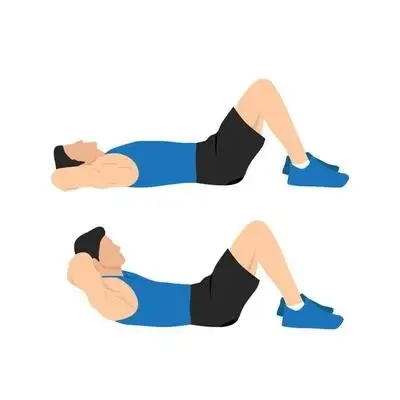
- Position: Supine lying position.
- Place yourself on your back. Place your feet hip-width apart on the ground. Place your arms over your chest and bend your knees. Breathe in and contract your abs and lift your neck.
- Take a breath and go back to where you were before.
- Hold duration is five to ten seconds.
- Repetition should be ten per session.
Bicycle crunch

- Position: supine lying position.
- To stabilize your spine, contract your core muscles and pull in your abdomen.
- Use your hands to gently hold your head.
- Exhale and, starting gently, pedal like you’re on a bicycle, bringing one knee up to your armpit and straightening the other, both legs higher than your hips.
- In order to contact your elbow to the opposing knee as it rises, rotate your body.
- Twist to the opposite side till your elbow hits the opposing knee while continuing to extend the second leg and drag the other knee into your armpit.
- Hold duration is five to ten seconds.
- Repetition should be ten per session.
Russian twist
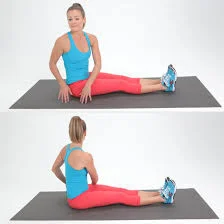
Russian twist steps:
- Position: Supine lying position.
- Place your knees bent and your legs together on the floor. Your feet should remain on the ground or just off it. The sit bones of your pelvis should be where you sit.
- Lean back until your body is at a 45-degree angle from the floor while keeping your posture tall. Make sure your knees and hips are 90 degrees bent.
- Use your core. Throughout the action, keep your chin tucked down, like you’re cradling an egg beneath it.
- Place a medicine ball, dumbbell, weight plate, or your arms—either straight or bent—in front of your torso.
- Hold duration is five to ten seconds.
- Repetition should be ten per session.
Mountain Climbers

- Position: Prone lying position.
- Place yourself in a plank posture, distributing your weight equally between your hands and toes.
- Verify proper form by placing your hands shoulder-width apart, keeping your back flat, contracting your abs, and aligning your head.
- As much as you can, bring your right knee into your chest.
- Pull one knee out and draw the other in as you switch legs.
- As fast and as far as you can, run your knees in and out while keeping your hips down. With every leg shift, take turns breathing in and out.
- Hold duration is five to ten seconds.
- Repetition should be ten per session.
Reverse Crunch

Reverse crunches steps:
- Position: Supine lying position.
- With your feet level on the floor and your knees bent at a 90-degree angle, lie face-up on a mat or other soft surface. Keep your hands down and your arms close to your sides.
- Breathe out and tense your core. Throughout the exercise, maintain a 90-degree bend in your knees.
- Tuck your knees as near to your face as feels comfortable without lifting your mid-back off the mat. Your lower back and hips need to rise off the floor.
- After a few intervals of holding, softly bring your feet back down to the floor.
- Hold duration is five to ten seconds.
- Repetition should be ten per session.
Stability ball crunch

- Position: Supine lying position.
- With your feet level on the floor and a stability ball beneath your mid-back, lie down. When selecting a ball, try to maintain your knees at a 90-degree angle and your thighs parallel to the floor.
- As in a typical crunch, crunch your trunk upward with your hands behind your head.
- Return to the starting position after holding for a brief while at the peak of the movement.
- As your core strength increases, increase the number of repetitions and sets.
- Hold duration is five to ten seconds.
- Repetition should be ten per session.
Oblique crunch
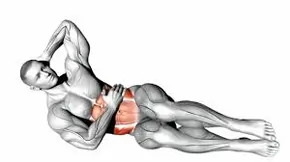
- Position: Side-lying position.
- Position yourself on a bench with your left leg comfortably bent on top, your right hip touching the top of the bench, and your right foot beneath it. Place your left hand behind your head and your right hand on your chest.
- With your foot under the bench for balance, crunch your trunk forward as far as it is comfortable.
- When you get to the top of the movement, pause for a second and then gently go back to the beginning position.
- On each side, repeat for a minimum of ten repetitions. As the exercise gets simpler, you can increase the number of repetitions and sets.
Indications
The primary purpose of crunches is to tone and develop the abdominal muscles. It is among the most often suggested core exercises for enhancing posture and stability. Among the primary indicators are:
- Weak core muscles: To increase core stability and strengthen the rectus abdominis. By strengthening the muscles that support the spine, postural correction helps to improve posture. For those who want to define and tone their abdominal muscles, abdominal toning is recommended.
- For modest lower back rehabilitation following appropriate core activation training, it is used in physiotherapy programs (under supervision).
- Sports training, which is used by athletes to improve performance in tasks requiring rotational control and trunk flexion.
- Weight management program: As a component of overall exercise regimens to increase muscular endurance and metabolism.
- Enhancing stability and balance: Having strong core muscles helps with coordination and balance in general.
Contraindications
Although they work well to develop the abdominal muscles, not everyone is a good candidate for crunches. Among the primary contraindications are:
- Crunches can exacerbate acute lower back pain or injuries by increasing spinal strain.
- A herniated or bulging disc can be made worse by forward bending and spinal flexion.
- Neck difficulties – People with cervical discomfort or neck instability may strain their neck when practicing crunches.
- Following recent abdominal surgery, patients should avoid crunches until their doctor gives the all-clear.
- Osteoporosis or spinal fragility – Flexion workouts may raise the risk of vertebral fractures.
- Pregnancy, particularly the second and third trimesters, Crunches are dangerous at later stages because they might compress the abdomen.
- Poor form and an increased risk of injury might result from severe obesity or core weakness.
Benefits
Builds a stronger core by strengthening the rectus abdominis, which is the main goal of this exercise.
- Enhances posture: A strong core lowers the chance of slouching or bad posture by supporting the spine.
- Improves stability and balance: Crunches strengthen the core, which enhances balance and general body control.
- Promotes lower back health: Proper crunches can help stabilize the lumbar area and ease moderate back pain.
- Enhances athletic performance: Sports and activities requiring trunk rotation or flexion benefit from having a strong core.
- Abdominal tones: Assists in defining and sculpting the abdominal muscles for a more attractive appearance.
- Increases endurance: Consistent practice can increase the core region’s muscular endurance.
Common mistake
Getting Your Neck Pulled
The ab crunch is a simple workout that lifts the shoulder blades a couple of inches off the floor. When performing ab crunches, place your fist behind your chin to maintain the right posture of your neck.
Excessive Crunching
Your neck is strained, and it becomes more difficult to work your abs. Shoulder jerking increases velocity and decreases workout efficacy. Instead of utilizing momentum to raise your body, take your time and perform the exercise gently since it takes time to develop ab strength.
Leaning back on the floor
When doing ab crunches, it’s easy to let your shoulders fall to the ground, but it’s better to keep your core tight the entire time. You should never fully let your shoulders drop to the ground.
Arch of the back
Previously, it was advised to maintain a flat back against the floor during the whole exercise. Maintaining a neutral spine is now considered optimal since it places your spine in the greatest possible position to support you.
You may quickly identify it by rocking your pelvis back and forth, then letting it rest in the middle. Your abs could require some time if your back arches excessively. When performing core crunches, try placing your feet on a step or platform to support your back.
Rotation of the Hips
All of the rotation should be done by your torso. You should drive your legs straight forward and backward and avoid turning your hips. Throughout the exercise, keep your lower back pushed onto the ground.
Straining of the Neck
To concentrate on your body performing the rotational work, avoid pulling your head forward. Simply twist your body as far as you can if you feel yourself straining with your head and neck to get your elbow to touch your knee.
Your Toes Are Bouncing
Exercise with good form is essential for both injury prevention and maximum efficacy. For instance, bouncing on your toes while doing the manoeuvre is a classic rookie error made by mountain climbers.
Although it may seem like a more difficult workout, the bouncing really uses your core muscles less. Maintaining proper form can be aided by wearing appropriate footwear, such as CrossFit shoes.
What Makes a Sit-Up Different from a Crunch?
These two ab workouts can both help you develop a strong core, but they are different in a few respects.
- Movement pattern: Raise your entire upper body off the ground to complete sit-ups. Crunches, on the other hand, only require you to raise the upper portion of your body over your belly button, so your range of motion is limited.
- Worked muscles: Your midsection’s core muscles are worked during crunches and sit-ups. Sit-ups, however, also work your hip flexor muscles.
- Level of difficulty: Compared to the simple crunch, the sit-up is a little more complex ab exercise. To reduce your chance of injury, speak with a personal trainer if you’re having issues with crunching form or have any back pain.
- Variants: The bicycle crunch and the reverse crunch are two examples of crunch variants. To make your sit-ups more difficult, think about gripping a kettlebell or weight plate while performing the activity.
Advice for Better Performance
- Prioritize quality over quantity; deliberate movement works better than quick repetitions.
- For general fitness, mix crunches with full-body exercises.
- To promote fat loss and muscle gain, eat a balanced diet.
- Be consistent; it takes time to build core strength.
- Incorporate days of relaxation to facilitate muscle recuperation.
Typical Myths Regarding Crunches
Myth 1: You can get a six-pack just by crunching.
Truth: In order to show off abdominal muscles, fat must be lost.
Myth 2: More fat is burned at high repetitions.
The truth is that total calorie deficit is more important than spot reduction.
Myth 3: Your back will suffer from crunches.
Truth: Crunches are safe as long as they are done correctly.
Conclusion
A common type of abdominal exercise, crunches serve to tone and strengthen the core by focusing on the rectus abdominis muscles. They can enhance posture, abdominal endurance, and core stability when done properly. Crunches should be used in conjunction with a well-rounded workout program and a healthy diet, though, as they are insufficient for full-body fitness or noticeable fat reduction.
To avoid injury, anyone with certain conditions, such as pregnancy or diastasis recti, should avoid or modify this activity. All things considered, when performed properly and moderately, crunches may be a useful part of a program that strengthens the core.
FAQs
Are crunches exercises safe or not during pregnancy?
Generally speaking, crunches are not advised during pregnancy, particularly during the second and third trimesters. Crunches can impose too much strain on the abdomen and spine because the expanding uterus weakens and strains the abdominal muscles as pregnancy goes on. This may result in lower back discomfort, decreased blood supply to the uterus, and an increased risk of diastasis recti, or separation of the abdominal muscles. Pregnant women are instead encouraged to concentrate on milder core-strengthening activities that engage the abdomen without endangering the mother or the unborn child, including pelvic tilts, modified planks, or exercises prescribed by a physiotherapist.
Can crunches exercise burn belly fat?
Exercises using crunches cannot immediately reduce abdominal fat. The layer of fat covering the belly is not considerably reduced; instead, they mainly tone and strengthen the abdominal muscles. A balanced diet, total caloric expenditure, and full-body activities, including cardio, weight training, and high-intensity interval training (HIIT), all contribute to fat reduction. Once body fat has been decreased, crunches can assist in increasing muscle definition; however, for belly fat reduction to be successful, they must be paired with a healthy diet and other fat-burning exercises.
Are cruches an effective exercise for core strengthening?
Actually, crunches are a good way to strengthen your core, especially the rectus abdominis, which is the muscle in your front abdomen. Crunches assist in increasing muscular endurance, stability, and trunk control—all of which are critical for both everyday tasks and athletic performance—by continuously stretching the spine and activating the core. Crunches do not completely work all of the core muscles, including the obliques and deep stabilizers, even if they do strengthen the primary abdominal muscles. In order to achieve balanced muscle growth and spinal support, crunches should be performed in conjunction with other exercises such as planks, bridges, and rotational motions to achieve full core strength.
Can crunches worsen diastasis recti?
Indeed, diastasis recti, a condition in which the two sides of the rectus abdominis split along the midline, can be made worse by crunches. The forward spinal flexion used in traditional crunches can push the abdominal wall outward and create intra-abdominal pressure, further extending the already thin linea alba. Particularly for women who have just given birth, this might prolong the healing process and potentially widen the gap. Standard crunches are typically avoided by people with diastasis recti in favour of safer core-strengthening activities such as pelvic tilts, transverse abdominis activation, and customized core exercises that are prescribed by a physiotherapist.
Are crunches better than planks?
In core training, planks and crunches have distinct functions; therefore, one is not always “better” than the other. While planks work the whole core, including the deep stabilizers, obliques, lower back, and shoulders, without requiring any spinal movement, crunches mainly work the rectus abdominis, emphasizing spinal flexion and abdominal muscle power. Planks are safer for people with back problems or diastasis recti since they also aid with general stability, posture, and endurance. Consequently, planks offer a more thorough and effective core workout than crunches, and combining the two can produce the best strength and stability outcomes. Crunches are helpful for defining muscles.
What is bicycle exercise?
A common core-strengthening exercise is the “bike exercise,” which involves lying on your back and simulating the pedalling action of a bicycle. It works the hip flexors and thighs in addition to the abdominal muscles, particularly the rectus abdominis and obliques. In order to complete this exercise, you must lie flat on the floor, raise your legs, and pedal while rotating your opposing elbow toward the lifted knee. Muscle endurance, coordination, and core stability are all enhanced by this combination of movements. With the right form and control, the bicycle workout may help tone the midriff, improve balance, and promote spinal health.
How to do crunches for beginners?
To minimize strain and increase efficacy, novices should practice crunches slowly and correctly. To begin, place your feet level on the floor, hip-width apart, and bend your knees while lying on your back on an exercise mat. With your elbows relaxed and open, place your hands lightly over your chest or behind your head. Pull your belly button toward your spine to activate your core muscles. Then, as you exhale, slowly raise your head, neck, and shoulder blades off the ground. Don’t use your hands to pull your head; instead, use your core. While taking a breath, slowly lower yourself back down after holding for a while at the top. For each set, aim for 10–15 controlled repetitions.
References
- Cpt, P. W. (2024c, July 9). AB crunches: proper form, variations, and common mistakes. Verywell Fit. https://www.verywellfit.com/how-to-do-a-perfect-abdominal-crunch-1229513
- Nunez, K. (2019b, September 26). How to do crunches and other exercises for toned abs. Healthline. https://www.healthline.com/health/exercise-fitness/how-to-do-crunches#bicycle-crunch
- Ms, E. Q. (2023b, May 26). How to do a bicycle crunch: fitness tips, variations, and common mistakes. Verywell Fit. https://www.verywellfit.com/bicycle-crunch-exercise-3120058
- Cpt, P. W. (2024b, May 19). Learn to master mountain climbers. Verywell Fit. https://www.verywellfit.com/mountain-climbers-exercise-3966947
- Nunez, K. (2019c, September 26). How to do crunches and other exercises for toned abs. Healthline. https://www.healthline.com/health/exercise-fitness/how-to-do-crunches#bottom-line