
Bakasana (Crane Pose)
What is Bakasana?
Bakasana (Crane Pose) is an arm-balancing yoga pose that builds strength in the wrists, arms, shoulders, and core while improving focus and balance. It involves lifting the body off the ground by resting the knees on the upper arms and balancing on the hands.
Crane Pose mainly strengthens your arms, shoulders, and core while also improving mental clarity. The only distinction between Bakasana and Kakasana, or Crow Pose, is the alignment of the arms. While the arms are completely straight in Crane Pose (straight arms in Crane Pose represent the crane’s legs), they are bent in Crow Pose.
This pose is also known as bakasana or crane pose because it makes our bodies appear like a crane or baka with both legs elevated. The body is similar to the crane’s upper body, while the extended arms are similar to the crane’s long legs. It primarily works the wrist, mid-body, upper back, and lower back in addition to the biceps, triceps, and forearms.
Muscle Work During Bakasana:
- Arm and Shoulder Muscles
- Biceps and Triceps Muscles
- Upper Back Muscles
- Middle Back Muscle
- Core Muscles
What is the difference between the Crow Pose (Kakasana) and Crane Pose (Bakasana)?
Crow pose (Kakasana) and Crane Pose (Bakasana) are frequently used interchangeably. These positions are both very similar and very dissimilar in their creation.
In the Crane position, the hips are as high as possible, and the knees are crossed beneath the armpits. The primary distinction is maintaining a straight arm position.
In contrast, your knees are not tucked under your armpits in Crow Pose. You create an almost 90-degree angle by bending your arms at the elbows. After that, you contract your lower abs and lay your shins on your triceps, or upper arms.
Additionally, the names differ. Compared to a crow, a crane is a larger bird with longer legs. Thus, in the crane pose, we bend our arms to form the crow’s shorter legs and keep our arms straight to form the crane’s legs.
How to Perform?
- Place your legs hip-width apart and stand upright in Tadasana, also known as Mountain Pose, on your yoga mat.
- Spread your thighs slightly wider than your chest and perform a full squat while maintaining a straight back and spine.
- With your elbows resting on the inside of your knees, keep your arms between your thighs.
- Maintain this position to build stability.
- Exhale, then spread your fingers and rest your palms on the mat about a foot in front of your feet. With your elbows pointing outward, place your palms shoulder-width apart.
- Place your knees as close to your armpits as you can while bending your elbows and raising yourself on the balls of your feet.
- To shift the weight of your body to your arms, bend forward, take a breath, and raise your feet off the ground.
- Try to keep your body weight properly distributed across both hands as you straighten your arms without locking your elbows. If necessary, you can circle your back.
- Bring your feet closer to your hips and lift your hips.
- Start by holding this stance for 10 to 30 seconds, or longer if you have the strength and breathing permits.
- When you’re finished, return to the initial squat position by lowering your body softly and placing your feet on the floor.
Benefits:
- Strengthens the arms and shoulders, which bear the weight of the entire body.
- strengthens and tones the muscles in the core.
- The middle and lower back muscles are stretched in a crane stance.
- strengthens your inner thighs and opens your groin.
- improves blood flow to the spine and massages the spinal cord.
- enhances the body’s metabolism and digestion by massaging the organs in the abdomen.
- enhances proprioception, or the awareness of your body’s location in space, and bodily control.
- enhances mind-body synergy and raises bodily awareness.
- helps us get ready to execute complex arm-balancing poses both physically and emotionally.
- boosts self-esteem and encourages bodily activity.
Beginner’s Advice:
- Don’t try to find balance or enter the pose too quickly. As you proceed carefully, find your balance at each step.
- Bring your knees as high into your arms as you can, avoiding placing your legs on your arms.
- Pressing your arms into your knees and your knees into your arms can make you feel safer.
- For improved wrist comfort and grip, place yoga blocks or a folded blanket beneath your hands.
- Lift the legs one at a time at first, then increase your strength until you can lift both at once.
- When you’re ready to lift off the ground, push your upper arms up into your shins and bring your groin into your pelvis to ensure that your core muscles—rather than just your hips—are supporting the lever and helping you with the lift.
- Don’t raise their butts too high and away from their heels to get into this stance. Keep your buttocks and heels tucked in and close to each other.
- Since this is a more difficult balancing stance, you will likely fall a lot. But you shouldn’t become angry or frustrated. To improve your hold on the pose, give your body and yourself some time. To improve, enlist the aid of a friend or teacher.
Preparatory Pose:
Malasana (Garland Pose):
In yoga, the Yogi Squat, also known as Malasana, is a profound hip-opening pose. In addition to improving blood circulation from your tailbone to your toes, this pose will quickly extend your pelvis.
Just squat with your pelvis close to the floor and your thighs pointing outward. Maintain the prayer position while using your elbows to change the resistance in your hip flexors and thighs. Maintain this position for one to five minutes.
Navasana (Boat Pose):
This is a great yoga pose for strengthening and activating the entire core. To Sart, sit in Staff Pose, raise your legs off the mat, bend your knees, and use your core to shift your weight onto your tailbone.
For four to five rounds, hold this position and hold it for a few seconds. You can hold Crane Pose for extended periods of time with the help of this pose.
Chaturanga Dandasana (Four-Limbed Staff Pose):
Prior to Crane Pose, perform Chaturanga Dandasana to engage key body regions such as the shoulders, forearms, and wrists.
To enter Chaturanga Dandasana, begin in Downward-Facing Dog, transition into a high plank, and bend your elbows. Repeat five to ten times while holding this low plank for a few seconds at a time.
Variations:
Baby Crow Pose (Bala Kakasana):
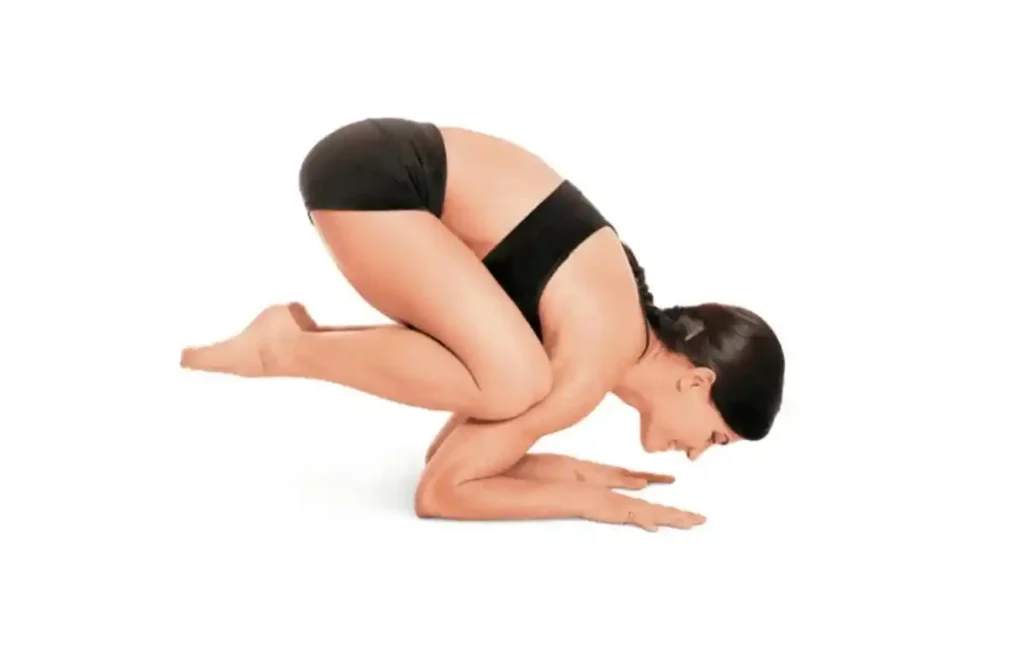
Beginners who are just beginning to practice arm balance will benefit most from this variant. Put your forearms on the floor and grasp the mat with your fingers after performing Malasana.
Now, lift both legs off the mat, move your body weight slightly forward, activate your core muscles, and place one knee on each tricep at a time.
Crow Pose (Kakasana):

For intermediates who are still working on arm balance, this version is ideal. Get into Malasana first, then put your palms on the floor and use your fingers to hold the yoga mat.
Place your knees on your triceps and maintain a wide bend in your elbows. As you slightly transfer your body weight forward and raise both of your legs off the mat one at a time, contract your core and concentrate your eyes.
Bakasana with eagle legs:
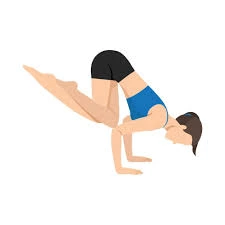
An advanced version of the crane position is the eagle pose, which involves crossing one leg over the other at the knee. Once you have raised yourself off the ground, you should have developed a considerable degree of strength and stability to perform this leg formation.
Bakasana with a Chair:
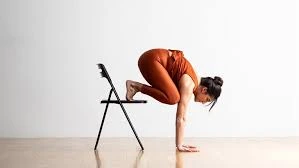
This adjustment allows you to comfortably rest your legs on a chair or stool behind you. Using a chair might help you develop arm and core strength if you are a novice.
Precautions:
- During the posture, you could fall forward and sustain injuries. To prevent harm, place a soft object in front of you, such as pillows or folded blankets.
- Don’t put all of your weight on your fingers or wrists. Distribute the body weight equally across both hands’ wrists, fingers, and palms.
- Avoid looking back at your heels as this can throw you off balance. Maintain your eyes on the spot right below your head.
- Avoid spreading your elbows out on the sides during this position, as this may put strain on your wrists. Make sure they align with the shoulders and wrists.
Contraindications:
- Avoid doing this pose if you have conditions like spondylitis or carpal tunnel syndrome.
- Performing the Crane Pose during pregnancy is bad for the fetus’s health since it places a lot of strain on the abdomen. Additionally, avoid doing it when you are menstruating.
- Avoid doing this pose if you have recently had an injury or had surgery on your arms, legs, hips, back, or neck.
- This pose should be avoided by patients who have migraines or hypertension because it causes an abrupt spike in blood flow to the brain.
Conclusion:
In the crane posture, emphasis is on rising and balancing. It also facilitates the mind-body connection and allows for increased focus and body awareness. Therefore, it is advised that novices begin with the crane pose and work their way up to more intermediate positions after mastering it.
FAQs
Are Bakasana and Kakasana the same?
The poses known as Bakasana (Crane Pose) and Kakasana (Crow Pose) are not interchangeable. Although they both fall under the same category of yoga poses, or arm balance, their methods of execution differ slightly.
The body is balanced fairly close to the floor in Crow Pose, with the arms bent. However, you need to balance your body farther from the floor and maintain your arms straight for Crane Pose.
What are the benefits of Bakasana?
tones the shoulders and arms.
improves concentration and focus.
increases forearm and wrist strength.
enhances balance and body awareness.
strengthens the core, shoulders, and arms.
Can beginners perform the Bakasana Pose?
Since Bakasana may be too physically demanding for a novice or intermediate yoga practitioner, beginners should refrain from doing it at first. Before beginning the Bakasana practice, it is preferable to practice balancing your body and mind in yoga poses.
What is Parsva Bakasana?
A strong arm balance variation of Bakasana is Parsva Bakasana. Side Crane Pose is the result of the Sanskrit words parsva, which means side, baka, which means crane, and asana, which means posture. This pose involves balancing both arms on one elbow, then switching to the other.
What is the difference between Bakasana and Crow Pose?
Kakasana and Bakasana differ in that in Kakasana, or Crow pose, your elbows are bent at a 90-degree angle. Your arms should be either straight or slightly bent in the Crane posture (Bakasana).
Who should not do Bakasana?
Because the arms bear the majority of the body weight, pressure may accumulate on the fractured wrist or worsen the initial signs of a sprain. Periods or pregnancy: Because Bakasana (Crane Pose) puts pressure on the abdomen, pregnant women are not allowed to perform it.
What are common Bakasana mistakes?
Your shoulder girdle is not stable. Your hips are too low, and you’re not giving yourself an inward hug. You’re not rounding your back; you’re jumping.
References:
- Allen, W. (2025b, August 26). Bakasana. https://myyogateacher.com/yoga-asana/bakasana
- Crane Pose (Bakasana): How to Do, Benefits, and Precautions – Fitsri Yoga. https://www.fitsri.com/poses/crane-pose