
Top Chest Exercises for a Bigger and Stronger Chest
Introduction:
Chest workouts are vital for increasing upper-body strength. Strengthening the muscles in the chest can help you achieve a muscular, formed posture. However, developing chest muscles has several advantages beyond making you look toned.
What are the Benefits of Performing Chest Exercises?
Your shoulders may be rotated and pulled forward and inward using the pectoralis major and minor muscles in your chest. You can move your arms up, down, in, and out since they also stabilise your shoulders.
Fundamental actions also need the use of the chest muscle:
- Opening a door by pressing on it.
- Moving a shopping cart.
- Scooping up a youngster off the ground.
As with the back muscles, strong chest muscles are required for optimal posture.
What are the chest’s muscles?
The three main chest muscles:
- pectoralis major
- pectoralis minor
- serratus anterior
The main function of this tiny auxiliary muscle is respiration, or breathing.
The pectoralis major consists of two separate muscles:
- clavicular head
- sternocostal head
The sternocostal head, on the other hand, descends the arm from a forward or flexed posture. Additionally, it is engaged in movements like internal rotation of the humerus and horizontal adduction, which is similar to a bear embracing someone.
By drawing the shoulder blade forward and down against the rib cage, the pectoralis minor stabilises the shoulder blade. This motion is referred to as shoulder blade protraction.
On the outside front of the first through eighth ribs, the serratus anterior begins like a saw and ends on the shoulder blade’s medial border, which is closest to the spine. It stabilises the shoulder during pushing motions by drawing the shoulder blade under the ribs to stop scapular winging.
Top chest workouts for function and strength:
Incline push-up
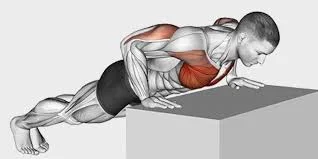
This is an excellent warm-up to get the chest ready for work. An active warm-up before exercise has been found to help reduce the risk of injury. The muscles are primed for activity with lower resistance exercises that are similar to the ones you are going to execute.
- First, put your hands on the table.
- Maintain a neutral spine and body alignment.
- Hold your chest firmly to the floor.
- After that, return to the position.
- For up to 20 repetitions, make sure the resistance seems manageable. Step closer to your hands if necessary, and farther away if necessary, to make it more difficult.
Flat bench press

Equipment required:
barbell or dumbbells,
flat bench
- Begin by relaxing supine on a bench.
- Hold the barbell with your palms towards your feet and your thumb around it.
- Straighten your arms and push them towards the ceiling to remove the weight from the rack.
- Lift the weight above your chest.
- Lower the bar gradually to mid-chest level.
- Maintaining a 45° elbow angle
- Hold for a Few Seconds.
- Then Return.
Incline bench press

Equipment required:
barbell or dumbbells,
incline bench
- Hold the barbell with your palms towards your feet and your thumb around it.
- Straighten your arms and push them towards the ceiling to remove the weight from the rack.
- Lay the weight across your collarbone.
- The weight should be gradually reduced.
- Go back to where you were before.
- 8 To 12 repetitions for 3 sets.
During the exercise, maintain the same flat back and feet as you would on the flat bench. Once more, it is strongly advised that you perform this exercise under the supervision of someone.
Decline bench press
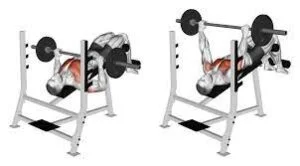
Equipment required:
barbell or dumbbells,
decline bench
- Consider your ankle over an ankle rest and lie prostrated on a decline bench with the knees bent.
- Hold the barbell with your palms towards your feet and your thumb around it. Arms should be straight.
- Carefully bend your elbows so that your chest is supported by the weight.
- Return to the starting position.
- Three sets of eight to twelve repetitions.
Pushup

- Step back into a high plank position after starting on your hands and knees.
- Maintain a neutral spine.
- Maintain an upright core and bend your elbows at 45 degrees.
- Without sacrificing the alignment of your spine and pelvis or the support of your core, try to sink as low as you can.
- Keeping your elbows straight.
- Displace your chest from the ground.
- Continue, doing 8–12 repetitions. Perform three sets.
Decline pushups can be made more difficult by placing your toes on a raised surface, like a table or bench.
Chest dip
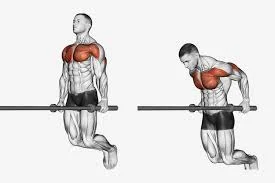
- Hold the two parallel bars with your palms facing inwards while standing facing them.
- Raise your body so that it is parallel to your hands by extending your elbows and applying pressure to your hands.
- At that point, bend your elbows and drop your chest towards your hands.
- After that, return to the starting position.
- Do it again.
- Perform 8–12 repetitions in 3 sets.
Squeeze press

- Place your feet shoulder-width apart to begin.
- There should be one dumbbell in each hand.
- Straighten your arms in front of you.
- Hold for five seconds.
- Squeeze again after releasing.
- Perform ten reps of this.
Upward fly
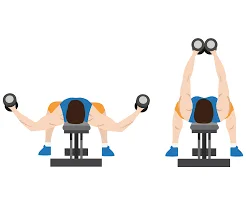
- While standing, keep your feet shoulder-width apart.
- The dumbbells should be placed on your thighs with your hands towards the front of the room.
- As you gradually bring the weights to chest level, draw them together to form a ‘V’ shape.
- After that, return to the starting position.
- Do this ten times.
Lying chest fly
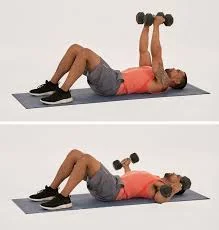
- Continue by resting supine and grasping a dumbbell with both hands.
- Raising your arms will allow you to touch the weights together over your chest.
- The arms should then be lowered once more.
- Work on your upper arms and chest while focusing on letting your shoulders drop.
Plank shoulder tap

- Start with the plank position.
- Hands are directly beneath your shoulders.
- Straighten your body from head to heels.
- Extend your fingers widely.
- Whenever you lift your right hand and strike your left shoulder, pass on your weight to your left hand and lower your stomach in towards your spine.
- Do it 10 reps.
- Then switch to the opposite side.
Plank to downward-facing dog

- Start with plank position.
- To return to a downward-facing dog position, raise your hips and contract your lower abs.
- Elevate your glutes to the ceiling and your heels to the floor.
- Using your hands, firmly press down.
- Then proceed cautiously into the plank once more.
- Do this ten times.
Wall chest stretch

- Face the wall, keeping your right arm shoulder-high and straight to the side.
- Slowly press your arm against the wall after placing your right hand on it.
- As you move your body to the left, away from the wall, keep your arm on the wall behind you.
- After 30 seconds of holding, switch sides and stretch the other arm.
Bent arm wall stretch

- Approach the wall as your right arm is positioned at an angle of 90° and resting on the wall.
- Place your biceps, forearms, and palms against the wall.
- To make the stretch more intense, hold here or slowly rotate your body to the left.
- Hold for 30 seconds.
- Then switch sides.
Corner Stretch
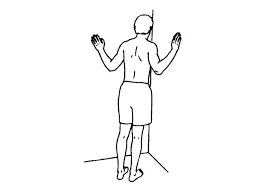
- Turn to face a room’s corner.
- Put your feet together and space them approximately two feet from the corner.
- On each wall, place a forearm with elbows just below shoulder height.
- Make sure your chest and shoulders are properly stretched by bending forward. The stretch can be lessened or halted completely if any pain is experienced.
- Hold for 30 to 60 seconds.
If you can’t find a corner, you can also execute this stretch in a doorway by resting your forearms on the door jambs, which are the sides of the door frame. Do it 3 to 5 times.
FAQs
What is the greatest workout for the chest muscles?
The Top 5 Chest Exercises Everybody Should Perform.
Flat Barbell Bench Press.
Incline Dumbbell Bench Press.
Bodyweight Dip.
Incline Bench Cable Chest Fly.
Bodyweight Push-Ups.
Which chest workout is the most effective?
Bench Press
However, if you’re serious about training, or even if you merely walk into any ordinary strength facility in the globe, you can’t avoid the workout. There’s a reason the motion is so common: it works.
How can I gain muscle?
Muscle growth is encouraged by resistance training. it is done via,
resistance bands
free weights
weight machines
Does a push-up develop the chest?
Indeed, chest muscles can be strengthened and built with push-ups. Push-ups are an excellent bodyweight exercise that targets the pectoralis major and minor muscles in the chest as well as the triceps, shoulders, and core.
What are some ways to strengthen your chest?
Use progressive overload and good form when performing exercises like the bench press, push-ups, and chest flies to build up your chest strength. To work the chest muscles from various angles, think about adding exercises like cable crossovers, incline bench press, and decline bench press.
Referances:
- Mpt, T. E. P. (2023, March 29). 7 Top chest exercises for a strong and functional upper body. Healthline. https://www.healthline.com/health/fitness-exercise/best-chest-exercises#8-best-exercises
- Restivo, J. (2024, February 27). Chest workouts: Exercises for strength and function. Harvard Health. https://www.health.harvard.edu/exercise-and-fitness/chest-workouts-exercises-for-strength-and-function
- 5-minute upper-body strength training workout. (2024, December 10). [Video]. TODAY.com. https://www.today.com/health/diet-fitness/best-chest-exercises-rcna22993
- Meyler, Z., DO. (2018, September 10). Easy chest stretches for neck pain. Spine-health. https://www.spine-health.com/wellness/exercise/easy-chest-stretches-neck-pain