

Walking Lunges
What are Walking Lunges?
Walking Lunges are a dynamic lower-body exercise that strengthens your quads, hamstrings, glutes, and improves balance and coordination while promoting functional movement.
A version of the static lunge exercise is the walking lunge. You “walk” ahead by lunging out with the other leg after completing a lunge on one leg, as opposed to standing back straight as you would in a static bodyweight lunge. For a certain number of repetitions, the exercise continues.
Walking lunges work the glutes, hips, and core in addition to the leg muscles. Adding weights or performing a walking lunge with a torso twist are two other ways to increase the difficulty of walking lunges.
A useful weight-bearing exercise that can increase lower body strength and range of motion, and facilitate daily living tasks, is the walking lunge. You will employ the core muscles to aid with balance and stability throughout the walking lunge, even if the lower body’s powerful muscles are the main movers.
Muscle Work During Walking Lunges:
- Glutes
- Hamstring Muscle
- Quadricep Muscle
- Calves
- Hip Muscles
Video of Walking Lunges
How to Perform?
- Place your feet hip-width apart to start. Keep your core active and your shoulders back. You can either keep your arms at your sides or clasp your hands behind your head.
- Breathe in as you lower your body towards the floor and stride forward with your right foot. You should take a long enough stride so that both knees are bent at a 90-degree angle as you lower your torso.
- Let your left back knee approach or make contact with the floor. Don’t press your front knee too far forward; instead, keep it just above your ankle. Look directly ahead while maintaining an upright posture or gently reclining your body.
- Hold the bottom lunge position for a count.
- Stepping into the next lunge with your left foot, exhale as you push off with your rear foot to bring it forward.
- With each stride, switch legs and continue walking. Prioritise quality above quantity and strive for a fluid, controlled movement.
Benefits:
Expand your range of motion
By improving flexibility and loosening up your hips and hamstrings, walking lunges can help you extend your range of motion. This can aid athletes, casual exercisers, and fitness beginners equally by improving posture and balance.
Improved performance
One type of functional exercise is the walking lunge. They imitate everyday motions, such as getting up, sitting, and moving forward to pick something up off the ground. Walking lunges may be made simpler in real life by practicing them on a regular basis.
Boosts Balance and Core Stability
The walking lunge is particularly dynamic since it is executed unilaterally while standing, integrating your lower body muscles with your core muscles.
Encourages One-Stop Training
Training unilaterally, or equally using both sides, is made possible by the walking lunge. Any muscular imbalance between the right and left legs can be found and addressed with unilateral exercise.
It can be carried out anywhere
Walking lunges are the perfect portable workout that you can do anywhere—at home, the gym, on a business call, at a hotel, or pretty much anyplace else.
Variations:
Walking lunge with torso twist
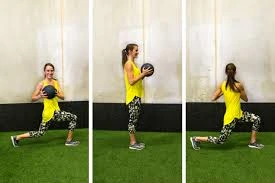
- Place your feet hip-width apart and stand erect. Hold a weight or medicine ball in front of your abdomen with both hands, elbows bent at a 90-degree angle, while contracting your abs.
- Put your weight on your heel as you take a step forward with your right leg.
- Bend your right knee and drop it until it is parallel to the floor in a lunge stance as your right foot hits the floor and stabilises. Hold on.
- Holding the weight with both hands, rotate your upper body to the right once you are secure in the lunge posture. Your torso should be the source of the movement.
Walking lunge with weights
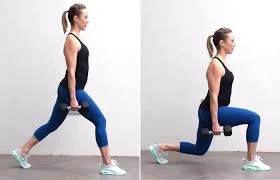
- With your shoulders back, take a straight stance. Maintain an erect posture while holding one dumbbell in each hand and maintaining your arms at your sides.
- Throughout the whole exercise, maintain your arms at your sides in a relaxed position. Put your weight on your heel as you take a step forward with your right leg.
- Lower yourself into a lunge stance by bending your right knee as your right foot hits the floor and stabilises.
- Repeat the motion on the left leg by putting your left foot forward without moving the right leg. In a lunge stance, pause with your left leg parallel to the floor.
- Repeat this motion, switching legs and “walking” forward as you lunge.
Overhead Walking Lunges
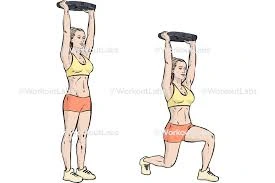
As you lunge, hold a medicine ball or weight above your head.
Lateral Walking Lunges
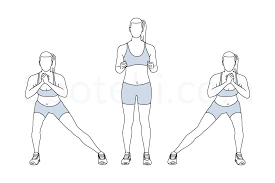
Step sideways, focusing on your glutes and outside thighs.
Hill Walking Lunges
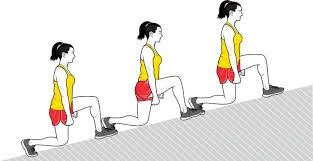
Ascend a hill while performing walking lunges.
Precautions:
Compared to a static lunge routine, you must use greater caution when performing walking lunges. The following advice will help you do the workout in the safest possible way:
- To learn the proper form, you might begin with a static lunge if you are a complete beginner.
- Throughout the entire exercise, aim to maintain a straight posture rather than sagging forward.
- As you go forward, contract your muscles.
- You risk arching your back if you take too lengthy a step.
Common Mistakes:
The foundation of executing a walking lunge is proper form. It may take some trial and error to get the hang of this routine, from alignment and posture to focusing on the correct muscles. Being aware of the typical blunders in advance might help you start properly and prevent injuries.
Adjust Your Footing
The feet are one area where the walking lunge is frequently performed incorrectly. Maintaining a hip-width distance between your feet during a set is essential for a safe walking lunge. Now is not the moment to put one foot in front of the other, since you might end up looking foolish.
Take a Right Step
Keep an eye on your stride while you walk. Your hip and groin area may get uncomfortable if you overstride or take too long steps. Start with smaller steps and work your way up as your strength and mobility improve.
Avoid putting your back knee on the ground
Letting the rear leg touch the floor is another frequent technique error. When taking a step, you want to keep your back knee hovering above the floor, despite the temptation to drop the leg to the ground.
Verify that your tortoise is upright
Your form may change and put additional strain on your knees and lower back if you flex your torso too far forward or stare down at the floor rather than in front of you.
Conclusion:
A dynamic and efficient technique to work several muscle groups while improving flexibility and balance is the walking lunge. Walking lunges provide a flexible choice for every fitness level, whether you do them as a stand-alone exercise, as part of a leg day workout, as part of your current full-body regimen, or as part of a dynamic warm-up.
FAQs
What’s the difference between lunges and walking lunges?
As you raise forward to continue walking, walking lunges place greater strain on your front leg. On the other hand, when you return to the beginning position, stationary lunges put additional strain on your rear leg. Balance: Compared to regular lunges, walking lunges demand greater stabilisation.
Will walking lunges build muscle?
“Compared to static lunges, it will require a lot more effort, recruit more muscles, improve balance, and require both legs to work in unison, all of which will help you build stronger muscles and increase your mobility.”
How many walking lunges per day?
Begin by performing three sets of 8–12 weightless lunges on each leg. Next time, try for the same number of reps with a little more weight if that feels okay.
Do walking lunges burn belly fat?
Regularly performing lunges aids in working several muscular groups simultaneously. They help you burn calories and gain lean muscular mass in addition to testing your balance and coordination. They are, therefore, an excellent choice for activities that reduce abdominal fat and increase functional fitness.
What are the benefits of doing walking lunges?
Lunges enhance your balance and build stronger lower-body muscles.
You get more flexible with lunges.
You may improve your athletic performance and functional fitness by doing lunges.
Muscle imbalances can be corrected by lunges.
Your metabolism may be boosted with lunges.
Lunges are accessible and handy.
References:
- Lindberg, S. (2024, November 25). Walking lunges are a staple Functional Fitness Move—Here’s How to Master them. https://www.onepeloton.com/blog/how-to-do-walking-lunge
- Chertoff, J. (2019, June 24). How to Step Up Your Workout with Walking Lunges. Healthline. https://www.healthline.com/health/exercise-fitness/walking-lunges
- Fit, C. (2022, August 8). Walking Lunges: How-To, Variations, Benefits, Precautions & More. blog.cult.fit. https://blog.cult.fit/articles/walking-lunges-variations-benefits-precaution-and-more