
Visvamitrasana (Sage Visvamitra’s Pose)
What is Vishvamitrasana?
Visvamitrasana (Sage Visvamitra’s Pose) is an advanced yoga posture that combines deep hip opening, hamstring stretch, spinal twist, and upper-body strength. Named after the sage Visvamitra, this pose enhances flexibility, balance, and coordination while building strong arms and core control.
In Visvamitrasana, the torso extends towards one raised leg while the legs are spread apart. It stretches the hamstrings, opens the hips and shoulders, and nearly twists the entire body. As a result, it is thought to be beneficial for the musculoskeletal system.
Leaping into a better and more refined form of oneself is a common yoga practice. One can incorporate a sense of balance, rhythm, and flow into their daily body motions by performing this asana. However, a person’s entire character is energised, and they feel more alive when they dedicate themselves to this stance.
Meaning:
The stance known as Visvamitrasana is named after Visvamitra, a monarch who became a sage. Visva, which means “the world,” and Mitra, which means “a friend,” make up Vishwamitra. Sage Visvamitra is renowned for his yogic ability to show compassion to everyone he encountered. Visvamitrasana is devoted to the sage Vishwamitra because it opens the heart, or compassion centre, in our bodies.
This pose uses the prana to nourish life and not only gives strength and vigour, but it also aids in creating inner equilibrium. In order to preserve mankind for future generations, the practitioner is able to pay attention to their surroundings and respond amicably.
As the name implies, Visvamitrasana gives the inner self the capacity to be an open ocean of happiness, making everything possible from the inside out. For others in our immediate vicinity to recognise the immense potential that each of us possesses. Combining these options allows one to create a vast visionary horizon that supports the subtle inner self’s ecology.
Muscle Work During Vishwamitrasana:
- Upper Back Muscles
- Biceps and Triceps Muscles
- Core Muscles
- Hip Muscles
- Gluteus Muscle
- Hamstring Muscle
- Quadriceps Muscle
How to Perform?
- Enter the Adho Mukha Svanasana first, then stay there for a few breaths. Now take a breath, raise your right foot, and place it outwards next to your right palm.
- Next, place your left foot flat so that its toes point outward. Now raise your right arm so that it is in front of your foot and place your right shoulder beneath your knee.
- You are ready to leap into the last posture as you solidify your left foot on the mat. Now, turn your foot outside and face your left body by applying pressure to the outer border.
- Now raise your right thigh and allow your body to tilt slightly to the right. At this point, your left foot stays flat on the mat while your right hand supports your bodyweight.
- Try wrapping your left hand around your right foot’s toes now. Then, take a breath and extend your right leg so that its sole faces the direction you are facing.
- For as long as it feels comfortable, extend your spine, open your chest, and look up at the ceiling.
- Release the attachment of the right foot and left hand gradually now. Return to the Adho Mukha Svanasana by bending your right knee and dropping your leg.
Benefits:
Strengthens bones:
The body’s weight was distributed appropriately since there were only a few places where the body was attached to the floor. Because of the gravitational pull on certain bodily parts and the structures around them, the bones can absorb more calcium from the blood. Make them stronger as a result.
Encourage Breathing:
When performing Viswamitrasana, moving the chest upward facilitates chest openness, which helps the lungs breathe at their best. As a result, the lungs’ capacity increases, enabling them to carry more oxygen throughout the body. Thus, it encourages breathing.
Boost Your Flexibility:
This pose works well for increasing the body’s range of motion. Muscles are stretched, and their threshold for flexibility is raised by the twisting and extension that occurs during practice. With each practice effort, this establishes a new threshold.
Massages the Organs of the Abdomen:
The abdominal organs are massaged by twisting and turning, which increases blood flow in the abdominal cavity’s blood vessels. The kidney, pancreas, gallbladder, stomach, small and large intestines, liver, etc., are so nourished.
Aids with Sciatica:
Stretching or twisting can help ease the discomfort associated with sciatica. Consequently, the gluteal and piriformis muscles, which can become inflamed and push on the sciatic nerve, can be loosened by performing Visvamitrasana. Additionally, it aids frequent practitioners with their lower pain.
Therapeutic Benefits:
- Visvamitrasana’s difficult nature allows for chest expansion, which enhances respiratory capacity and facilitates breathing.
- This pose’s hip opening guarantees more range of motion, which improves circulation and gives the back muscles additional support.
- In Visvamitrasana, our stomach and waist are still tight; therefore, opening the waist promotes postural alignment and helps activate the core muscles.
Beginner’s Advice:
- A tensed shoulder may make it difficult for beginners to reach the right foot with the right hand over the head. Thus, the first step in visvamitrasana is to simply raise the hand over the head and extend it upward using a rope or other support.
- Beginners may find it difficult to do this pose all at once due to tense hamstrings. As a result, they should avoid forcing the stance and execute this asana patiently. In practice, one can find ease by working on their hamstrings.
- The inner thigh of the extended leg should be pressed against the triceps of the fundamental hand by practitioners who struggle to balance the posture. It will provide posture with the support it needs.
Preparatory Pose:
Parsva Supta Padangusthasana: The leg position, which resembles Visvamitrasana, increases the range of motion at the hip joints and lubricates the hip fascia.
Uttana Padasana (Lizard Pose): A complementary warm-up for Visvamitrasana is Lizard Pose. The hip flexors in the back leg and the inner hips in the front leg are both strengthened by this pose.
Trikonasana (Triangle Pose): Trikonasana imitates Visvamitrasana’s leg stance. It is perfect as a proprietary pose because it is undoubtedly more of a regressed stance than Visvamitrasana.
Utthitha Parsvakonasana (Side Angle Pose with option to bind): Bound Side Angle Pose lengthens the muscle at the front of the chest and twists the body. An excellent stance to do before Visvamitrasana.
Side Plank (Vasisthasana) – Parsva Padangusthasana Variation: For Visvamitrasana, strengthening the arms and core is essential because these regions support a large portion of the pose’s structure. With the option to hold the foot to give flexibility to the posture’s balance, the side plank develops the essential arm strength and core stability.
Props and Modifications:
- Leaning to either side may be possible in visvamitrasana due to the torso’s lower height. To circumvent this, practitioners might attain height by using bricks beneath their fundamental hand. This will make the pose more predictable and lessen the impact of the side stretch.
- If the practitioners’ hands are unable to reach the foot over their heads. They can connect the strap to their outstretched foot and hold it by the hand over their heads to get to that foot.
- The practitioners can utilise a chair and rest their leg on it if they are having trouble raising their extended leg. Then, gently touch the foot of the outstretched leg and correct their posture.
Variations:
Ardha Visvamitrasana:
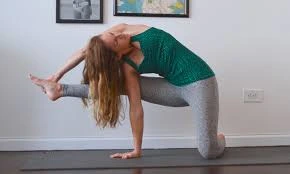
- Compared to Visvamitrasana, where the practitioner strives for the maximum extension, this pose places less emphasis on the extended leg. While the left leg is still stretched in the base pose. Ardha Visvamitrasana pose is less difficult because one leg is placed on the floor via the knee.
- Enter Adho Mukha svanasana first, then extend your right leg outward next to your right hand. Now, lean your torso to the left and rest your left knee on the floor such that your upper thigh faces the direction of your right hand. This will bring your right hand in front of you.
- Now, reach for the right foot with your left hand while lifting both at the same time, and stay there for a while. Next, make your way back by raising your left knee and lowering your right leg.
Extended Side Angle Pose (Utthita Parsvakonasana):

- While the left leg stays straight behind the body and the right leg is at a 90-degree angle in Utthita Parsvakonasana, the right leg is lifted and stretched in Visvamitrasana and is grasped by the right hand over the head. The right hand was positioned next to the right foot from the inside, and the body slid upward for a long time while the left hand was pointing in the same direction.
- Start by striking the warrior position with your right leg at a 90-degree angle, your left leg straight behind your torso, and your hand raised in namaste mudra. Put your right hand next to your right foot from the inside by lowering your torso from the right side.
- Now elevate your left hand straight into the heavens by rolling your torso upward. Turn your attention to your left hand and hold it there for a while. Next, make your way back by lowering your left hand, raising your torso back into a warrior position, and then letting go.
Precautions:
- Practitioners should ensure that their right knee is positioned next to their armpit when placing their right foot next to their right hand. This guarantees the pose’s stability.
- Lift one hand slowly and bring it around the front of the opposing foot while maintaining a strong foot foundation. With both legs extended, there could be a risk of falling behind.
- By expanding the sacrum, one should aim to keep the body in the same plane and prevent any compression of the lower back. An overall balance in the posture is established by such placement.
Contraindications:
- Visvamitrasana should not be performed by practitioners who have hamstring syndrome. This could put pressure on the nerve that could be pinched between the pelvic bone and the hamstring muscles. Ignoring it would be painful.
- Visvamitrasana should not be performed by pregnant ladies. Intense abdominal straining could cause the stomach to contract, which is inappropriate in this circumstance.
- Shoulder, elbow, wrist, ankle, neck, spine, and knee injuries should be avoided by practitioners until their condition returns to normal. But carrying on could lead to more severe health problems.
- Those who have had surgery on their abdomen, waist, lower back, knee, or shoulder should avoid eating until they are well. Before starting the practice after recovery, one should speak with their physician.
Conclusion:
In addition to teaching people how to coexist peacefully, Vishwamitra and his asana also assist people in regaining their best possible health and well-being.
The practitioner may encounter a variety of mental and physical difficulties due to the advanced level. However, they become aware of the full potential of this potent asana once they reach the posture’s last point. To perform this asana properly, one needs pto ractise it every day.
FAQs
What does Visvamitrasana mean?
Visvamitra Sage Asana denotes posture, while sana is named after Saint Visvamitra. Visvamitra was the name of a famous king and sage. I’m dedicating this pose to him. Split, hip opening, shoulder opening, twisting, and balancing are all components of this position.
What are the benefits of Ardha Visvamitrasana?
Benefits of Ardha Visvamitrasana: Stretches, Strengthens, Lengthens. This pose strengthens bones. Flexibility and Range of Motion: Regular practice of this pose increases the general flexibility of the involved muscles and joints.
What is the story behind Visvamitrasana?
This stance bears the name of an ambitious monarch who, after much effort, became wise. This pose is an adaptation of Vasisthasana, the guru that King Visvamitra was attempting to surpass. Vasisthasana, also known as Side Plank, is a considerably easier stance than Visvamitrasana, which represents the yoga pose’s origin.
What are some common mistakes in Visvamitrasana?
Avoid hurrying into the position without enough preparation, as this can cause imbalance and even damage. Work within your existing limitations and make sure your body is adequately warmed up.
What are some follow-up poses after Visvamitrasana?
After doing Visvamitrasana, I find that poses like Downward Facing Dog are healing. Other poses that are effective include a seated forward fold and Child’s Pose (Balasana).
References:
- Visvamitrasana (Sage Visvamitra’s Pose): Steps, Benefits, Variations – Fitsri Yoga. https://www.fitsri.com/poses/visvamitrasana
- Sage Visvamitra’s Pose Yoga Pose (Visvamitrasana). Tummee. https://www.tummee.com/yoga-poses/Visvamitrasana
- Komal. (2025, February 24). How to master Visvamitrasana: Benefits, steps & modifications. Davjones. https://davjonesyoga.com/visvamitrasana/