
Dandayamana Yoga Mudrasana
What is Dandayamana Yoga Mudrasana?
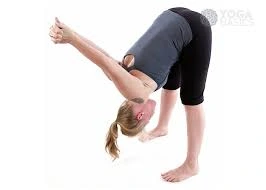
Dandayamana Yoga Mudrasana is a beginner pose that involves tilting your head down and lifting your clasped hands from behind while standing in mountain pose. The shoulders, quadriceps, hamstrings, upper back, and lower traps are all naturally stretched in this pose.
- “Danda” translates to “stick or staff,”
- “Mudra” means “seal,”
- “Yamana” means “balancing” or “maintaining,” and “asana.”
- Means “pose” in Dandayamana Yoga Mudrasana.
Therefore, it means the Standing Yoga Seal Pose. It gets its name from the fact that one must balance their body in a forward bend while their hands are interlaced (or sat) behind them.
Dwikonasana is another name for Dandayamana Yoga Mudrasana. In this context, “Dwi” stands for “two,” “Kon” for “angle,” and “asana” for “pose.” During the position, the upper body forms two angles: one with the lower body and another with the lifted arms from behind.
When the core muscles are warmed up, this posture is typically done in the middle of the standing sequence. Because it offers flexibility and strengthens the neck, spine, hip joints, shoulder joints, and arms, it is beneficial for people who work at desks. Additionally, it aids in controlling blood flow in your arteries, which in turn promotes heart and soul harmony.
Muscle Work During Dandayamana:
- Arms and Shoulders Muscles
- Neck Muscles
- Upper Back Muscles
- Lower Back Muscles
- Core Muscles
- Hamstring Muscle
How to Perform?
- First, enter Tadasana and maintain a straight posture. Your palms should touch your outer thighs inward, and your body weight should be distributed equally between the soles of your feet.
- Now spread your feet two to three feet apart. Retract your arms and clasp your fingers together. You must ensure that your chest is upright and elevated in this position and that your shoulder blades pull against one another.
- Exhale, slowly raise your interlaced hands, and let your head swing comfortably from your neck forward. Try to get your head as near to your knees as you can.
- With your arms pointing upward and downward towards your lower body, your upper body will form an angle in this position. Because two angles are created in this pose, Dandayamana Yoga Mudrasana is also known as Dwikonasana.
- This will be your last job. Try to stay in this position for as long as you feel comfortable, or for at least ten or twelve breaths.
- Next, as you exit the pose, inhale deeply, compress your shoulder blades, and then release your arms as you exhale.
- Now bring your arms back to your sides and raise your upper body to a standing position. Now, assume the Tadasana position once more.
Benefits:
Strengthens the arms and improves shoulder flexibility:
The scapulae, or shoulder blades, come together as you bring your arms linked from back to front. This improves flexibility and stretches your shoulders. This reduces shoulder muscle deficiencies and saves injuries.
Additionally, it aids in maintaining and enhancing your posture. It boosts the force of lifting and throwing motions.
Increases the flexibility of the finger and wrist joints:
The flexibility and dexterity of the wrist and finger joints are enhanced by Danyamana Yoga Mudrasana. This stretching stance relieves mild hand and finger pain as a preventive precaution. It improves the range of motion of your hands and fingers while also strengthening them.
Enhances stability and balance:
The posture teaches your hips, tummy, lower back, and pelvic muscles to cooperate. This improves stability and balance for engaging in other physical activities.
Strengthens the spine and hip joints:
Hip and spine joints can be strengthened and toned using Dandayamana Yoga Mudrasana. The position bends towards the knees while stretching the hip and spine joints.
People who spend a lot of time on computers find that it works wonders for them since it gives their hips and spine joints plenty of flexibility and stretch.
Balances the mind and heart:
Your upper body approaches your knees as you execute the posture. Your head receives more blood as a result. It aids in lowering anxiety and tension. The stance serves to balance the mind and the heart.
Aids in body toning:
Dandyamana Yoga Mudrasan is an effective asana for toning your body and reducing belly fat. This helps to gradually deplete the fat in the abdomen. It therefore contributes to reaching your fitness objective.
Preparatory Pose:
- Tadasana (Mountain Pose)
- Gomukhasana (Cow Face Pose)
- Adho Mukha Svanasana (Downward Facing Dog Pose)
- Yoga Mudrasana (Yoga Symbol Pose)
- Supta Vajrasana (Reclined Thunderbolt Pose)
Modifications:
- To make the pose easier, try keeping your feet apart; to make it harder, try keeping your feet closer together.
- In a similar vein, you can attempt straightening your arms and legs further to increase the stretch once you become accustomed to the pose and feel at ease performing it.
- Advanced yoga practitioners can try to retain their heads between their knees or tilt them towards their feet while performing this pose.
Variations:
Camel Pose (Ustrasana):
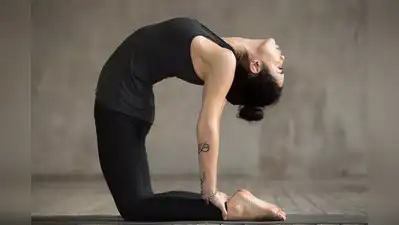
By attempting to touch your hands with your feet or the ground, you can add variation to the stance.
Chair Pose (Utkatasana Vinyasa):

Standing upright allows you to stretch your hands upward and slightly bend your knees.
Parivrtta Utrasana:
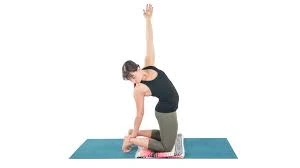
Try putting one hand on the ground and the other up as you lean forward.
Precautions:
- You should do preliminary asanas to loosen up your shoulder and hamstring muscles before starting the position.
- Maintain stability and control over your shoulder blades in relation to your ribs as you begin the pose. Remember that by doing this, you provide your muscles with a solid base on which to comfortably stretch your arms.
- Avoid attempting this asana too hastily. Your neck may be compressed as a result. To do this pose smoothly and make the most of it, take your time.
- In yoga, breathing plays a crucial role. Thus, attempt to synchronise your breathing with this asana’s motions.
Contraindications:
- You shouldn’t perform Dandayamana Yoga Mudrasana if you have a recent or ongoing injury to your neck, back, shoulders, or legs.
- People with untreated high blood pressure should not perform this position.
- Additionally, the pose should not be performed by pregnant women.
Conclusion:
You would gain a lot from doing Dandayamana Yoga Mudrasana alongside other asanas daily. The stance makes use of both the upper and lower bodies at the same time. It also aids in the treatment of back pain, shoulder pain, and issues relating to the spine.
The stance does more than only ease your body’s physical discomfort. But also eases anxiety and tension, two types of internal suffering. As a result, once you begin doing it, you will see improvements in your body and mind.
FAQs:
Who should avoid the Dandayamana Yoga Mudrasana?
Neck, back, shoulder, hip, knee, or ankle injuries, whether they are fresh or chronic.
untreated hypertension, cardiac problems, diarrhoea, peptic ulcers, and abdominal hernias.
pregnancy (because of pressure in the abdomen).
severe sciatica, slipped disc, or weakness in general.
What are the benefits of Dandayamana Bharmanasana?
The pose is said to invigorate the body and the mind in addition to treating fatigue, headaches, anxiety, and insomnia. Uttanasana may aid in better digestion because it massages the abdominal organs. It maintains the flexibility and length of the spine’s nerves.
What does dandayamana mean?
Yin Yoga, which is a therapeutic yoga pose, is natural. Asana means “pose,” Bharmana means “table,” and Dandayamana means “balancing.” The person is attempting to maintain balance with just one hand and one leg in this position, where their spine is like a stick, and their back is like a tabletop.
What Suggestions and Modifications Are Available for Dandayamana Yoga Mudrasana?
Take a deep breath, release it, and start slowly while synchronising your breathing.
Step your feet wider or slightly bend your knees if your feet are tight.
Use a strap between your hands if you can’t reach.
Pay attention to your standing foot.
Reference:
- Dandayamana Yoga Mudrasana (Standing Yoga Seal Pose): Steps and Benefits – Fitsri Yoga. https://www.fitsri.com/poses/dandayamana-yoga-mudrasana
- Standing Yoga Seal Pose Yoga Pose (Dandayamana Yoga Mudrasana). Tummee. https://www.tummee.com/yoga-poses/Dandayamana Yoga Mudrasana.


