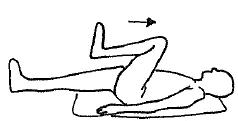
Knee To Chest Stretch Exercise
Introduction
Knee to Chest Stretch Exercise is a simple and gentle stretching exercise that helps relax the lower back, hips, and gluteal muscles. It is commonly used to reduce lower back stiffness, improve flexibility, and relieve tension after prolonged sitting or physical activity.
To more effectively target your lower back muscles, let your legs and hips relax while you stretch.
You’re not alone if, even knowing that your low back muscles are extremely tight and making every effort to release them, you ever feel like you’re missing the mark when you try a low back stretch. Stretching our hips, necks, calves, and other muscles is quite simple for many of us.
But the muscles in your back? Not very much. These can become difficult to reach when they are very tight. If you don’t pick the correct exercise for the job, it can be challenging to find the sweet spot for low back muscular stretchiness.
To increase back flexibility, you could perform a prolonged toe touch. Although you are theoretically stretching those muscles by rounding your back, the movement of toe contacting mostly occurs at the hip joints. That usually leads to back rounding, which is also not very safe.
The knees-to-chest stretch can help with that. In addition to feeling fantastic most of the time, it’s an excellent technique to help your low back muscles become more flexible after a day at the computer or an afternoon spent doing housework or gardening.
However, the knees-to-chest stretch is beneficial for more than just releasing low back muscles. The knees-to-chest stretch might help lessen stiffness related to spinal arthritis and/or spinal stenosis as a range-of-motion exercise, or a movement that increases your joint flexibility.
Range-of-motion exercises can help persons with osteoarthritis lubricate their joints, improve blood flow, and supply nutrients to the affected area.
What is a Knee-to-Chest stretch?
A straightforward stretching exercise that helps release tense hip and lower back muscles is the sitting knee-to-chest stretch. It means reclining with one knee brought towards your chest.
What muscles does the knee-to-chest stretch work?
This mild exercise works the hamstrings, lower back, glutes, and hip flexors.
Hip flexors: These muscles, which include the rectus femoris and iliopsoas muscles, are situated in front of the hip joint. Walking, sitting, getting up and standing in a chair, motorcycling, and kicking a ball are all made easier by hip flexors.
Glutes: The glutes, which are found in the buttocks, are essential for running and walking, climbing stairs, squatting, and staying balanced. Additionally, having strong glutes helps prevent lower back, hip, and knee problems.
Lower back muscles: Lower back discomfort can be lessened by strengthening and stretching these muscles.
Hamstrings: The muscles at the bottom of the thigh are called the hamstrings. Walking, running, leaping, climbing, kneeling, bending, and lifting are all activities that require them.
Other secondary muscles, including the adductors (inner thigh muscles) and abdominal muscles, are also used in the knee-to-chest stretch.
How to Do the Knees-to-Chest Exercise
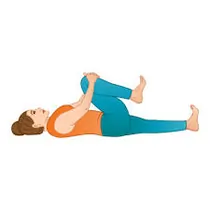
Start the knees-to-chest stretch with just one leg for your own safety. It’s probably time to move on to lifting both legs if, after a few days, you’re doing it painlessly.
Consult your healthcare physician if you’re not sure if a knees-to-chest stretch with two or one leg is safe for your specific back issue.

Instructions:
- Firstly, lie down with your foot flat. We refer to this as the supine position.
- Raise one bent knee just enough to allow both hands to grab your lower leg. Just below the knee, interlace your fingers.
- We’re gonna do both legs, but start with one leg. It’s probably safer to start with one and then rapidly follow with the other because doing both at once requires a lot of abdominal strength, especially for backs that are prone to injury.
- Similar to the single-legged variation, cross your wrists or interlace your fingers between the lower legs, just below the knees, if you are doing both at once.
- Try to keep your lower back, pelvis, and legs as relaxed as you can while you’re tugging. When utilized passively, the knees-to-chest exercise more effectively accesses the lower back muscles.
- Hold for a short while.
- Put your leg back on the ground.
- On the opposite side, repeat.
Knee-to-chest stretch benefits
The knee-to-chest stretch is an effective way to release tense muscles in your hips and lower back, which are frequently caused by activities like sitting for extended periods of time or climbing stairs. Additional advantages consist of:
- increasing the range of motion and flexibility of the glutes, hamstrings, and hips. Daily activities like sitting upright, climbing and descending stairs, walking, running, picking up objects from the ground, and household tasks like sweeping, mopping, gardening, and lifting goods can all benefit from this.
- promoting deep breathing and offering a brief break from daily tensions in order to promote relaxation and stress reduction.
- By using your core muscles and stretching the muscles surrounding your pelvis and lower back, you may strengthen your core.
FAQs
What is knee-to-chest exercise good for?
The knee-to-chest stretch is an excellent way to release tense muscles in your hips and lower back, which are frequently caused by activities like sitting for extended periods of time or climbing stairs. Enhancing the range of motion and flexibility in the hips, hamstrings, and glutes are additional advantage.
How to progress from knee-to-chest?
This involves lying on your back with your feet flat and your knees bent. Repeat on the other side after slowly hugging and releasing one knee into the chest. Raising both knees to the chest, softly squeezing in, and then releasing will advance this. The best advice is to only go as far as your discomfort permits.
How many minutes for knee-to-chest?
Keeping the other foot level on the ground or the other leg straight, depending on which is more comfortable for your lower back, bring one knee to your chest. Hold for 15 to 20 seconds. Lower the knee to the beginning position while relaxing.
What are the benefits of the knees to chest pose?
Benefits. strengthens the thighs, calves, ankles, and spine; strengthens the ligaments and tendons of the feet; lessens flat feet; increases low back flexibility; lessens low back strain; helps the body establish pelvic stability; and lessens inflammation and indigestion.
Are 7 chest exercises good?
Basically, if your goal is to increase the size of your chest through muscle hypertrophy, you would need to execute three to four chest exercises per workout; if your goal is to improve strength, you would need to perform two to three exercises. Dumbbell bench press, cable chest fly, dips, incline bench press, and dumbbell flyes.
What will happen if I do 100 knee push ups everyday?
Your muscles will require extra time to recover if you find it difficult to do 100 push-ups. It’s usually advised to give muscles at least 48 hours of rest to optimize strength. You run a higher risk of damage if you keep using these muscle fibers without getting enough rest.
Is the knee to chest good for lower back pain?
The Ideal Stretch for Pain in the Lower Back
The “knee to chest stretch” is one of the most popular and successful exercises for relieving lower back discomfort.
Why can’t I lift my knee to my chest?
A few people have hip joints that are more prone to impingement. Additionally, some people have balls or sockets that are a little strange in shape. A cam lesion, which essentially indicates a thicker portion of the femur, may be seen on the ball.
What is the knees-to-chest position called?
The knee-chest position, also referred to as the genupectoral position, is a medical position in which the patient rests on their knees and chest. It is frequently used for examinations, certain surgeries, childbirth management (such as cord prolapse), and to treat conditions like Tetralogy of Fallot cyanotic spells.
Important features:
Genupectoral position is a medical term.
The head is turned, the body is supported on the knees and chest, the hips are raised, and the weight is supported on the elbows, upper chest, and shoulders.
Applications include gynecological examinations, rectal exams, cord prolapse, fetal malposition (such as breech), treating “tet spells” in Tetralogy of Fallot, and certain surgeries.
Related: Although the medical knee-chest is more specialized, a similar stretch (knees to chest) is known as the Heat Escape Lessening Position (HELP) for cold water survival and Apanasana in yoga.
What are the disadvantages of the knee-chest position?
However, negative effects of the knee-chest position have been identified, including deep vein thrombosis, bilateral calf-muscle ischaemia with rhabdomyolysis and acute renal failure because of the prolonged flexion of the lower limbs, and persistent postoperative hip and quadriceps pain.
What are the benefits of the knees-to-chest pose?
Strengthens the muscles in the lower back.
Increases the flexibility of the spine and upper back.
Massages the muscles in the pelvis and abdomen.
Enhances colon function.
A treatment for constipation and unpleasant wind.
Massages the reproductive system.
References
- Cpt, A. A. (2025, October 22). Knees to chest stretch for low back muscles. Verywell Health. https://www.verywellhealth.com/knees-to-chest-exercise-296870
- How to do the single Knee-to-Chest exercise – Health Information Library | PeaceHealth. (n.d.). https://www.peacehealth.org/medical-topics/id/abo6363
- Seated knee to chest stretch. (n.d.). [Video]. Hingehealth. https://www.hingehealth.com/gb/en/resources/articles/knee-to-chest/