Cycling Exercise
Introduction:
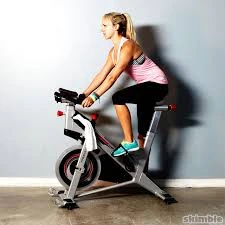
Cycling Exercise is a simple yet powerful cardiovascular activity that improves heart health, strengthens leg muscles, and boosts overall endurance. Whether done outdoors or on a stationary bike, cycling is a low-impact workout suitable for all ages, helping with weight management, joint mobility, and stress reduction while keeping your body active and energized.
This training program strengthens the muscles in the upper legs and glutes, which are a cyclist’s power source. Additionally, it increases endurance in the parts of the upper body that usually become tired during long road trips.
How to Train for Cycling?
- Boost the strength of the leg muscles that give you the ability to ride a bicycle up hills and through headwinds.
- Increase your strength in the knees, arms, wrists, hands, shoulders, and neck—areas that are likely to hurt after a long day of riding.
- Do some core exercises to improve your balance. Riders who have strong core stability in the saddle can put their all into propelling the bike.
- Increase your cardiovascular activity. Add frequent cycling rides with lots of hills to your workout regimen.
Benefits:
Greater bulk of muscle. Our muscle mass normally decreases with age, which can result in poor metabolic health, weakness, and decreased endurance. Weight training can help increase muscle mass and counteract this decrease.
Increased density of bone. Although cycling is excellent for cardiovascular health, it doesn’t produce the stress required to build bone because it has a mild impact.
Joints that are more robust and sturdy. The joints are stronger when the muscles supporting them are stronger.
Less imbalance in the muscles. In addition to strengthening the muscles used in cycling, strength training can assist in preventing physical imbalances by strengthening underused muscles.
Preventing injuries. You are less likely to sustain an accident while riding and in daily life because of stronger joints and fewer muscular imbalances.
Training Exercise for Road Cycling:
As you train, have the following in mind:
Your physique should fit the exercises, not the other way around.
Adjust the activity or omit it if something hurts, and take additional days off if necessary.
Start slowly and go at your own pace.
As your training advances, increase the weight, resistance, or repetitions.
Warm-up:
Spend five to ten minutes cycling or running at a leisurely pace to warm up. Then, as you work through the tasks in this article, adhere to the following instructions:
For speedier activities, just make sure your breathing is normal. Inhale during the first exertion and exhale as you return to the starting position.
At the conclusion of each exercise (unless specified), take a 30- to 45-second break.
Walking Lunge with Rotation:
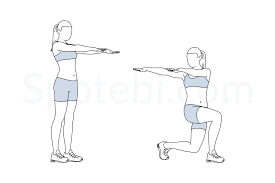
- Place your feet a little apart as you stand.
- Make a lunge by stepping forward with one foot. At a 90-degree angle to the floor, your rear knee should drop. Additionally, you should have your forward knee at a 90-degree angle.
- Turn your body sideways toward your lead knee as you take a stride forward. Keep your arms slightly raised from your sides at chest height.
- The next phase in a lunge is to drive up and through your forward leg. Now you should have your back knee out front.
- For a total of 20 repetitions, repeat 10 times on each side.
Single Leg Deadlift Exercise:
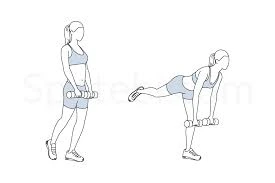
- Hold a dumbbell in your left hand while standing with your feet shoulder-width apart.
- Bend forward at the hips while extending your left leg backwards, centring your weight over your right foot. Keep your balance as you lower the dumbbell toward the floor. Keep your hips from rotating.
- Squeeze your glutes to bring yourself back to the starting position, keeping your back straight and your core active.
- Perform this 20 times, then perform 20 reps on the opposite side.
Goblet Squat Exercise:
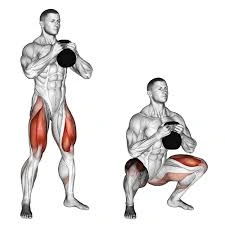
- Place a dumbbell against your chest in a vertical position.
- Turn your toes out a little and place your feet shoulder-width apart, or a little wider.
- Consider how you sit in a chair: maintain your shoulders back, your back straight, and your chest open as you lower your hips straight toward the floor. (Remember to keep your heels down and avoid letting your knees go past your toes when performing this.)
- Power back up to the starting position by using your quadriceps and glutes.
- Perform this 20 times.
Plank with Single-Arm Row Exercise:
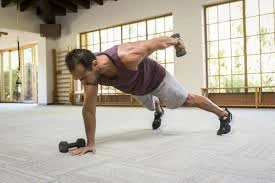
- Start by placing your feet wide apart and your hands on dumbbells in a plank position.
- Row one elbow back until the dumbbell reaches your rib cage.
- Put the dumbbell back on the floor and do it again.
- Throughout the exercise, keep your body straight from head to toe to maintain a plank position. To better engage your neck muscles, keep your chin slightly tucked and stare at the ground in front of you rather than allowing your hips to spin.
- Do 10 to 15 repetitions for each arm.
Bridge with Hamstring Curl Exercise:
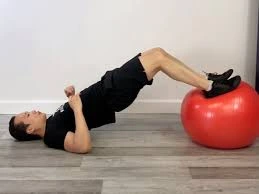
- With your legs outstretched and your heels resting on the exercise ball, lie on your back with your arms down by your sides.
- As you roll the ball toward your butt and pull your legs back, contract your abs and glutes.
- When your knees are bent just a little bit above 90 degrees, stop.
- Roll the ball away from you and straighten your legs once again.
- 15 times, repeat the sequence.
Back Extension Exercise:
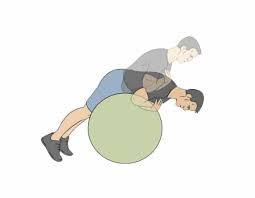
- Place the workout ball on your stomach.
- Make sure your elbows and shoulders are level by crossing your arms in front of you.
- Raise your shoulders gradually until your body is in a straight line. To keep your head neutral, keep your chin slightly tucked under.
- Take on the shape of the ball by lowering your shoulders back down.
- Do this 15–20 times.
FAQs
What is rule 9 in cycling?
The ninth Velominati rule is: You are a badass if you ride in inclement weather for a period. It also indicates that you are aware that there are only poor fashion choices and no adverse weather.
What is the best method of training for cycling?
Interval training, which involves incorporating brief sprints into endurance rides, is a popular cycling technique. Enhancing your strength and endurance on a bike can also be achieved by training in mountainous terrain. The goal is to become proficient at longer climbs while improving your breathing and cadence.
What happens if I do cycling every day?
Your general level of fitness will grow as a result of your deeper breathing, increased sweating, and elevated body temperature. Regular cycling has several health benefits, such as improved cardiovascular fitness. improved flexibility and strength of the muscles.
When to avoid cycling?
Extreme Heat: It’s usually better to refrain from cycling if the temperature rises above 95°F (35°C). The risk of heat exhaustion or heatstroke is significantly increased by such high temperatures. Riding in freezing rain or snow can result in slips, falls, and collisions, making it risky.
Which skill is necessary for cycling?
Cornering, braking, climbing, descending, and using the gears are all on my list; they are not included in any particular order. You also need to learn how to maintain your bike, how to ride in a group, what to wear, and a lot more.
References:
- McCoy, J. (2026, January 5). These cycling exercises for strength are underrated, according to coaches and trainers. Bicycling. https://www.bicycling.com/training/a69917251/underrated-strength-exercises-for-cyclists/
- Combining cycling and weight training: tips, exercises & workouts. (2025, February 3). PureGym. https://www.puregym.com/blog/cycling-and-weights/