Arnold Press
What is Arnold Press?
The Arnold Press is a dynamic shoulder-strengthening exercise made popular by legendary bodybuilder Arnold Schwarzenegger.
A variation of the overhead press, a weight-training exercise that increases arm and shoulder mass, is the Arnold press. The Terminator, who reportedly used the technique to gain muscle, was the inspiration behind the moniker of this specific variant. However, there are correct and incorrect ways to perform any workout that involves lifting weights.
Muscle Work During Arnold Press:
The shoulder is a very intricate joint that may move in a wide variety of ways. One of the primary muscles used in an Arnold Press is the three-headed deltoid, which is its most noticeable muscle.
The Arnold Dumbbell Press engages all three deltoid muscle heads, in contrast to other shoulder press variations like the military press and overhead press, which concentrate primarily on the anterior and lateral deltoid heads:
- Anterior Head of Deltoid
- Posterior Head of Deltoid
- Lateral Head of Deltoid
How to Perform?
- Pick up a bench and make sure it is positioned at its highest inclination. Raise the dumbbells and put your arms by your sides.
- Holding the dumbbells palms up toward you, raise them to shoulder level.
- To fully stretch your arms, rotate them into a shoulder press position and then push up. At this point, your palms should face forward.
- With your elbows pressed against your body, reverse the process and raise the dumbbells and your arms back to shoulder level.
Benefits:
- Better shoulder activation: The Arnold press’s circular motion aids in the recruitment of all three deltoid heads, potentially providing more evenly distributed muscular growth.
- Increased range of motion: The shoulder joint‘s range of motion is expanded by the inward-to-outward rotation. This might increase mobility and flexibility.
- Functional strength: The Arnold press enhances sports performance and real-life functional strength by simulating more organic arm movements.
- Enhanced core engagement: The movement tests stability, so the core muscles must remain active during the lift.
How does the Shoulder Press differ from the Arnold Press?
The only distinction between the Arnold Press and the traditional dumbbell shoulder press is the absence of rotatory action. As you push your weight during an Arnold Press, you are limiting your wrist movement to your typical up-and-down with your palms facing out, rather than switching from a palm-to-chest to a palm-to-front motion.
This simply indicates that you are solely working on your anterior and lateral delts, which is not necessarily a bad thing. Additionally, as everyone knows, you can concentrate more on lifting bigger weights and developing pure strength if you target fewer muscle groups.
Your severe shoulder press will gradually get better as you become proficient at the Arnold Press.
Variations:
Half Kneeling Arnold Press:
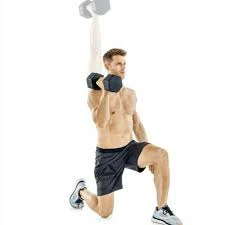
Both the seated Arnold press and the half-kneeling Arnold press work the triceps, trapezius, and all three heads of the deltoid muscles. The stabilisation mechanics are the primary distinction. The seated Arnold press is excellent for shoulder hypertrophy because it uses the bench to offer a sturdy basis.
In addition to improving hip and posterior chain stability over time and lowering lower back strain, the half-kneeling Arnold press necessitates additional torso stabilisation, increasing core usage and gains.
Seated Arnold Press:
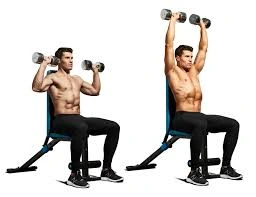
With one significant exception—you perform the repetitions one arm at a time—the alternating seated Arnold press has many of the same fundamental ideas and movement patterns as the normal seated version.
By addressing any strength disparities or physical variations, this unilateral technique creates a more consistent look and enhances performance on both shoulders. Although the same muscles are used, the alternate form necessitates more stabilisation, especially from the supporting and core muscles, in order to maintain good posture.
Standing Arnold Press:
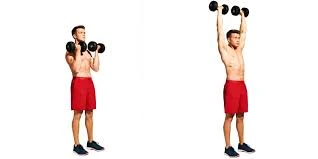
The standing Arnold press, like all variations, effectively engages the triceps, trapezius, and deltoid muscles. The absence of the bench greatly increases lower-body and core activation, which is the same distinction between the standing and kneeling forms.
Standing Arnold presses, which emphasise fitness and functional strength and help with full body coordination, are often performed with lesser weights; sitting variations are excellent for greater loads. They are frequently utilised in HIIT-focused sessions or dumbbell circuits since they are simple, quick, and efficient.
Seated Seesaw Arnold Press:
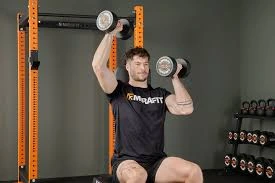
Another seated form is the seesaw Arnold press, which differs in its mechanism of movement. In contrast to the alternating Arnold press, this exercise creates a seesaw-like impact by pressing one dumbbell while lowering the other.
Compared to the conventional sitting variation, this variation is more dynamic and functional because it places a strong emphasis on stability, mind-muscle connection, coordination, balance, and core control. But it’s still a great way to strengthen your delts and any other supporting muscles.
Incline Arnold Press:
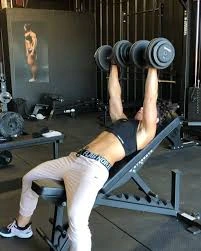
The incline Arnold press, on the other hand, is a combination of the shoulder and incline chest press that puts some strain on the upper chest and front delts. It is usually done on an adjustable weight bench that is angled between 30 and 45 degrees.
This variation increases general shoulder activation and improves upper body pressing strength. The incline version enhances upper chest engagement and pushing mechanics, while the seated version places more emphasis on shoulder development.
Risk While Performing Arnold Press:
The Arnold press may not be appropriate for everyone, despite the fact that it can provide an efficient shoulder workout. Because it’s a more complicated workout, employing too much weight or bad form can make you more likely to get hurt.
Among the possible dangers are:
Shoulder injury: Shoulder impingement can occur as a result of raising the arm over the shoulder and rotating it.
Lower back strain: Back pain can be caused by bad form, poor posture, and a lack of core activation.
Wrist pain: The Arnold press’s twisting motion may cause wrist strain.
Safety Tips:
- Throughout the exercise, maintain a flat back against the pad.
- Avoid letting the head protrude too far forward.
- As you press, drive your bicep to your ear and release your breath.
- If you experience any neck or trap pressure during the exercise, address a lack of shoulder flexion or thoracic spine extension.
- Shoulder tension can be maintained by keeping the elbows slightly bent at the top and avoiding complete locking out.
- A lack of shoulder mobility, due to inadequate scapular upward rotation, may be indicated if you are unable to lock out your elbows overhead.
Conclusion:
It turns out that almost anyone can work out as well as Mr. Olympia, who has won seven times. To improve your posture and encourage broad shoulders, you can target a greater variety of muscles by including a twisting motion into your standard shoulder press.
You should debate which exercise you should perform first on your next shoulder day, rather than wondering if you should perform the shoulder press or the Arnold Press.
FAQs
What are the disadvantages of the Arnold press?
The Arnold press’s unusual rotational movement pattern makes it unsuitable for handling large objects. Because it involves rotational movements, increasing the poundage may result in greater shoulder discomfort.
Is the Arnold Press safer than the shoulder press?
When done properly, these activities are safe, but here’s how to reduce the risks: Overhead Press: To protect the lower back, concentrate on engaging your core. Arnold Press: To protect shoulders and wrists, limit your range of motion.
What muscles do Arnold Press work?
All of the deltoid’s heads are targeted by the Arnold Press. With shoulder presses, the rear deltoids are sometimes overlooked, but with the Arnold press, they are used because of the wrist rotation. Additionally, the upper chest, traps, and triceps are worked.
Can Arnold presses improve shoulder mobility?
The Arnold Press improves shoulder mobility. Your joints go through a wider range thanks to the rotation. Over time, this increases flexibility. Together, you will increase your strength and range of motion.
What Does The Arnold Press Work?
Although it puts greater strain on the shoulder joint than other shoulder press variations, the Arnold press isn’t always detrimental to your shoulders. Before attempting this version, we advise doing the dumbbell shoulder press to increase shoulder strength, stability, and mobility.
References:
- How to do an Arnold Press | Arms & shoulders | The Gym Group?www.puregym.com/exercises/arms-and-shoulders/shoulder-press
- The Arnold Press: What It Is, Benefits & How To Do It Safely – 2025/Thwaini/row.gymshark.com/blog/article/what-is-the-arnold-press
- Six Arnold Press variations: Daniel Wilson (27 Oct, 2025) | Mirafit| mirafit.co.uk/blog/six-arnold-press-variations
- Arnold shoulder press: Benefits, risks, and how to do it properly – 2025 – Morales-Brown/www.medicalnewstoday.com/articles/arnold-press#risks