
Rope Climbing Exercise
Introduction:
The Rope Climbing Exercise is a powerful upper-body and full-body workout that builds strength, endurance, and coordination.
Using your hands, arms, upper body, and frequently your legs, you lift yourself up a vertical rope in a bodyweight strength workout called rope climbing. Most gyms will have:
- A thick climbing rope, typically with a diameter of 1.5 to 2 inches
- 12 to 20 feet in height
- Padded flooring or a crash mat underneath
Rope climbing used to be a competitive sport and a required exam in both the military and educational institutions. It appears nowadays in:
- CrossFit exercises and functional fitness
- Races on obstacle courses
- Evaluations of police and military fitness
- Grip-strength training and gymnastics
The amount of strength, coordination, and control required for rope climbing is what makes it unique. Even seasoned lifters who are proficient with barbells but don’t perform a lot of bodyweight work may find it difficult to complete a single rope climb.
Muscle Work During Rope Climbing:
- Shoulder and Upper Back Muscles
- Biceps Muscles
- Latissimus Dorsi Muscle
- Core Muscles
- Gluteus Muscle
- Quadriceps Muscles
- Calves
Techniques for Rope Cimbing:
The J-Hook: The Traditional:
The traditional gym rope climbing method is the J-hook. It allows you to take a powerful “step” on the rope without fully encircling both legs.
Instructions:
- Leap, bend your arms slightly, and grasp the rope with both hands.
- To suspend the rope on the inner of your dominant leg, raise your knees.
- So that the rope lies along the arch, place it beneath that foot.
- Pinch the rope between your shoes and place the second foot on top to form a “J.”
- Straighten your legs to stand tall on the rope. Slide your hands up simultaneously.
- After you’re standing upright, bend your knees again, raise the rope, and repeat.
The S-Wrap: To Increase Grip:
More friction and control are provided by the S-wrap, often known as the Spanish wrap. Although it moves a bit more slowly, it’s excellent for novices or extremely tall ropes.
How to perform an S-wrap?
- As before, begin by grabbing the rope and raising your knees.
- To create an “S” shape around your calf and foot, wrap the rope around the outside of your leg, under the foot, and back over the top.
- To secure it, pinch with the other foot on top.
- Get to your feet, raise your hands, and repeat.
Free Climbing – For the Advanced:
Rope climbing without the use of the legs is known as free climbing. You are just lifted by your arms and upper body.
You should only do this advanced rope climber exercise if:
- You feel very at ease climbing ropes with an S-wrap or J-hook.
- You can perform ten to fifteen rigorous pull-ups.
- You have great grip endurance.
Simple method:
- You can hang yourself from the rope or sit on the ground.
- To compensate, keep your legs slightly ahead of you.
- Make use of strong arm pulls and firm core tension.
- Limit swinging; instead of flailing, consider “short but strong” pulls.
Benefits:
Unbelievable Grip Power:
Repeated rope climbs are one of the few activities that improve grip. Your forearms adjust quickly due to the thick surface and constant stress. This also applies to:
- Deadlifts
- Barbell rows
- Rock climbing, martial arts, and grappling
- Daily chores involve hauling bulky suitcases
Coordination and Whole-Body Strength:
The muscles used for rope climbing come from nearly every major area of the body, including the lower, upper, and core. It trains you to move as a cohesive whole rather than as discrete sections.
Boredom-Free Conditioning:
Exercises using a short rope for climbing are incredibly helpful for conditioning:
You can be crushed in a matter of minutes with five to ten rope climbs combined with kettlebell swings, burpees, or runs.
Without lengthy, tedious treadmill sessions, you get both cardio and strength benefits.
Confidence and Mental Toughness:
To be honest, it’s an incredible feeling the first time you touch the top of the rope. Training in rope climbing helps you overcome your persistent fear of heights and falling while boosting your confidence in your own bodyweight power.
Beginner’s Advice:
- For four to six weeks, concentrate on pull-ups (with assistance if necessary), rows, dead hangs, and simple core exercises.
- Practise J-hooks and S-wraps low to the floor for complete sessions.
- Just make one or two pull-ups, then descend again.
- As your rope climbing muscles grow stronger, gradually increase the distance.
- Establish a reasonable objective, such as one to three complete rope climbs each workout.
- Only add more while maintaining a clean technique.
- Include timed sets (maximum rope climbs in five minutes).
- Once you’re strong and self-assured, try free climbing.
Exercise for Rope Climbing:
Seated to Stand Rope Climbing:
Sitting on the ground, straddle a rope that is suspended from a pull-up bar. Using one hand over the other, ascend and descend the rope. Depending on your degree of skill, use your feet’ aid as much or as little as you’d like.
Towel Pull-ups:
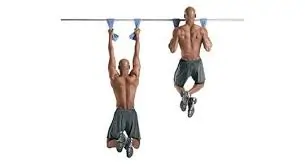
Do pull-ups while holding a gym towel in each hand by tossing it over a pull-up bar. If you don’t have a pull-up bar, execute the same exercise with your feet on the floor while hanging the towel from a barbell in a squat rack. Pull the towel to each side of your head in turn to add more movement.
Negative pull-ups:
You can improve on your grip and increase your pulling strength by performing negative pull-ups or chin-ups. Lower yourself for five counts after starting with your chin over the pull-up bar. This can be advanced by holding weight between your ankles or scaled by performing with your feet on the ground.
Lat Pull-downs:
Strict form lat pull-downs with as much weight as you can for sets of three to six repetitions are an excellent approach to overcome any sticky spots in your pull-up or rope climb.
Common Mistakes:
Attempting to Muscle It Just with Your Arms:
This is the typical mistake made by beginners.
Fix: Drill the S-wrap or J-hook until it feels natural. Locking the feet and “standing up” on the rope should be the first step in every repetition.
Observing Straight Down:
You feel afraid and elevated when you stare at the floor.
Fix: Keep your eyes up or slightly ahead. Have faith in your technique and the mat.
Hurrying Down:
Many injuries occur on the descent rather than the ascent.
Fix: Use controlled slides to descend hand-over-hand while maintaining some foot friction. Avoid just “dropping” and catching yourself at the last minute.
Disregarding Skin and Equipment:
Torn calluses and rope burns are real.
- For S-wrap rope climbs, wear shin protection or long socks.
- Maintain moisturised hands and filed calluses (but dry during workout).
- Chalk is beneficial, particularly for hands that are perspiring.
FAQs
Is rope climbing a good workout?
Climbing a rope can be an amazing full-body workout, depending on your technique. The main muscles you will be using are listed here. Core: Because of the rope’s instability and mobility, you must use your core muscles to maintain your balance and provide stability.
Are rope climbs difficult?
Gym rope climbing may seem easy: all you have to do is pull yourself up a rope, right? However, looks can be deceiving! Your entire body is used in this difficult blend of strength, coordination, and skill.
Is the L-sit rope climb hard?
Strength and technique are both needed for the difficult and specialised L-sit rope climb. When performing this exercise, it’s important to keep in mind that your feet shouldn’t fall past the bottom of your glutes. Maintaining correct form and optimising efficiency during the climb depend on this.
What are the benefits of rope climbing?
In conclusion, there are several advantages to climbing rope workouts, such as a full-body workout, stronger grips, better balance and coordination, and more cardiovascular endurance. You can greatly improve your general well-being and level of fitness by incorporating these activities into your routine.
What are the common mistakes in rope climbing?
Lead with the rope behind your leg.
Ineffective communication.
Over an edge, Carabiner.
Back-clipping.
Z-clipping.
Using carabiners with deep grooves and fixed quickdraws.
blindly relying on bolts.
positioned within the drop zone.
References:
- The top 5 exercises for rope climbing – 2025 – Gottlieb//www.onnit.com/blogs/the-edge/the-top-5-exercises-for-rope-climbing?srsltid=AfmBOoqXx2U8UuM6GXo7AZ5ej6Jj_0Gq7viUehiODzNZwT2SQc2mEunN
- Rope climbing | exercise | technique | training | Benefits/www.reset.in/blog/rope-climbing-workout