Rib Mobility Exercises
Introduction
Rib mobility exercises are essential for improving chest expansion, enhancing breathing efficiency, and reducing stiffness in the upper body. The ribs play a key role in respiration and spinal movement, so limited mobility can contribute to discomfort, poor posture, and restricted lung capacity.
These exercises are particularly helpful for people with sedentary lifestyles or postural problems since they gently stretch and mobilize the rib cage to encourage improved oxygen intake, reduce stress, and develop overall thoracic flexibility.
Rib Anatomy
In addition to a variety of ligamentous (bone-to-bone), muscular, and neurological components, the thoracic spine and the ribs that articulate with it constitute a unique combination of bony anatomy.
Your thoracic spine, or the middle part of your back, is made up of twelve thoracic vertebrae stacked on top of one another. Twelve pairs of ribs create the thoracic cage, which shields your internal organs. These pairs are further classified as true ribs, fake ribs, and floating ribs because they mimic their rib neighbors above and below.
Through a special physical connection known as the costal cartilage, the real ribs are directly attached to the sternum (sometimes referred to as your breastbone) through the sternocostal joint. These are ribs 1 through 7 in total.
Through the costal cartilage of the seventh true rib, the false ribs eventually establish an indirect link with the sternum. Ribs 8, 9, and 10 are regarded as the false ribs.
Because of their solitary attachments to the thoracic spine, the floating ribs are genuinely “floating” and fail to comply with the sternum. Ribs 11 and 12 are these.
Where are the ribs situated?
The true and false ribs’ sternal attachments in the front have been appreciated, but what about their vertebral attachments in the back? The costovertebral and costotransverse joints allow each rib to articulate with two thoracic vertebrae. Remember that the intercostal nerve‘s collateral branches provide robust innervation to these joints, as this will be essential in the future.
A thoracic ring is created by each pair of ribs, their sternal attachments, and their vertebral attachments when you stand back and consider the wider picture. Because each thoracic ring has thirteen joints, it can be difficult to diagnose musculoskeletal conditions in this area of the body when there is pain.
The intercostal nerves, which run the length of the ribs and supply both sensory and motor branches, innervate the ribs. Between the ribs are tiny intercostal muscles that help with breathing by raising and lowering the ribs in response to the lungs’ inhalation and exhalation. Lastly, the intercostal nerve is caused by an associated vein and artery. It turns out that, aside from the typical bony issues, this is a somewhat complex region of anatomy.
Nevertheless, it would be a mistake to overlook the fact that the thoracic spine and rib cage are involved in the respiratory, cardiac, and digestive systems in addition to the musculoskeletal system.
Physical therapists are not the only medical professionals who are frequently interested in this area of anatomy. When a patient experiences pain at one of these joints, it is important to carefully consider causes other than musculoskeletal pain.
What is a Rib Dysfunction?
We can take advantage of that. Additionally, we will continue to refer to rib pain as rib dysfunction for semantic reasons. Soon, we’ll go more into the suggested anatomical causes for frequent episodes of rib dysfunction.
Explaining Rib Dysfunction & Pain
The thoracic spine is often ignored when it comes to pain in the spinal column. In addition to the distinct rib discomfort and flare-ups that can occur here, clinicians typically treat it the least of the three spinal segments (cervical, thoracic, and lumbar).
Furthermore, poor pain source identification is frequently caused by the thoracic spine’s neuronal complexity and numerous referral patterns. Additionally, many other body systems, such as the heart, kidneys, lungs, and esophagus, are mentioned here from the perspective of the clinician.
Rib Mobility Exercises
Cat-Cow Pose

Cat-Cow Stretch steps:
Originating in yoga, the Cat-Cow Pose is a popular and powerful fundamental pose used by many other therapies.
Beginning on all fours, align your knees with your hips and your hands with your shoulders. Put your spine in a neutral position to begin.
Breathe out such that your head hangs while your hands are pressed into the ground and your mid-back is curved toward the ceiling.
Take a breath to bring your spine back to neutral, then keep extending so that your chin rises and you can gaze up. Keep your core muscles strong and raise your chest and tailbone to the sky.
Try to maintain a fluid motion. Holding for 5 to 10 seconds at the conclusion of each movement, repeat 8 to 12 times.
You can perform the same exercise while standing with your hands on a desk or counter if kneeling is not an option. The surface ought to be at or below hip level. The exercise can also be done with your hands on your knees while seated in a chair.
Advice: Breathe deeply and fully throughout. Be careful not to overarch your lower back when you move into extension.
Thread the needle

Thread the needle steps:
An excellent exercise for thoracic rotation with a small amount of extension is threading the needle. It is highly effective and less likely to result in lower back rotation because of the additional difficulty of working against gravity and staying on all fours.
Start on all fours, aligning your knees with your hips and your hands with your shoulders. Put your spine in a neutral position to begin.
Take a breath and raise your right hand, palm facing away from your body, toward the ceiling.
Breathe out, then lower your right arm across your body and place it on the ground under your left arm. Let your eyes follow your right arm until your right cheek and shoulder touch the floor.
Lift your left arm into the air to expand your shoulder and chest once you’ve “threaded the needle.” Inhale deeply.
Return to the beginning position by bringing your left arm back down. Repeat the stretch on the opposite side.
Hold the stretch for five to ten seconds after completing the exercise six to eight times on each side.
Advice: Keep breathing completely into your ribs and move at a modest pace.
Downward-Facing Dog

A great mobility exercise for thoracic extension and opening up the front of the shoulders is the downward-facing dog.
Start on your hands and knees.
Breathe in, then lift your hips up and away from the floor as you exhale. Bend at the hips to form an inverted V.
To push your chest through your arms and toward your legs, take a breath.
Breathe out to move your weight forward, then go back to where you were before.
For three sets, repeat eight to twelve times.
Advice: Go slowly to moderately, pausing at the top of the pose to take a deep breath and feel your spine extend. If the stretch is too hard, keep your knees slightly bent. Alternatively, you can make this stretch easier by resting your arms on a table, chair, or counter.
Supine spinal twist

The lower back can be stretched in a circular motion using this exercise.
With your arms out at your sides and your legs straight, lie on your back. Your body should resemble a T.
Raise your right knee to your chest.
Take a breath, then turn your body to the left as you exhale, trying to lower the inside of your right knee to the floor. Next, turn your head to the right.
After three seconds of holding this stretch, turn back to the beginning position. After eight to twelve repetitions of this leftward motion, switch sides.
Hold the stretch for 5 to 10 seconds after completing 8 to 12 repetitions on each side.
Advice: For extra support, think about putting a cushion or rolled-up towel below your head.
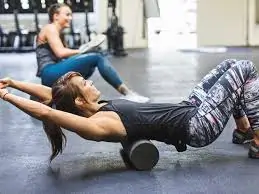
Assisted thoracic extension on a foam roller

You may strengthen your trunk muscles, extend your thoracic spine, and improve your upper body’s range of motion by using a foam roller.
The bottoms of your shoulder blades should rest on it when you lean on it. To support your neck, plant your feet, bend your knees, and put your hands behind your head.
Raise your hips a little with your breath. Make an arc in your upper back by opening your chest and bending back over the roller.
Pay attention to sensitive regions as you roll your upper back up and down. Allow your body to soften toward the floor by taking deep breaths into your rib cage. In each posture, take a few breaths.
Release your hands and extend your arms back and up if your neck feels supported.
Moving up and down your mid-back, repeat five times for three sets.
Advice: Keep breathing deeply into your ribs. Put your hands, a block, or a hard pillow below your head if the arched position is causing any neck strain.
Child’s Pose

Child’s Pose can assist extend your spine and stretch your shoulders, lower back, and chest muscles.
Get on all fours to begin.
Take a breath, then sit back on your heels as you release it. Put your hands forward and lower your forehead to the floor.
Feel the stretch from your lower back to your fingers as you slowly inhale and exhale.
For three sets, hold this stance for 30 to 60 seconds.
Use a blanket or bolster beneath your forehead, stomach, or thighs for additional support.
Seated spinal twist

The main movement of the thoracic spine, rotation, is the subject of this exercise.
Lengthen your spine while sitting on a chair with your buttocks at the front edge. Put your hands on your knees.
Breathe in, then exhale and turn to the left, placing your right hand on your left knee and your left arm behind you. Keep your spine neutral while you rotate, and visualize yourself growing taller.
To get back to the center, take a breath. Repeat oppositely.
Hold the stretch for five to ten seconds at the conclusion of each of the eight to twelve repetitions of the entire sequence.
Tips: Maintain the squeeze of your legs to keep your pelvis from shifting. Feel the rotation of your spine originating from above your waist. Keep breathing and aim to grow taller with each repetition.
Seated side stretch
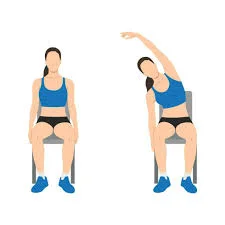
This seated exercise can flex the thoracic spine in a lateral plane and offer deep stretches for the arms, lats, and lower back.
With your knees slightly apart and your feet together, take a seat on the edge of a chair. Put your arms by your sides.
With your palm facing forward, raise your left arm to your side and bend it at a 90-degree angle. Hold the seat’s edge at your side with your right hand.
Raise your left hand over your head and stretch it to the right toward the ceiling while maintaining a straight spine, creating the appearance of an arch. Concentrate on making the left side of your body longer.
Repeat on the opposite side after exhaling to get back to the beginning position.
Hold each stretch for five to ten seconds after completing eight to twelve stretches on each side.
Advice: Try to maintain a long spine and hold your breath in your ribs.
FAQs
How to improve rib mobility?
Sit Back and Forward Fold.
Side Stretch with Spiraling.
Thoracic Windmill with Towel.
Quadruped Thoracic Rotation.
Wall Angel (Scapular Wall Slide)
Short-Seated Wall Reach.
Deep Diaphragmatic Breathing.
Can scoliosis mess up your ribs?
Chest and rib pain may result from the spine pulling on the rib cage and shifting its location as it develops an abnormal spinal curve. Let’s examine the condition itself and some fundamental anatomy before we talk about scoliosis rib discomfort.
What causes rib cage tightness?
The majority of rib pain is not harmful. The most frequent causes of rib cage pain include stress, postural problems, muscle strain, and costochondritis. Although they are not fatal, many illnesses can be excruciating and chronic.
Is stretching good for hurt ribs?
While breathing exercises are the primary form of rehabilitation for broken ribs, chest-stretching activities also work effectively. As you get better, you should gradually increase each type at a modest and gentle pace.
What organ is most affected by scoliosis?
Children with idiopathic scoliosis and their pulmonary function
Scoliosis is a restrictive lung illness that causes a multifactorial reduction in lung volumes, displaces the intrathoracic organs, limits rib movement, and alters the respiratory muscles’ mechanics.
Can your spine affect your ribs?
Your ribs are directly attached to the thoracic spine, which passes through the center of your back. Back and rib pain can result from issues in this area of the spine, such as arthritis or a herniated disc.
What emotions get stuck in the ribs?
We often brace when we are suffering, overwhelmed, afraid, or under ongoing stress. This defense mechanism, which locks down breath and causes chronic tension, may exist in the diaphragm and ribs.
What organ is directly under my rib cage?
The liver is the main organ that is directly under the right rib cage. It is in the upper right part of the abdomen and is mostly protected by the lower ribs. The gallbladder, which is just below the liver, the right kidney, and the diaphragm are other parts of this area.
Important Organs Under the Right Rib Cage:
Liver: The biggest solid organ, which is protected by the lower right ribs.
The gallbladder is right below the liver.
The right kidney is located a little behind and below the liver.
Diaphragm: The muscle that is right above the liver.
On the other hand, the spleen, stomach, and pancreas are mostly on the left side, under the rib cage.
What does a misaligned rib feel like?
A rib that is out of place or subluxed usually causes sharp, stabbing pain that is very strong. It is often accompanied by a clicking or popping feeling in the chest or back. It feels like a constant, localized catch, which makes it hard to breathe deeply, twist, or cough. The pain usually starts in the spine and spreads to the front of the body.
Important Signs and Feelings
Localized Sharp Pain: A strong, stabbing, or pinching pain that usually happens in the back near the shoulder blade or in the front or side of the chest.Rib Out” Feeling: When you move, cough, or laugh, you feel like something is clicking, snapping, or slipping.
Breathing hurts: It’s hard to take a deep breath, or you feel a sharp pain when you breathe in.
Muscle spasms: very sore muscles and spasms around the rib that is hurt.
Pain that comes and goes: The pain may come and go, but it often gets worse when you twist, bend, or sit at a desk.
Back and chest pain: The pain often feels like it’s stuck in the back between the shoulder blades, but it can also happen anywhere along the rib cage.
Frequent Reasons
As described in: ribs often slip out of place.
Sudden twisting or turning, like when you throw something.
Lifting heavy things or doing the same thing over and over again.
Coughing or sneezing hard.
Bad posture or slouching when sitting.
Why do I feel so tight around my ribs?
Muscle strain, spasms, or anxiety are common causes of tightness in the ribs, but conditions like costochondritis, bad posture, or digestive problems can also cause it. Star Health Insurance and Aurora Health Care say that stretching, heat or ice packs, and rest may help. If the tightness is very bad, lasts for a long time, or makes it hard to breathe, get medical help right away because it could be a sign of a serious problem.
Possible Reasons for Tight Ribs:
Musculoskeletal Problems: Strained intercostal muscles, spasms, or costochondritis (inflamed cartilage), which are often caused by moving the same way over and over, coughing, or getting hurt.
Respiratory Problems: Pleurisy (inflammation of the lining of the lungs) or a pulmonary embolism.
Digestive Problems: Acid reflux or gallbladder problems can make you feel pain and tightness in other places.
Structural/Nervous System: Bad posture or a “MS hug,” which is when nerves squeeze together.
Things You Can Do at Home to Feel Better:
This YouTube video from a rib injury expert suggests using a foam roller to open the chest or doing thoracic spine extensions.
Star Health Insurance suggests using a heat or ice pack on the affected area to ease tension.
Massage: Gently rubbing the area or rolling a tennis ball against a wall can help release tight muscles.
Care Insurance says to make sure you’re sitting in the right way to avoid bad posture.
When to Get Medical Help:
Pain that is getting worse, sharp, or very bad.
Feeling tight and having trouble breathing, feeling dizzy, or having a fever.
If you think the pain might be related to a heart problem, get medical help right away.
References
- Lefever, C., & Lefever, C. (2025, July 24). Exercises for rib dysfunction. [P]Rehab. https://theprehabguys.com/exercises-for-rib-dysfunction/
- Menzies, R. (2026, March 30). 8 Thoracic mobility exercises for a strong, Pain-Free back. Healthline. https://www.healthline.com/health/fitness/thoracic-mobility-exercises
- Ms. G. C. (2023, February 3). 3 rib cage mobility exercises to find relief! – MamasteFit. MamasteFit. https://mamastefit.com/3-rib-cage-mobility-exercises-to-find-relief/
- Osteopathy in Hatfield. (2021, June 14). Ribs Stretching Exercises | Osteopathy and physiotherapy in Jersey and Northampton. Osteopathy and Physiotherapy in Jersey and Northampton | Jersey and Northampton Physiotherapy and Osteopathy. https://osteopathy.colganosteo.com/ribs-stretching-exercises/
- pliability // 11 Rib Mobility Exercises for Mid-Back Flexibility & Core Health. (2024, October 8). https://pliability.com/stories/rib-mobility-exercises
- Soriano, A. (2025, February 1). The simple guide to improve rib cage mobility. Chaplin Performance. https://chaplinperformance.com/the-simple-guide-to-improve-rib-cage-mobility/