Ring Dips Exercise
Introduction:
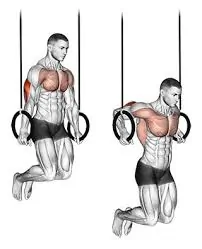
The Ring Dips exercise is an advanced upper-body strength movement performed using gymnastic rings. It primarily targets the chest, shoulders, and triceps while also engaging the core and stabilizing muscles due to the instability of the rings.
Your hands can move with the range of motion when rings are used in place of parallel or straight bars. This can help reduce tendon and joint pain that is frequently caused by dipping. Additionally, compared to a stationary implement, it puts more strain on the shoulders and core to stabilise the body.
Muscle Work during Ring Dips:
- Chest Muscles
- Shoulder Muscles
- Triceps Muscle
How to Perform?
- Make sure the rings are at about stomach level by adjusting their height.
- Grasp the rings with both hands while standing between them.
- Maintain straight arms and keep your elbows toward your torso.
- Squeeze your glutes, contract your core, and bring your shoulders back.
- Inhale deeply and lift each foot off the ground individually. Before you do anything else, be sure you can maintain your balance in this posture.
- Take another breath and start to fall once you’re sure you’re stable enough.
- Gradually lower yourself until your elbows are slightly bent, and your chest feels stretched.
- Gently return to the top after applying pressure through your triceps. Avoid explosive motions since they may induce instability.
Benefits:
Muscle Hypertrophy:
Ring dips elevate parallel or straight bar dips to a new level. Ring dips do a terrific job of increasing the muscular contractions and duration under strain, but I think bar dips are better for going heavier with loads and really taxing the chest and triceps with higher volume.
Increasing those factors can sustain muscle injury and encourage muscular growth and size, particularly when combined with more stable dip variations like bar dips.
Joint Health:
Increasing force application across a wider range of motion will nearly always lead to improved control at end ranges, connective tissue health, and injury resilience. Injuries to joints and tissues are frequently caused by a lack of control, coordination, and force production through muscle contractions (rather than relying on tissues and ligaments), which eventually lead to longer recovery times (weeks rather than days).
Body and Core Control:
Functional movement and athletics are based on the capacity to regulate one’s body in space and generate force. Ring dips are difficult because they need to be performed slowly and deliberately, requiring strength, coordination, mobility, and a strong mind-muscle connection.
Because the rings put a lifter in a highly difficult position that may soon become unstable and dangerous if someone tries to rush or cheat the reps, ring dips (strict) can also educate people to contract the core, legs, back, and entire body.
Sport Skill Enhancement:
Such controlled but unstable training exercises may also help many other athletes improve their proprioception, muscle coordination, and joint/connective tissue strength to strengthen weak joints.
Beginner’s Advice:
- In theory, there are two ways to execute dips; neither is incorrect; they are simply different motions with distinct functions: To improve tricep recruitment, maintain an erect posture, and keep your elbows close together. To improve chest activation, lean forward and spread your elbows.
- To prevent excessive spinal movement, try to maintain the legs straight down while bracing the core and glutes.
- Place a box beneath the handles to raise yourself to the rings if there are no steps leading to them.
- Jump into position if there isn’t a box available.
- Keep your head from jutting forward as you descend.
- To maintain tension in the triceps, make sure the elbows stay just short of lockout.
- Some people may find it more comfortable to try a fake grip, which involves wrapping the thumb over the bar.
Variations:
Supported Ring Dip:
Supported ring dips are a nice first variation. One approach is to support yourself by keeping one foot on the ground. When performing the exercise, try to use as little leg support as you can. Another option is to have a training partner stay nearby and be ready to grab you if you begin to lose your balance.
Ring Dip Holds:
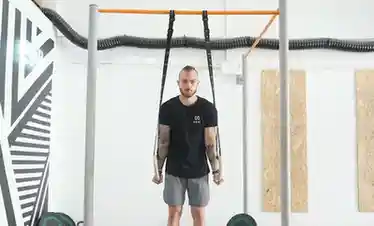
A cool variant that works your muscles and improves stability is the ring dip hold. You may improve your core stability and develop your chest and triceps by holding the top or bottom position.
Tempo Ring Dips:
Tempo ring dips are a helpful variant that strengthens technique, stability, and appropriate muscular engagement. You can perform tempo ring dips on your own, but it’s ideal to execute them with a coach.
For every rep, set and follow time targets. For instance, push yourself up for three seconds after lowering yourself for three.
Common Risks and Injury Prevention:
Although they work well for strengthening the shoulders and triceps, dip workouts are risky, especially for the shoulder joint. Before adding dips to your exercise routine, you must assess your body’s mechanics. Joint compression and muscle overload can result from poor form, such as letting the elbows fall below shoulder height.
Maintaining an erect chest, using the back muscles, and ensuring active tension in the arms and shoulder blades are all crucial for performing dips properly. Alternative triceps workouts, such as close-grip pushups or bench dips, may provide a safer alternative if you feel any pain or discomfort during dips.
Common Mistakes:
Rushing the ring dip procedure is the most dangerous error to avoid. Ring dips are a difficult bodyweight exercise that calls for exceptional body control and stability, as was previously mentioned. If you’re new to the movement, work your way up to ring dips using the appropriate progression plan.
Adding weight to yourself at the beginning of ring dips is another error to avoid. For instance, you might be tempted to perform ring dips in the same way if you are at ease performing bar dips by attaching weight to yourself. However, you should respect the movement and know that ring dips will return you to the starting point. Try the bodyweight version first.
Stability is the subject of the third ring dip error. Since it takes time to become stable, there is nothing intrinsically wrong with instability. However, trainees would frequently seize the rings, hang themselves in midair, and start trembling wildly.
People would still try to dip despite not being in a solid position, which raised the possibility of harm. Never lower yourself until you are stable and able to maintain the rings’ stability to prevent this.
FAQs
What are the benefits of ring dips?
As a complex exercise, the dip works multiple muscular groups simultaneously. Dips typically strengthen the arms, shoulders, back, and chest, but you can target each of these particular zones by varying the distance and location of your hands while doing the exercise.
Are ring dips more effective?
Ring Dips are a difficult variation of the traditional Dips on parallel bars that call for a lot of strength and stability. They strengthen and balance the shoulders, triceps, and chest by using additional muscular groups. Ring dips help you get ready for more difficult exercises like the Ring Muscle Up.
Will ring dips build chest?
Bulgarian ring dips are a difficult workout that works the muscles of the chest. The rings provide a wider range of motion than standard bar dips, which results in a deeper chest stretch. The chest stretch is made much more intense by bringing the upper arms farther outside.
What muscles do ring dips work out?
A basic bodyweight exercise that mainly works the triceps, pectorals, and anterior shoulder is the ring dip. In addition to strengthening and improving your upper body’s versatility, mastering this exercise will help you improve your athleticism as you progress toward more difficult exercises like the ring muscle-up.
Can beginners do ring dips?
A beginner-friendly variation of traditional ring dips, assisted ring dips with feet on the ground help strengthen the triceps, shoulders, and chest. While partially lowering body weight, the foot support on the ground enables safe practice of the exercise and stability.
References:
- 4 Benefits of ring dips – 2023 – Dewar, Dewar/barbend.com/benefits-of-ring-dips/
- Ring Dip: Video Exercise Guide & Tips – Muscle and Strength/www.muscleandstrength.com/exercises/ring-dip
- Ring Dips: how-to, progression, variations, mistakes – 2025 – Stefanov/www.hevyapp.com/exercises/ring-dips/
- Dip Exercise: Shoulder-Safe triceps strength for joint health/healthaudit.co.nz/dip-exercise-shoulder-safe-triceps-strength-for-joint-health