
9 Best Chest Stretching Exercises
Chest stretches can help you maintain an upright posture and keep your shoulders from sliding forward. Static or dynamic chest exercises help release tense muscles and improve mobility by targeting secondary muscle groups, including the back and shoulder blades. Similar to tricep and bicep stretches, the goal of chest stretches is to allow for unrestricted movement across your upper body.
Benefits of chest stretching exercises:
You may rotate and draw your shoulders in and forward by using your pectoralis major and pectoralis minor muscles in your chest. You can move your arms up, down, in, and out, as they also help stabilize your shoulders.
For daily tasks like pushing a door open, pulling a shopping cart, or picking up a child off the ground, your chest muscles are crucial. They are also essential for playing sports like tennis, baseball, and swimming.
Strong chest muscles are essential for proper posture, just as the back muscles are. Additionally, strengthening your chest muscles can lower your risk of shoulder injuries and increase shoulder stability.
9 Best Chest stretching exercises:
Pectoralis Major Stretch

- Start with a standing position.
- Maintain a shoulder-width distance between feet.
- Stretch your arm out to shoulder height, pressing your forearm and hand flat against a wall or other sturdy vertical object.
- Let your chest muscles lengthen as you slowly turn your body away from the outstretched arm.
- The stretch should be repeated on the opposite side.
Doorway Stretch

- Place your feet together in a doorway.
- Position your forearms on the doorframe with your elbows at shoulder height and bend them at a 90-degree angle.
- Lean carefully into the doorway and take a very modest step forward with one foot until your chest feels comfortable.
- Keep your spine neutral and steer clear of excessive lower back arching.
- Stepping forward with the opposite foot, repeat the stretch on the opposite side.
Chest Opener Stretch

- Sit or stand with your shoulders relaxed and your back straight.
- Place your fingers palms inward and interlace them behind your back.
- Feel the stretch in your shoulders and chest as you slowly raise your arms while maintaining a straight posture and an open chest.
- Maintain a relaxed jaw and neck.
- At the physiotherapist’s guidance, repeat the stretch after a gradual release.
Child’s Pose
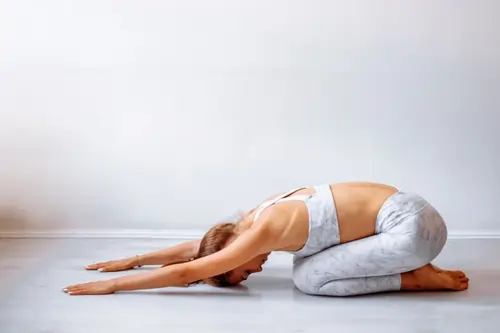
Child pose steps:
- Assume a tabletop posture and begin on your hands and knees.
- Make sure the knees are behind the hips and the wrists are squarely beneath the shoulders.
- Sit your buttocks back on your heels and gently move your arms forward until your forehead touches the mat.
- At the physiotherapist’s direction, hold for a few seconds.
- Breathe deeply and move your hands back to your knees to get out.
Camel Pose

- Start in a kneeling position.
- Put your toes flat on the ground or tuck them in.
- Reach back slowly and touch each heel with one hand.
- Engage your core, keep your shoulders back and down, and steadily drive your hips forward while maintaining an elevated chest.
- Hold for 15 to 20 seconds, then do it three times.
Hands Behind the Back

- Start with a standing position.
- Maintain a shoulder-width distance between feet.
- Straighten your arms and interlace your fingers behind your back.
- Pull your shoulder blades down while maintaining an elevated chest.
- Hold for 15 to 20 seconds, then do it three times.
Floor Angels

- Start with supine lying.
- Place both arms at a 90-degree angle along their sides, palms up towards the ceiling.
- Bring your arms gently up over your head until they are completely extended, keeping your body in constant touch with the floor.
- After that, carefully return both arms to their initial 90-degree posture.
- Repeat 10 times for 3 sets.
- Always keep your ribs tucked in and your back flat on the floor.
Pec Release

- Position a tennis or lacrosse ball between your pectoralis muscles and a wall or doorway.
- To alleviate the tension in your muscles, slowly lean your body into the ball for 20 to 30 seconds.
- Repeat the previous process after moving the ball to different locations in the chest region.
Bow Pose

Bow Pose steps:
- Maintaining your hands palm up at your sides and your chin on the workout mat, lie flat on your stomach.
- Bring your heels as near to your butt as you can comfortably, while bending your knees. The ideal distance between knees is hip-width.
- Raise your hands and grasp each ankle.
- Make sure your fingers are wrapped around your ankle instead of your feet. Keep your toes pointing.
- Breathe in while pulling your lower abdomen in and upward and squeezing your pubic bone down. Holding onto your ankles, raise your heels off the ground.
- Lift your head, thighs, and chest off the mat at the same time. At this point, just your core should be in contact with the floor.
- When you are in the bow posture, open up your chest by sliding your shoulder blades down towards one another.
- Focus on your breath, balance, and stretch as you hold the position for 20 to 30 seconds while looking straight ahead.
- Exhale and carefully release the Pose. Return to the mat by lowering your head, thighs, and chest. Release your ankles and pull your hands back to your sides, allowing your feet to return to the mat.
- After a few seconds of rest, continue the stance until you feel that the stretch has worked.
FAQs
How do you expand your chest?
With your palms facing up, clasp your hands behind your back. Press your shoulder blades together and pull your hands down. Your chest ought to protrude. Ten to twenty seconds of holding.
Can I stretch my chest every day?
Daily chest-opening exercises can help avoid constriction, encourage good posture, and improve breathing.
When should I be worried about chest tightness?
You should visit the emergency room if your chest discomfort is strong and new, or if it is accompanied by other symptoms like nausea or shortness of breath. Heart discomfort typically originates in the middle or left side of the chest and might extend into the jaw or down the left arm.
Why does my chest feel like it needs to be stretched?
Chest tightness can be caused by a variety of medical diseases, including infection, trauma, anxiety, lung disorders, and digestive disorders.
How quickly can you see effects from stretching?
In conclusion, everyone has a different time frame for increasing their flexibility, but usually, after two to three weeks of regular flexibility exercise, we will see an improvement in our flexibility. The muscles and joints will react with time and effort.
Referances
- Jey, T. (2023, August 9). The 4 best Stretches for a Strained chest muscle | Physiotherapists in Toronto | Yorkville Sports Medicine Clinic. Physiotherapists in Toronto | Yorkville Sports Medicine Clinic. https://www.yorkvillesportsmed.com/blog/the-four-best-stretches-for-a-strained-chest-muscle
- pliability | 24 Best Chest Stretches to Relieve Tension & Improve Posture. (n.d.). https://pliability.com/stories/chest-stretches
- Williams, A. (2025, February 18). Best chest stretches for tight chest muscles. OriGym Center of Excellence. https://www.origym.co.uk/blog/best-chest-stretches-for-tight-chest-muscle
- wM6jXv4t1KaI. (2018, October 9). 5 Stretches for Tight Chest Muscles – INSYNC PHYSIO. INSYNC PHYSIO. https://insyncphysio.com/chest/5-stretches-for-tight-chest-muscles/


