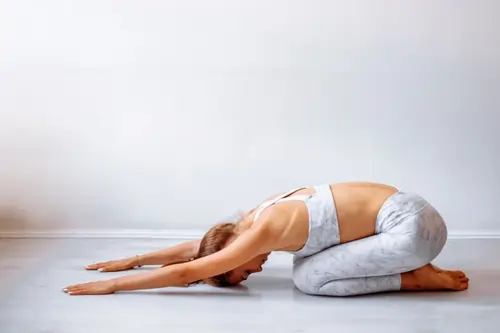
Balasana (Child Pose)
What is Balasana or Child Pose?
Balasana (Child’s Pose) is a gentle resting yoga pose that helps relax the body, calm the mind, and stretch the hips, thighs, and lower back. It’s often used as a resting position during yoga sessions to restore energy and promote relaxation.
The yoga pose known as “balasana” has profound philosophical significance that derives from the practice of yoga. This position symbolizes the innocence, trust, and surrender that characterize children. A symbolic means of regaining one’s innocence and present-moment awareness is the Child’s Pose.
Anatomy
Balasana involves the use of numerous muscles:
- Trapezius muscles
- Posterior deltoid muscle
- Rhomboids
- Erector spinae muscles
- Latissimus dorsi muscles
- Teres major muscles
- Oblique muscles
- Gluteus muscles
- Hip flexor muscles
How to Perform Balasana or Child Pose?
- On a yoga mat or the floor, assume a kneeling position.
- Bend forward slowly until your thighs and stomach meet. If you are unable to maintain your buttocks against your heels, don’t worry.
- Put your hands down on the floor or mat in front of you.
- Place your forehead lightly on the floor or mat and let your neck to relax.
- Shut your eyes, inhale deeply, and allow your entire body to unwind. As long as you believe it is necessary, hold this posture.
- Return to the seated position gradually.
Balasana (Child Pose) Video
Benefits of Balasana (Child Pose):
- Promotes Digestion: The first advantage of frequently doing child’s pose is that it will help you digest food more easily. Your internal organs receive a gentle massage while your stomach sits on your upper thighs, which eventually aids in better digestion.
- Gives energy: In fact, this restorative yoga pose is performed in between other poses to provide energy. Your entire body relaxes when you are in the Balasana stance, and you start to heal your body and mind.
- Strengthening Your Lower Back: We must spend a lot of time at our desks due to our current lifestyle. This may cause your lower back to get compressed. It typically occurs when we shift more of our body weight to our lower back rather than our lower abdominal muscles.
- Reduces Tension: Child Pose yoga is a great way to relieve fatigue after a demanding workday. Additionally, when you inhale deeply, your neurological system is alerted to the calmness of your surroundings.
- Boosts the circulation of blood: One of the less well-known advantages of Balasana is an improvement in blood circulation. The stretch and position still encourage greater blood flow, even though the asana’s body movements are slow.
- Leads to Better Sleep: The yoga child posture helps people sleep better because it instantly relaxes their bodies and minds. Your tension is released, and your mind becomes calmer.
- Enhances Mobility and Flexibility: You stretch your ankle and shoulder muscles as you perform the Balasana yoga pose. Flexibility and mobility are enhanced by these stretches. Additionally, increased flexibility helps you avoid potential injuries.
Contraindications of Balasana or Child Pose:
- Injury and Surgery: This practice should not be followed by anyone who has recently had surgery on their ankles, shoulders, knees, or hips. This pressure in the abdomen should be avoided by postpartum mothers who have had a cesarean section.
- Absence of Body-Breath Connections: This posture should be avoided by those who are not mindful of their breath because they may hold their breath in the forward fold, which can be harmful.
- Physical Strength and Weakness: In case of epilepsy, high blood pressure, or migraines should be supervised and practiced at shorter intervals. Avoid putting additional strain on joints in case of rheumatoid arthritis and severe knee discomfort. Due to chest constriction, a person with asthma can also practice at shorter intervals.
- Others: Older patients with heart conditions and knee joint problems should avoid this stance, as should pregnant women.
Variations of Balasana or Child Pose:
Wide-Legged Child Pose
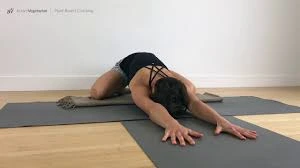
- To practice it, begin on a tabletop position, with your big toes facing each other and your knees somewhat wider than your hips, possibly as wide as your mat.
- Hold the pose for three to five breaths while lowering your forehead to the floor.
Extended Child Pose

- Place your hands as far forward as you can without straining them, starting in the traditional child’s position.
- When your arms are fully extended or slightly bent, your shoulders, upper back, and arms may feel fairly stretched.
Thread the Needle Child Pose
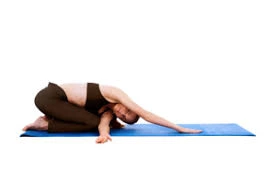
- Inhale as you raise your right hand off the mat, then exhale and thread it under your left arm to begin in the typical child’s position.
- Your right hip may rise a little as your right shoulder and ear rest on the mat.
- As your right hip and glutes feel stretched, take a breath.
- After holding for a few breaths, move sides, pausing slightly to allow your spine to adjust.
Child Pose with Bind

- To improve the range of motion in your arms and shoulders, interlock your fingers behind your back while maintaining the bend at your hips.
- Focus on letting go of any tension in your upper body while taking a few deep breaths.
Child Pose with Chair and Bolster
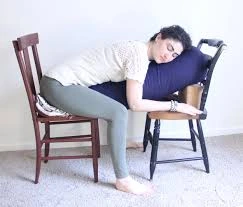
Child’s pose can be performed while seated when practicing chair or wheelchair yoga by placing a chair in front of you and supporting yourself with a pillow or bolster.
Child Pose with a Block

Start on your knees and forearms. Placing the block or bolster under the forehead is ideal. You can either tuck your toes under or let them drop to the ground. Hold the stance for as long as you desire, or take at least 8 to 10 deep breaths.
Child Pose with a Bolster

- To begin, go on your hands and knees. Slowly release onto a vertically positioned bolster between your inner thighs.
- Place your cheek or forehead against the bolster. To keep your neck stretched evenly on both sides, if you place one cheek on the bolster, make sure to switch to the other cheek after a few breaths.
- Hold the stance for as long as you desire, or take at least 8 to 10 deep breaths.
Common Mistakes:
- Your hips and lower back may become overly tense if your knees are too close to one another.
- Excessive chest folding can cause discomfort in the shoulders and lower back. Lower your chest slowly using your breath and a tiny part of your arms.
- Holding your breath during the pose.
- Don’t make knee distress adjustments.
FAQs
What is balasana known as?
A soothing and easy yoga practice, Child’s practice (Balasana in Sanskrit) is commonly employed as a transitional stance between more strenuous poses. When a toddler is fatigued or looking for comfort, they may curl up into a ball, which is how the stance got its name.
Which disease is cured by balasana?
Therefore, regular practice of yoga, particularly basic poses like balasana, along with a busy lifestyle, can help avoid heart disease.
Is Balasana good for back pain?
Yes. Because it progressively stretches and relaxes the lower back, balasana is a useful way to cure mild to moderate back discomfort. In yoga, it’s frequently advised for back wellness.
Who cannot do balasana?
Anyone who has had knee, ankle, or hip surgeries should avoid using the Balasana with Bolster since it can create severe discomfort, which is definitely not what you want. People who have weak knees or ankles cannot perform the Balasana with a Bolster.
What is the main benefit of balasana?
A soothing and easy yoga practice, Child’s practice (Balasana in Sanskrit) is commonly employed as a transitional stance between more strenuous poses. It reduces tension, improves mental clarity, enhances flexibility, and calms the nervous system. Additionally, it encourages relaxation and improved respiration.
Is balasana good for diabetes?
One of the best yoga poses for naturally managing diabetes is Balasana. It relieves rotator musculature, neck, and back pain and aids with stress reduction. Additionally, it promotes spinal extensor and hamstring relaxation to increase the synthesis of beta cells that produce insulin.
References:
- Fit, C. (2022b, April 11). Balasana: Steps and Benefits of Child’s Pose on Hips, Thighs, & Ankles. blog.cult.fit. https://blog.cult.fit/articles/balasana-steps-amazing-health-benefits-of-childs-pose-on-hip-thigh-ankle
- Admin. (2023b, September 12). Child’s Pose (Bālāsana) : How to Do IT, Benefits & Precautions. Learn Yoga, Asanas & Meditation. https://www.vinyasayogaashram.com/blog/childs-pose-balasana-how-to-do-it-benefits-precautions/
- Yoga Journal. (2025, February 25). Child’s Pose. https://www.yogajournal.com/poses/child-s-pose
- Vallie, S. (2024, December 8). How to do a “Child’s” yoga pose. WebMD. https://www.webmd.com/fitness-exercise/how-to-do-childs-pose
- Yacep, L. B. E. 5., & Yacep, L. B. E. 5. (2023, June 18). 13 Child’s Pose Variations For More Comfort, A Deeper Stretch, & Creative Flows. Yogajala. https://yogajala.com/childs-pose-variations/
- Yogashala, G., & Yogashala, G. (2025, March 11). Balasana (Child’s Pose): Benefits, Steps & Common Mistakes to Avoid. Gurukul Yogashala. https://gurukulyogashala.com/blog/balasana-childs-pose/
- Balasana Yoga(child Pose). Tummee. https://www.tummee.com/yoga-poses/Balasana