

Pull-ups Exercise
What are Pull-ups?
Pull-ups are among the most underutilised workouts for building upper-body, back, and core strength. It requires a chin-up bar, which may assume a variety of forms. A pull-up training bar is an excellent option for individuals seeking adaptable portable fitness equipment. Power racks also provide a standalone alternative.
The classic pull-up uses an overhand hold on the bar, but the chin-up is a variant that often employs an underhand grip. If you’re new to pull-ups, there are several modified variants you may utilise to get the strength required to do them. Pull-ups are useful for upper-body strength and circuit training exercises.
Certain ab machinery, such as power towers, is intended to create it. Certain ab devices, such as power towers, are designed to make it easy to incorporate pull-ups into your workout routine.
Muscle Work During Pull-ups:
- Latissimus Dorsi Muscle
- Brachialis Muscle
- Biceps Brachii Muscle
- Infraspinatus Muscle
- Trapezius Muscle
- Rhomboids Muscle
- Teres Major Muscle
- Subscapularis Muscle
- Forearm Muscles
- Core Muscles
Video of Pull-ups:
How To Perform Pull-ups?
With your feet dangling loosely, the pull-up bar should be high enough that you must jump up to reach it. Stand underneath the bar, your feet shoulder-width apart. Jump up and grasp the bar with an overhand grip that is approximately shoulder-width apart. Completely extend your arms, resulting in a dead hang. A balanced stance is attained by bending your knees and crossing your ankles. Take a breath at the bottom.
- Exhale and elevate your chin to the bar. Pause at the top.
- Lower yourself while breathing, bringing your elbows straight.
- Repeat the movement without contacting the floor.
- Perform as many reps as specified in your program.
Benefits of Pull-ups:
Strengthens upper body muscles.
Multi-joint exercises such as pull-ups and chin-ups train the shoulders, upper back, biceps, and lats. They enhance general upper-body muscular growth and can result in significant strength improvements.
Improves grip strength.
Grip strength is essential for lifting bigger loads in several workouts that require you to grip the weight, but it is also crucial as we age.
Functional Movement.
Pull-ups will be helpful if you ever find yourself dangling from a precipice. But, in all seriousness, pulling is a fundamental human movement pattern that we must all learn in order to achieve optimal functional fitness. Difficult upper-body exercises like pull-ups and chin-ups enhance overall physical performance by strengthening the upper body.
Convenience and Accessibility.
You can perform pull-ups and chin-ups almost anywhere: at the gym, at home using a pull-up bar, or anywhere you can safely hang a suspension system. Because these workouts do not require any equipment, they are appropriate for all fitness enthusiasts, from gym attendees to international travellers.
Variations or Modifications of Pull-ups:
If you can’t do a full pull-up yet, there are several strategies you may use to develop your strength and start practicing pull-ups.
Pull-up assist machine

Begin with a pull-up help machine. You’ll need to go to the gym for this, but it’s a great method to start building the strength needed for a pull-up.
Human assistance
Ask a trainer, coach, or spotter to “assist” you. Keep your knees bent and your ankles crossed. Your partner will offer a moderate lift while holding the tops of your feet. This slight aid helps to balance your weight as you lift.
Static Pull-ups
Using a box or step, raise yourself into the pull-up “finish” position, maintaining your chin at bar level for as long as feasible. This will help you increase upper-body strength gradually. Over the course of many weeks, gradually introduce the negative pull-up exercise (see below).
Negative Pull-ups
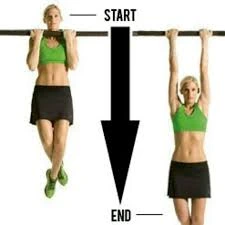
Hold your chin at bar level for a few seconds after using a box or step to raise yourself into the pull-up ‘finish’ position. Slowly lower yourself at a controlled pace, halting and holding at various places along the way. When you reach the bottom, repeat the process.
Half Pull-ups
Stand on a box or bench with your elbows bent about 90 degrees while grasping the bar. Starting a pull-up from this position demands significantly less strength than beginning with fully extended elbows. Begin with a few pull-ups like this, then gradually lower the box and straighten your elbows to do a more challenging pull-up.
Jumping Pull-ups
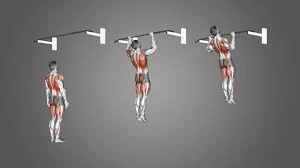
Stand on a box or bench that enables your elbows to flex slightly while gripping the bar. Keep your chin level with the bar and ‘leap’ into the pull-up ‘finish’ position, bending your knees until your elbows are fully extended. Gently lower yourself back into the box, and repeat. Over time, you’ll gain strength and be able to try new pullup variations.
Lat Pull-down
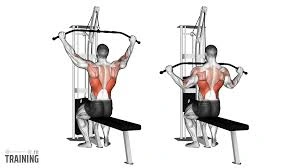
The lat pull-down machine is another approach to start developing the strength required for pull-ups. With this machine, you remain sitting with your knees pulled down while pulling the weight down to you. It’s a whole new body posture and angle, but it’s a safe place to start.
Contraindications:
Existing Injury: Individuals with shoulder or elbow conditions should avoid pull-ups due to their high impact on these joints.
Shoulder Impingement: Pull-ups can increase shoulder impingement, a typical condition during overhead movements.
Elbow Issues: Tendonitis can be brought on by repetitive motion that irritates the elbow tendons.
Overtraining: Excessive pull-ups, especially without sufficient rest, can cause overuse problems.
Beginners should start with aided exercises (e.g., negative pull-ups or resistance bands) and progressively improve, providing for enough rest and recuperation between sessions.
Proper Form: Incorrect form increases the chance of harm. It is crucial to keep the bar stable and maintain proper posture throughout the workout.
Grip Strength: Weak grip strength might restrict your ability to complete pull-ups and perhaps cause injury.
Muscle Recovery: Adequate rest (at least 48 hours for beginners) is required for muscle repair and development following pull-up exercises.
Safety and Precautions:
This exercise should be avoided if you have a back, neck, shoulder, elbow, or wrist ailment. Consult your physician or physical therapist about what is appropriate. Pull-ups get progressively harder as you gain weight. Pull-ups should only be done twice a week to avoid strain and injury. Allow at least one day between pull-up sessions. You prevent a fall, be sure you utilise a robust and stable bar.
Common Mistakes:
Avoid these blunders to get the most out of your pullups while avoiding injury.
Too quick or sloppy.
The whole movement should be gradual and controlled. When your form deteriorates, you should stop and relax to avoid damage.
Wide Grip.
If your grasp is overly broad, you will be unable to use your whole range of motion.
Short Range of Motion.
The best results will be achieved by fully extending your arms at the bottom and raising your chin to bar level at the top. If you have adequate strength to perform this complete range of motion, don’t fool yourself by only doing half rises.
Wrist and Thumb.
You should not flex your wrists. They should maintain a neutral stance during the pull-up. Place your thumb on the side that your fingers are on, rather than looping around the knob.
Flared elbows.
Maintain a strong grip on your elbows while performing the pull-up. Don’t let them flare out.
Kipping.
Kipping is a technique for performing pull-ups that uses lower-body motion. It is utilized in various types of exercise; however, it is not considered suitable for a strict pull-up. It should not be utilised until you have mastered your pull-up form and have been taught how to employ kipping in a controlled manner. Pregnant women should avoid kipping because the relaxin hormone affects their joints and increases the chance of damage.
FAQs
Are pull-ups an effective exercise?
Pull-ups and chin-ups are excellent workouts for increasing upper-body and back strength. With gradual improvement, you’ll be able to perform pull-ups and chin-ups correctly, lowering your chance of injury and getting the desired effects.
Do pull-ups give you abs?
Pull-ups primarily engage the rectus abdominis, biceps, lats, and traps. Pull-ups are essentially an arm workout, not a back exercise; hence, anyone who complains about “feeling pull-ups more in the arms than the back” should be aware of this. However, they are mostly abdominal exercises.
Can everyone learn pull-ups?
A pull-up is not something that everyone can do on their first try. Even if you can’t accomplish a whole pull-up, you can split it down into its component pieces and practice them separately. Use these four workouts to help you get stronger and more proficient at the key components of the pull-up action.
How many pull-ups by age?
Pull-up requirements for children differ depending on their age. Boys as young as six may perform one or two pull-ups, while 17-year-olds should strive for 13. Girls aged 16 to 17 should do one pull-up or hang for 5-9 seconds. These guidelines aid in understanding exercise objectives for individuals of various ages and abilities.
References:
- Ms E. Q. (2019, June 24). How to do pullups. Verywell Fit. https://www.verywellfit.com/pullup-bar-exercises-for-upper-body-strength-3120735
- Mahaffey, K. (2025, January 24). Chin-Ups vs. Pull-Ups: The Difference, Benefits, and Muscles Worked. NASM. https://www.nasm.org/resource-center/blog/chin-ups-vs.-pull-ups-the-difference-the-benefits-muscles-worked?srsltid=AfmBOopo-Ifm8kjXxyiTCkZ6PwoCJ_AbmzNZo_ass20Jpz4Nb5fd4Zs_
- Cpt, T. R. B. (2021, August 20). Is it a good idea to do pull-ups every day? Probably not. Healthline. https://www.healthline.com/health/fitness/pull-ups-everyday


