
Dragon Flag Exercise
Introduction
The Dragon Flag exercise is a unique core-strengthening technique that martial artist Bruce Lee popularised. It is a strenuous workout that works the whole abdominal area, including the hip flexors, lower abs, and shoulder and back stabilising muscles. This exercise emphasises control and body tension by raising and lowering the body in a straight line while supporting the shoulders and upper back on a bench.
The Dragon Flag improves muscular endurance, coordination, and general body stability in addition to strengthening the core. Because of its high degree of difficulty and the accuracy it demands, it is best suited for people who have a solid foundation in core training.
Indication
- To build superior stability and core strength
- To increase the control and endurance of the abdominal muscles
- For gymnasts, martial artists, and athletes who require strong core activation
- To improve coordination and body tension
- To enhance body control and functional strength
- To build stronger lower back and hip flexor muscles
- To encourage improved spinal stability and posture
- For those who want to have a toned and robust midsection
- To improve balance and general physical endurance
- For individuals advancing to more complex body-weight training tasks
Contraindication
- Lower Back discomfort or Injury: Because the vigorous core engagement and spinal stress might exacerbate pre-existing lower back discomfort, disc herniation, or lumbar instability, people should avoid this exercise.
- Cervical problems or neck pain: During movement, the neck bears a portion of the body’s weight. Individuals who have disc issues, neck strains, or cervical spondylosis run the risk of making their conditions worse.
- Weak Abdominals or Poor Core Strength: Exercises that lack a solid core base place undue strain on the spine and raise the possibility of muscular strain or injury.
- Hip Flexor Tightness or Injury: Improper form and increased pressure on the lower back during a movement can result from tight or damaged hip flexors.
- Shoulder or Elbow damage: Any damage to the shoulder, elbow, or wrist might render the exercise dangerous since the upper body stabilises the action by holding onto the bench or bar.
- Following Abdominal Surgery or Recent Injury: Because of the high intra-abdominal pressure, anybody healing from abdominal or pelvic surgery (such as a C-section or hernia repair) should stay away from the Dragon Flag.
- Diastasis recti: Due to severe abdominal stress, diastasis recti, also known as abdominal muscle separation, which is frequently observed after pregnancy, can worsen with vigorous core workouts like the dragon flag.
- Conditions related to the heart or hypertension: the exercise entails holding one’s breath and exerting a lot of pressure on the torso, which can raise blood pressure and be dangerous for people with heart disease or hypertension.
- Inadequate Supervision or Technique: If you perform the Dragon Flag without the right form or expert supervision, you run the risk of tearing muscles or injuring your spine.
- Pregnancy: This activity puts a lot of strain and pressure on the abdomen, which is dangerous and can hurt the mother and fetus.
Relevant Anatomy
The main muscle that contracts to maintain a straight torso and regulate movement is the rectus abdominis.
- Internal and external obliques help to stabilise the body and keep it from twisting while performing the workout.
- The hip flexors (rectus femoris, iliopsoas) are responsible for lifting and keeping the legs straight.
- The lower back’s erector spinae stabilises the spine and keeps it from arching or drooping.
- Gluteus Maximus: Assists in maintaining a stiff body and stretched hips.
- Quadriceps: Helps keep the legs straight and the body in alignment.
- Shoulders, or deltoids, stabilise the arms during the hold and support the upper body.
- Anchoring the upper body to the support surface is aided by the pectoralis major (chest).
- Triceps: Assist in maintaining the arms’ stability and lock when holding onto the support.
- Abdominal tension is increased by the transverse abdominis, a deep core stabiliser.
- During the hold, the serratus anterior helps maintain shoulder control and scapular stability.
Dragon flag
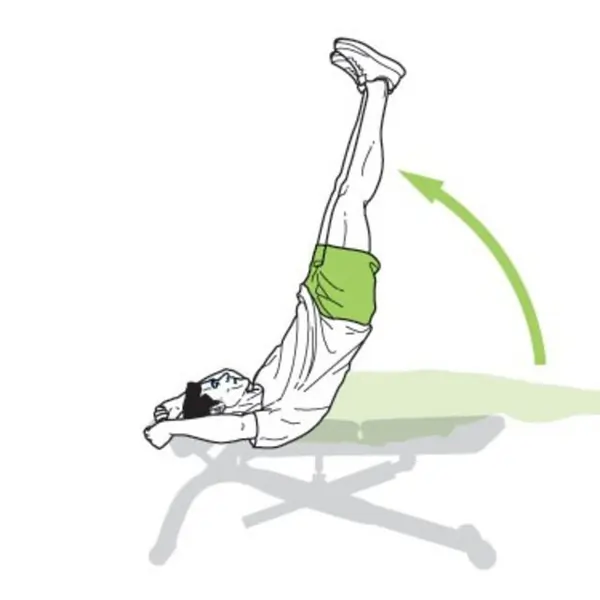
- Position: Supine lying position.
- To begin, lie on your back and reach behind you with your arms to grasp a strong bench, pole, or column.
- Raise your hips as you shift your weight onto your shoulders.
- Raise your body, legs, and feet to form a single, straight line.
- Align your knees, hips, and shoulders by bringing your body into a single line. Avoid placing your neck under the weight of your body. Maintain the weight on your shoulders and upper back.
- Your upper back should be the only area of your body that touches the floor.
- Hold for a maximum of ten seconds.
- Now, carefully lower your body back down to the floor until it is parallel to the floor while maintaining a tight core and buttocks.
- Throughout, make sure your legs remain straight and together.
- Holding your body slightly above the floor and maintaining this position before raising yourself again might provide an additional challenge.
- A good strategy is to do 3–4 sets of maximum repetitions; scale the motion on at least a portion of your reps to aim for at least 5 in each set.
What Are Some Typical mistakes to Avoid When doing Dragon Flags?
When it comes to doing dragon flags, form and concentration are crucial. To get the most out of your dragon flags and lower your chance of aches and injuries, make sure you steer clear of these mistakes.
- Back Arching: Avoid back arching. By arching your lower back, you may shift the focus from your abs to your lower back. There may be a danger of strain from this.
- Inadequate Warmup: Before trying to execute dragon flags, be sure you have adequately warmed up all of your muscles. This will aid in muscular activation as well as lessen the danger of soreness, strain, or other problems.
- Insufficient Rest Between Sets: It’s critical to acquire enough rest in between sets while using strong movements. Make sure to take a full one to three-minute break in between sets of your dragon flag workout.
- Bending the Knees: Exercise is less effective when the legs are not kept straight.
- Using momentum can cause muscular tension and reduced intensity since it involves rapidly lowering or elevating the body rather than moving in a controlled manner.
- Poor Shoulder Grip: Instability or shoulder discomfort might result from improperly fastening the upper body.
- Hip Dropping: The straight-line posture necessary for good form is broken when the hips are allowed to droop.
- Trying Too Early: If you do full Dragon Flags before you have enough upper body and core strength, you may be hurt.
- Neck Strain: Excessive head lifts and neck tensing might be uncomfortable or straining.
- Unsteady Motions, moving with difficulty, impair control and put more strain on the spine.
Require a modification?
Make sure you have progressed to advanced core training before trying the dragon flag. The core strength and stability exam should be easy for you; additionally, you ought to have minimal trouble performing V-sits, hip lifts, and reverse crunches.
Doing a dragonfly with your body stiff only from the shoulders to the knees, with the knees bent at a 90-degree angle, and letting your feet drop down to lessen the weight being lifted, is a good way to work up to the dragon flag if you are unable to accomplish it. To do the dragonfly, follow these steps:
- Position yourself on a bench such that your hands are by your head and that you are holding onto the bench’s edges.
- After bending your knees and bringing your thighs to a 90-degree angle, contract and raise your chest toward the sky with all of your might. Your knees should be 90 degrees bent, and you should be holding a half dragon flag.
- After a few seconds of holding the pose, carefully lower your torso until it hovers just a little bit over the bench.
Benefits of dragon flag exercise
- Enhances Core Muscle Strength: Provides a comprehensive core exercise by targeting the rectus abdominis, obliques, transverse abdominis, and even deep stabilising muscles.
- Enhances Spinal Stability: By requiring a straight body line throughout the lowering and raising motions, the exercise improves the stability and support of the lumbar spine.
- Strengthens Hip Flexors: Increases the strength and endurance of the legs by dynamically using the hip flexors to raise and drop them.
- Enhances Neuromuscular control and body awareness by requiring precise movement and balance, which enhances overall body control and coordination.
- Boosts Upper Body Strength: In order to support the body, the muscles in the arms, shoulders, and upper back are used, which has the effect of strengthening the upper body. Enhances functional strength for lifting, twisting, and stabilising by simulating real-life activities that call for core activation.
- Enhances Muscle Endurance: Maintaining a straight posture throughout the lowering phase increases the stamina of the stabilising and core muscles.
- Enhances Athletic Performance: Dragon Flags can help build core strength and control, which can help athletes perform better in martial arts, gymnastics, callisthenics, and sports.
- Benefits to appearance: Aids in defining the abdominal muscles, which results in a toned and defined waistline.
- Mental Discipline: The difficult practice strengthens mental toughness by requiring patience, attention, and bodily awareness.
Precaution
Get warmed up correctly: To avoid straining your muscles, always warm up thoroughly, paying particular attention to your shoulders, hip flexors, and core.
- Begin with Progressions: Don’t try the entire Dragon Flag right away. To progressively increase core strength, start with simpler variants such as half Dragon Flags, tuck holds, or lying leg lifts.
- Keep Your Form Correct: From shoulders to feet, maintain a straight posture. Do not slump your hips or arch your back.
- Throughout the exercise, keep your core active: Use a Stable Support: To keep your balance and prevent falling, cling to a strong bench, bar, or pole.
- Manage the Motion: To lessen the danger of shoulder or lower back injuries, do the exercise gently and avoid jerky or swinging actions.
- Correct Breathing: Avoid holding your breath. To avoid creating too much intra-abdominal pressure, exhale when lifting and inhale when lowering.
- Avoid if Injured: Until your back, neck, shoulder, or stomach injuries are completely healed, do not perform the exercise.
- Limit the number of reps. First: As strength and control increase, progressively increase the number of controlled repetitions in each set from 2 to 3.
- Emphasis on Core Engagement: Instead of depending just on momentum, actively brace your abdominal muscles. This guarantees that the exercise successfully works the core.
- Pay Attention to Your Body: If you have shoulder, neck, or lower back pain, stop right away. Sharp discomfort is a sign of tension or improper form, although mild muscular tiredness is typical.
- Incorporate Recovery: To avoid overtraining and muscular exhaustion, give yourself at least 48 hours of rest in between sessions.
Conclusion
An advanced core workout that develops remarkable strength, stability, and body control is the Dragon Flag. In order to maintain appropriate form, it engages the shoulders, chest, glutes, and legs in addition to the lower back, hip flexors, and abdominal muscles.
It is quite difficult and necessitates the right progression, technique, and control to prevent injury, yet it is very effective for core development and general body fitness. It is therefore most appropriate for people who have a solid background in core training, and when done properly, it may greatly improve muscular endurance, strength, and posture.
FAQs
How hard is the dragon flag exercise?
Even for seasoned fitness aficionados, the Dragon Flag exercise is regarded as one of the most difficult core-strengthening exercises. Because the entire body must stay stiff and straight while lowering and lifting it in a controlled action, it requires extraordinary abdominal strength, spinal stability, and total body control. The hip flexors, lower back, and shoulders are all strongly worked during this exercise, which calls for a firm grip and appropriate bracing for safety. Because it takes time to build coordination and strength, beginners frequently find it to be quite challenging. The Dragon Flag is not only a test of strength but also of discipline and body awareness since it may be extremely difficult to do numerous controlled repetitions without arching the back or compromising form, even for experienced trainers.
Does dragon flag exercise reduce belly fat?
The Dragon Flag exercise serves to generate substantial muscular definition and abdominal strength by focusing on the core muscles, which include the rectus abdominis, obliques, and hip flexors. But it doesn’t actually burn abdominal fat. Dragon Flags won’t reduce belly fat on their own since fat reduction can’t be targeted to a single part of the body. A balanced diet, regular strength training, and total calorie expenditure from cardiovascular activity are all necessary for effective fat loss. That being said, as part of a full exercise program, Dragon Flags can help fat reduction over time and add to total calorie burn because they are extremely demanding and work numerous significant muscle groups.
Which muscles are used for the dragon flag exercise?
A full-body core exercise, the Dragon Flag works the abdominal muscles above all else, but it also works a number of other muscle groups for control and stability. When lowering and raising the body, the rectus abdominis, sometimes known as the “six-pack” muscles, exerts tremendous effort to maintain the torso straight. The obliques help keep things stable and stop them from twisting. While the lower back muscles, such as the erector spinae, aid in stabilising the spine and preventing drooping, the hip flexors are essential for raising and maintaining the legs off the ground. Furthermore, the glutes and quadriceps help to maintain the body’s rigidity during the exercise, while the shoulders, chest, and triceps are used to attach the upper body to the support surface.
What are the common mistakes in the dragon flag exercise?
Inadequate technique or a lack of core strength are common causes of Dragon Flag exercise errors, which can decrease performance and raise the risk of injury. One common mistake is to arch the lower back rather than maintain a straight and stiff torso, which puts undue strain on the spine. Additionally, a lot of people droop their hips or bend their knees, which hinders the use of their abdominal muscles. The exercise becomes less intense and may cause shoulder or lower back discomfort if momentum is used instead of controlled movement, which involves swiftly lowering or rising the body. Instability may also result from inadequate shoulder stability or grasp when clinging to the support.
Are dragon flags better than leg raises?
Leg raises and dragon flags are both great core workouts, but they vary in difficulty, muscle activation, and intensity. Because leg raises mainly work the hip flexors and lower abdominals, they are easier for novices to do and effective for developing fundamental core strength. However, Dragon Flags are far more complex and need full-body tension, using the lower back, glutes, shoulders, chest, and hip flexors in addition to the abs and hip flexors for stability. Dragon Flags emphasise maximum power, control, and body awareness, whilst leg lifts may be done in greater repetitions to build endurance.
What are the differences between the dragon flag and the bridging exercise?
The kinematics, muscular emphasis, and degree of difficulty of the dragon flag and bridging exercises are very different. Bruce Lee popularised the dragon flag, a sophisticated callisthenics move that mainly works the deep core stabilisers and rectus abdominis. It requires remarkable core strength, spinal control, and posterior chain engagement as the entire body is lowered and raised in a straight line while the upper back stays secured. On the other hand, the bridging exercise, which is frequently utilised in fundamental fitness and physiotherapy, emphasises hamstring engagement, lumbar stability, and glute activation. Building a bridge with the torso and thighs entails raising the hips off the ground from a bent-knee stance.
What are the benefits of the dragon flag exercise?
The dragon flag exercise has a wide range of beneficial effects on muscular endurance, body control, and core strength. It is one of the hardest anti-extension core exercises since it works the rectus abdominis, transverse abdominis, and obliques. Along with the abs, it works the glutes, erector spinae, hip flexors, and even the lats and deltoids, producing a full-body stress that enhances resilience and neuromuscular coordination. Dragon flag practice can improve athletic performance, particularly in sports that call for dynamic stability and explosive trunk control. Because it requires exact technique and progressive strength growth, mastering this exercise also improves body awareness and mental discipline.
References
- Fit, C. (2022a, July 5). How to Do a Dragon Flag: Its Benefits, Variations & Safety. blog.cult.fit. https://blog.cult.fit/articles/how-to-do-a-dragon-flag-techniques-benefits-variations
- Ms, E. Q. (2019, March 22). How to do a dragon flag. Verywell Fit. https://www.verywellfit.com/dragon-flag-advanced-core-exercise-3120045
- Dragon Flag Exercise Demo video & info. (n.d.). https://www.catalystathletics.com/exercise/564/Dragon-Flag/