How to Effectively Engage your Core During a Workout?
Introduction
Even if you have never seen an exercise program or visited a gym, you no doubt have heard the term “engage your core” at least once in your life. Sometimes it’s bellowed while you’re sweating out your final rep, and other times it’s gently encouraged.
But you might be wondering what your core is, how to connect with it, and what that suggests. The muscles that surround your trunk, such as your abdominals, obliques, diaphragm, pelvic floor, trunk extensors, and hip flexors, make up your core.
To maintain balance and perform tasks like lifting weights and getting out of a chair, your core provides trunk stability. Additionally, it gives you the freedom to move your torso as necessary, such as when you swing a golf club or reach for your seatbelt.
Additionally, breathing, maintaining proper posture, urinating, and defecating all require the use of your core muscles.
Your diaphragm contributes significantly to the passage of air into and out of your lungs during each inhalation and exhalation. Your core muscles tighten to maintain an erect trunk when you sit up straight. They are there to start and stop your business when you use the restroom.
What are your core muscles?
Your core muscles are composed of multiple muscle groups.
Rectus abdominis
The rectus abdominis, sometimes referred to as the “six-pack muscle,” connects the front of your pelvis to your lower ribs. Its main function is to stretch your spine, like when you crunch or sit up in bed.
Because it is the most superficial of the core muscles, it is not as helpful for maintaining spine stability.
Internal and external obliques
The internal and external obliques connect your ribs to your pelvis on the lateral sides of your trunk. They stabilize the front and sides of the trunk statically.
Their main motions are side bending and trunk rotation, like when you swing a baseball bat. They also flex the spine while working bilaterally.
Transversus abdominis
The back and top of the pelvis, as well as the lower six ribs, are the origins of the transversus abdominis. Its fibers travel horizontally to the midline, or linea alba, of the body.
In order to give the lower back, in particular, a deep, segmental stability, the transversus abdominis co-contracts with the multifidus muscle.
Strengthening these muscles is often beneficial for people with persistent low back pain.
Pelvic floor
Located on the underside of the pelvis, the pelvic floor muscles function similarly to a hammock or sling. They rise toward the stomach when they are activated.
These muscles serve as deep stabilizers for the pelvis and spine in addition to initiating and stopping the flow of stool and urine.
Diaphragm
The underside of your lower ribs is where the diaphragm is attached.
Although it is the main muscle involved in breathing in and out, new studies indicate that it is also important for heart health, lymphatic return, controlling emotions, swallowing and vomiting, spinal stability, and pain tolerance.
Back extensors
The quadratus lumborum, multifidus, and erector spinae muscles are among your multilayered back extensors. Generally speaking, they connect a single vertebra to the vertebrae above and below or the spine to the pelvis.
Spinal extension (bending backward), postural support, and supporting the spine when bending forward and raising loads—like during squats or biceps curls—are their main purposes.
Iliopsoas
Often referred to as the iliopsoas, the iliacus and psoas major are two hip flexors that join into a single muscle belly. They attach to the femur, or upper leg bone, after arising from the iliac crest of the pelvis (ilacus) and the thoracic and lumbar spine (psoas).
When performing high knee movements, for example, the iliopsoas flexes the hip and pulls your legs closer to your body. However, it is regarded as a deep core stabilizer because it is also attached to the spine.
How to engage your core?
Depending on your goals, using your core muscles can mean different things. The muscles used and the sequence in which they fire, for example, will be different when performing situps than when attempting to maintain your balance while standing on one leg.
Additionally, depending on a number of variables, like whether you’re trying to move or stabilize your spine, whether you’re pushing or pulling weight, and whether you’re standing, sitting, or lying down, your muscles will feel different when you engage them.
It’s important to understand that these muscles work in concert during movement, regardless of how, when, or why you use your core. They don’t operate independently.
Being able to activate your core in every situation and manner is essential for having a truly strong and effective core that supports your moving body’s spine and provides dynamic stability. In this article, we’ll talk about four main approaches to engaging your core.
Concentric contraction of the abs or back
Core muscles are prime movers when performing back exercises like the Superman or classic ab exercises like the crunch.
For instance, during the crunch, your obliques and rectus abdominis shorten and contract concentrically, pulling your ribs toward your hips and raising your head and shoulders.
The body can accelerate or move through concentrated contractions.
For many people, these are the most common kinds of muscle contractions.
Eccentric contraction of the abs or back
To reduce the force or movement of the body, eccentric contractions work. They always occur together with concentric contractions on the opposite side of the joint and are lengthening contractions.
When you straighten and raise your spine, for example, if you’re leaning back while seated at your desk, two contractions will occur: an eccentric, or lengthening, contraction in the abdominals and concentric contractions in the spinal extensors.
For the core function, both are essential.
Abdominal bracing
Abdominal bracing is an isometric contraction of your abdominal wall muscles without causing your pelvis, ribs, or spine to move.
When lifting weights or other high loads, it serves as a means of protecting the spine.
Abdominal bracing is the best way to activate the superficial abdominal muscles, according to research.
Abdominal draw-in or hollowing
Focusing on moving your abdomen to your spine causes the abdominal draw-in motion, also called abdominal hollowing. This kind of contraction works best when considered as a dynamic component of your exhale and is employed for stability, such as gripping.
Drawing the abs in, or hollowing them out, is more efficient than bracing for activating the transversus abdominis and deep spinal stabilizers, according to research.
The most functional core is one that can successfully execute both the bracing and hollowing strategies and uses each approach as necessary, with the fact that there are strong supporters of both types of stabilizing contractions.
Exercises for core stability
You can work your core with the simple abdominal stability exercises listed below. They are useful in learning how to activate your core muscles, but they are by no means full.
Abdominal draw or Bracing

- Bend your knees and lie on your back. (You can also do this while sitting up straight.) Take a breath.
- Imagine bringing your belly button to your spine as you exhale to draw your stomach in. The muscles surrounding your sides and abdomen may tighten, but you should still be able to breathe.
- Hold for five to ten seconds. Relaxing. Do it again.
Plank

- Push up onto your hands and toes to begin. You can drop to your knees if this is too challenging.
- Keep your buttocks in alignment with your body and draw your abdomen toward your spine. Every muscle in your abdomen should be contracting.
- For 20 to 60 seconds, maintain this posture.
- It’s essential to remember that this workout puts a lot of strain on your spine. It’s a good idea to avoid this exercise or alter it by performing a wall plank or a plank on your knees if you have back problems.
Side plank

- lie on side, with elbow supported by the ground.
- You’ll have your upper body supported. For more balance, raise your upper arm to the sky or keep your hand on the ground.
- In order to balance yourself on your forearm and the side of your foot, raise your hips into the air and straighten your legs. If this is too difficult, draw a straight line from your knees to your head while keeping your knees on the ground.
- Keep your elbow, hips, and feet properly aligned. Keep your shoulder above your elbow as well. Your lower body’s obliques should be working.
- For 20 to 60 seconds, maintain this posture.
Bird dog
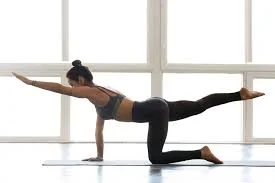
- As if you were a table, begin on your hands and knees. Keep your spine neutral.
- Extend one arm in front of you until it is level with your torso and head.
- In keeping with your arm and body, extend the opposing leg behind you. Don’t turn your hips out to the side; rather, keep them pointing down toward the floor. Your back and abdominal muscles should be working.
- After five seconds of holding, switch to the other arm and leg.
Dead bug

- lie down on the ground with knees bent.
- As you raise your knees so that your hips and knees are bent at a 90-degree angle, tighten your abdominals and maintain a flat back.
- Return after gently tapping one toe on the ground.
- Stretch your arms straight up over your shoulders to up the difficulty level. Keeping your lower back on the ground and your ribs drawn in, reach the opposing arm back overhead as you lower one foot to the ground.
- Keep your back flat and simply extend your leg as far as you can.
- Go back and change sides.
Bridge

- Bend your knees and place your feet hip-distance apart while lying on your back.
- Squeeze your buttocks and lift them off the ground while keeping your pelvis and trunk together.
- Hold for five counts.
- Put your trunk back on the ground and relax. Do it again.
What does the core do?
Stabilization, balance, breathing, and control over your bowels and bladder are just a few of the many tasks of your core.
Spinal mobility
Although we frequently consider the core muscles to be essential stabilizers—which they are—they are also in charge of flexion, extension, lateral flexion, and rotation of your spine.
Trunk stability
Your core muscles engage to maintain the stability of your trunk and support your spine when doing tasks like pushing or carrying an object, lifting something over your head, and picking something up from the floor.
These muscles are also essential for weightlifting and sports like soccer, running, and judo. Injury risk is decreased by maintaining a stable spine.
Balance
Both while you’re standing motionless and when your balance is being tested, your core muscles help you stay balanced.
For instance, your brain and trunk detect the sudden force and shift in balance that occurs when someone bumps into you. Your body stays upright as a result of your core muscles responding.
In sports like Olympic weightlifting, where your trunk must adjust and remain solid during shifts in weight distribution, your core muscles also help with balance.
Breathing and trunk stability
One of the main muscles that controls breathing is the diaphragm. It lines your lower ribs and is shaped like an inverted “U.”
When you breathe in, your lungs might expand because it flattens as they contract. On the other hand, your diaphragm compresses your lung cavity when it relaxes, forcing air out of your lungs like bagpipes.
Additionally, while you’re struggling to lift something heavy, your diaphragm may limit isometrically to hold your breath. In order to prevent injuries and maintain stability, this movement supports your trunk.
Bowel and bladder control
You can urinate or defecate (or hold it if you can’t go to the bathroom) thanks to the control your pelvic floor muscles provide over your colon and bladder.
Incontinence is a condition that arises when these muscles are weak. Still, it is frequently possible to avoid or treat this problem by strengthening these muscles.
Additionally, by raising abdominal pressure at your spine, the diaphragm and pelvic floor muscles work with the rest of your core to ensure spinal stability.
Scenarios that engage your core
- Sitting. Your back should be straight but not arched as you sit up straight. In the direction of your spine, draw your belly button. As if someone were going to punch you in the stomach, you can likewise make your stomach contract.
- Inhaling. Let your neck, shoulders, and abs relax. Inhale slowly while allowing your tummy to softly push outward. In order to avoid engaging supplementary shoulder and neck muscles to breathe, try to reduce the amount that your shoulders lift (or shrug) toward your ears.
- lifting weights. Resistance exercises that include holding weight in your arms, such as military presses, deadlifts, squats, and biceps curls, activate your core. Single-arm or single-leg exercises allow you to focus on one side more than the other.
- Cardio. Cardiovascular exercises use the core since they require multiple motions in different directions.
- Yoga. Planks, bridges, side planks, and balancing on one or both feet for poses like Tree Pose and Warrior Pose are just a few of the common exercises that use the core.
- Pilates. Pilates is a great way to improve the core through stability and mobility exercises. When coached properly, which emphasizes deep spinal support, it is a great way to learn how to use your deep core muscles.
FAQs
What are the big 3 core exercises?
The fundamental exercises for back resilience and core stability include bird dog, side plank, and modified curl-up.
What organ is most affected by scoliosis?
Children with idiopathic scoliosis and their pulmonary function
Scoliosis is a restrictive lung illness that causes a multifactorial reduction in lung volumes, displaces the intrathoracic organs, slows rib movement, and alters the respiratory muscles’ mechanics.
Is 3 times a week at the gym too much?
Exercising at a moderate or high level every day is not recommended because your body needs time to repair. Aim for three to five moderate-to-intense workouts per week, alternating with low-intensity exercise on the other days.
How to tell if a muscle is overtrained?
Typical indicators of overtraining may include:
recurrent joint pain and muscle soreness. reduced stamina, strength, and speed. increased blood pressure, heart rate, and even palpitations at rest. elevated risk of illnesses, including infections or colds, as well as overuse injuries.
What muscle is hardest to grow?
Important Parts of Building Muscle as You Get Older:
Peak Age: Around 30 to 35 years old, muscle mass and strength are usually at their highest.
Declining Phase: You might lose 3–8% of your muscle mass every decade starting in your 30s. This rate goes up after age 60–70.
Reversibility: Resistance training works very well for people of all ages. Adults in their 50s and 60s can still see a lot of muscle growth.
Advice for Older Adults: To fight sarcopenia, concentrate on regular resistance training two to three times a week, eat more protein, and control healing.
You can add muscle at any age, but it requires more work, commitment, and healthy eating.
Why is my core so weak even though I work out?
A strong core, which includes the abs, back, pelvic floor, and glutes, is shown by good posture, less low-back pain, and better balance. Functional signs include being stable while lifting, twisting, and doing everyday tasks, as well as being able to hold a plank for 60 seconds with good form.
Some signs of a strong, working core are:
Better posture means being able to keep your spine tall, straight, and stable all day.
Less Pain in the Lower Back: A strong core supports the spine and takes pressure off of it, which helps to ease back pain.
Stable Balance: You can do everyday tasks or activities like yoga (like Tree pose) without falling over.
Ease of Daily Tasks: You can easily carry heavy groceries, bend over, and twist without feeling pain or strain.
Good Plank Form: Being able to keep a straight line from your head to your heels for at least 60 seconds without letting your hips droop.
Better Athletic Performance: It’s easier to control your center of gravity when you run, lift, or do explosive movements.
How to Check Your Core Strength:
Plank Test: Time how long you can hold a plank. If you can hold a position for 60 seconds with the right alignment, you have good endurance.
Check your balance by standing on one leg with your eyes closed for 10 seconds without wobbling too much.
Hollowing Test: While lying on your back, breathe out and pull your belly button toward your spine. Try to keep this up for 10 seconds.
Will 100 crunches a day give you abs?
The body may eventually become used to supporting itself on muscles other than the deep abdominal muscles, such as the neck, gluteal muscles, or lower back. These patterns may occur from years of bad posture or bad movement habits, as well as during or after pregnancy.
Does slouching mean a weak core?
Weak core muscles may be indicated by slouching or an inability to maintain an erect posture. Your body finds it difficult to keep alignment when you don’t have a strong core, which eventually causes spinal problems. Fix it: You may develop awareness by sitting with your core engaged and maintaining proper posture throughout the day.
What is the 3-3-3 exercise method?
Three strength training sessions, three cardio days, and three active recovery days are all part of the 3-3-3 split. “It feels simple, realizable, and balanced, which is why I believe it’s popular. Women want structure that boosts rather than depletes their energy.
References
- Clinic, C. (2026, April 1). Core exercises for all levels. Cleveland Clinic. https://health.clevelandclinic.org/best-core-exercises
- Megan. (2025, February 5). How to engage your core plus 4 of our favourite core exercises. Innovation Physical Therapy. https://innovationphysio.com/blog/how-to-engage-your-core-plus-4-of-our-favourite-core-exercises/
- Mpt, T. E. P. (2022, February 15). A comprehensive guide to engaging your core. Healthline. https://www.healthline.com/nutrition/how-to-engage-your-core
- Nunez, K. (2024, April 24). The best core exercises for all fitness levels. Healthline. https://www.healthline.com/health/best-core-exercises
- Powell, W. (2025, May 15). How to engage your core. MUTU System. https://mutusystem.com/en-uk/how-to-engage-your-core/
- Seated abdominal bracing. (n.d.). [Video]. Hingehealth. https://www.hingehealth.com/gb/en/resources/articles/how-to-engage-your-core/