7 Medicine Ball Exercise For Core Stability And Power
Introduction
Medicine balls are more than just a name; when used properly, they can be the prescription you need to significantly enhance your general well-being.
This is especially true for your core, which is the collection of muscles in the middle of your body that includes your hips, lower back, and abs. Since the core serves as the basis for almost all physical activities, it is important for proper posture, stability, and general strength.
Medicine balls and their varieties, such as slam balls (no bounce) and wall balls (bigger, softer, some bounce), are incredibly special training instruments that can simultaneously improve your strength, power, mobility, and coordination.
We’ll show you how to utilize medicine balls to strengthen your core and maintain your health.
A weighted exercise ball used for full-body strength and endurance training is called a medicine ball. In physical therapy settings, it is frequently used as a tool to support stability and facilitate healing. This well-liked exercise tool tones and sculpts the back, arms, shoulders, core, and more.
What is a Medicine Ball?
A medicine ball is a weighted ball used for strength, stability, and conditioning workouts. It usually weighs between two and thirty pounds. They have been a part of functional fitness programs, physical treatment, and athletic training for many years.
Structure and Materials
- For grip and strength, the outer shell is composed of hard rubber, plastic, leather, or composite materials.
- Depending on the type, the core filling may be sand, gel, or air-filled.
- Surface texture: Textured for additional grip or smooth for rapid handling.
Types of Medicine Balls
- Dual Grip Medicine Balls: For accurate, two-handed pushes, rotations, and lifts.
- Kettlebell-Style Medicine Balls: These combine the advantages of a kettlebell grip with the adaptability of medicine balls.
- Rope medicine balls are perfect for activities involving explosive rotation and swinging.
- For general training, Deluxe Medicine Balls offer a balanced weight distribution.
- Extreme Medicine Balls: Stronger choices for intense exercise.
Getting Started: Safety & Proper Form
You may maximize the benefits of medicine ball training while preventing injuries by following simple safety recommendations before you start.
First, warm up
To prepare your muscles, spend five to ten minutes doing dynamic stretches and light cardio exercises like jumping jacks and marching in place.
Selecting the Appropriate Weight
Beginners: 4–8 pounds
Intermediate: 10–14 pounds
Advanced: 15 pounds or more
Note: To acquire the appropriate form, start lighter and progressively increase the weight.
Control & Grip
To avoid slipping, maintain a strong grasp. Bend your knees and elbows to absorb impact when you catch or receive a ball.
Environmental Assessment
Make sure you have adequate room around you, particularly for throws and slams. Remove anything that might prevent or trip you.
7 Medicine Ball Exercise For Core Stability And Power
1. Squats & Squeezes

- With your hips and shoulders square, lean your back against a wall, or you can do without wall support.
- If you want to work your arms as well, hold the medicine ball completely in front of you with your arms forward or above your head with your arms outstretched.
- Rise back up after sliding down until your knees are at a 90-degree angle.
- Depending on your level of fitness, hold the medicine ball slightly above your knees for 15 to 60 seconds during the fifteenth squat.
2. V-Ups

V-Ups exercise steps:
- Stretch your legs out while lying flat on your back.
- Holding the medicine ball in both hands, raise your arms above your head.
- Raise your feet and hands at the same time to create a V shape with your body.
- Return your arms and legs to the floor slowly.
3. Medicine Ball Presses

- With your feet flat on the ground and your knees bent, lie face up on a yoga mat.
- In front of your chest, extend your arms and grasp a medicine ball. Do a sit-up after raising your torso to a sitting position.
- Raise the medication ball above your head.
- Return to your lying position.
- Instead of bending your knees, extend your legs and perform flutter kicks for an extra ab exercise.
4 . Medicine Ball Chop Swings

- Hold the medicine ball in your upper right shoulder while standing with your feet hip-width apart.
- Make a 180-degree turn by twisting your torso to the left.
- You should turn your feet as you twist, swing, or “chop” the medicine ball downward, then lunge at the ground in the same direction.
- Now use a similar cross-body motion to raise the ball back up in the other direction.
5. Squat and Toss

- Place your feet shoulder-width apart as you stand.
- Keep the medication ball close to your chest.
- After squatting, raise your legs.
- When you’re upright, toss the medicine ball straight overhead and catch it.
- Return the ball to your chest and do it again.
6. Rock And Roll Ups

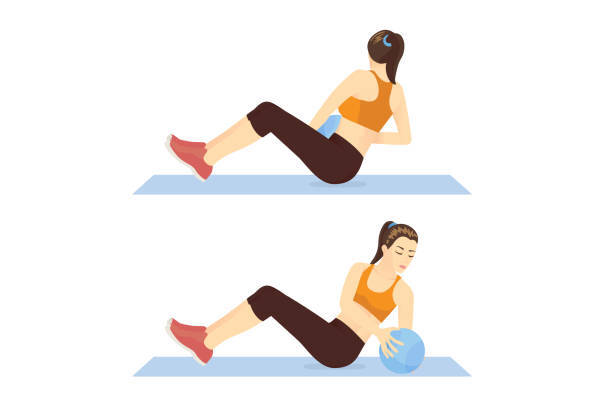
- Flex your knees and place your feet flat on the ground while lying flat on the ground. With your arms completely stretched overhead, hold the medicine ball.
- Bring your hands to your knees and pull your knees to your chest.
- Raise your body to the squat position. Next, straighten your posture.
- Return to the starting position after squatting once more.
7. Ball Flies

- With your knees bent at a 90-degree angle and your neck and shoulder blades resting on the ball’s center, lie face up on a stability ball.
- Holding a medicine ball, extend your arms toward the ceiling.
- Move the ball to your left hand, then gradually lower it until your left arm is parallel to the ground.
- Return the ball to the center, move it to the right hand, and repeat the process on this side.
- Straighten your arms, lower them flat to the floor behind your head, and then raise them back above your chest for an additional action.
Benefits of medicine ball core training
Medicine ball core training has several advantages when done properly:
Your core strength, which is the foundation of practically every workout, can be strengthened.
You can improve your stability and balance in daily life as well as during exercise.
You can achieve new levels of power and explosive strength, especially in compound and rotating movements, with the dynamic nature of medicine ball exercises.
You can improve your hand-eye coordination by throwing and catching medicine balls.
Functional fitness, or the kind you can utilize in daily activities, is something you can build.
By increasing your flexibility and strengthening some of your body’s essential muscles, you can lower your chance of injury.
Strengthening the stabilizing muscles surrounding your spine might help you achieve better posture.
You can improve your stamina.
Medicine ball core training has a strong “why.” Now let’s focus on the “how.”
- Builds Core Strength
- Improves Balance & Coordination
- Enhances Functional Movement
- Adds Variety to Your Workouts
- Compact & Portable
Choosing the right medicine ball
Weighted balls come in three primary varieties, which mostly vary in how much they bounce. Slam balls don’t bounce at all, medicine balls bounce the most, and wall balls bounce somewhat.
Each of these ball kinds is available in a variety of sizes, so it’s important to select the appropriate one because going too small won’t work and going too big can cause injury.
The perfect ball weight pushes you while still helping you to perform the movements correctly. The ideal weight will vary from workout to workout and will rise as your strength increases.
As you gain strength and improve your form, it’s a good idea to start small, say 2-4 kg, and then progressively raise the weight. To ensure you always have the proper weight on hand, weighted balls can be purchased in pairs.
When selecting the perfect medicine ball, there are a few additional things to take into account, such as:
Material: Leather balls are more comfortable to hold and may be more advantageous for controlled exercises, but rubber weighted balls are more grippy and better for throwing activities.
Size: While some medicine balls are lighter and larger, others are denser and smaller. Simply put, the ideal ball size for you should be simple to grasp, toss, and catch.
Sample medicine ball routine to build core stability
Are you prepared to apply what you’ve learned and build that core? This is an example of a basic weighted ball core workout:
- Wood chops: 12 repetitions each side (torso rotation and obliques)
- Ten repetitions of the medicine ball chest pass (upper and lower abs)
- Russian twists: 15 repetitions per side (core and obliques)
- Twelve repetitions of toe touches (upper abs and flexibility)
- Ten repetitions of medicine ball smashes (full-body power and core engagement)
- Twelve repetitions of overhead throws (arms, shoulders, and core)
You can repeat the circuit two or three times if you feel like it. It’s a good idea to stop if you can’t control your movements or keep proper form.
FAQs
How does a medicine ball improve core strength?
The ball’s weighted design provides resistance that works the muscles in the core and tests their stability in ways that are comparable to real-world exercises. Additionally, a lot of medicine ball motions call for the simultaneous activation of several muscle groups, which enhances balance and coordination.
What are the big 3 core stability exercises?
Let’s move on to the “Big 3” core stability exercises. These are the bird dog, side plank, and curl-up exercises.
What are the benefits of a strong core?
A strong core helps you stand up straighter, decreases back pain, and makes you stronger overall. Planks, bird dogs, dead bugs, glute bridges, and side planks are all good basic exercises. These exercises work the abs, obliques, and lower back. They don’t need much equipment and give the whole midsection a full workout for stability and strength. exercises for the core:
Plank (Forearm or High): Keeps the spine straight and works the transverse abdominis, shoulders, and glutes. Keep your body straight and hold for seconds.
Bird Dog: Get on your hands and knees and stretch out your opposite arm and leg. This will work your deep core and erector spinae. This exercise helps you stay stable and keeps your lower back safe.
Glute Bridge: Lying on your back with your knees bent, lift your hips to work your glutes, lower back, and hamstrings, which are all important parts of a strong core.
Side Plank: Lie on your side and lift your hips while resting on one forearm. This works the obliques to keep you stable from the side.
How to Use These Exercises:
Sets and reps: For dynamic movements like the bird dog and the bridge, do sets of reps. For static holds like the plank and the side plank, do sets of holding for seconds.
How often: You can do these times a week, every day, or as a warm-up.
Focus: Make sure your core is braced (tight) the whole time and focus on form over speed.
How to use an exercise ball to strengthen your core?
Core exercises on a fitball (also called a stability ball) make your core stronger, help you balance, and improve your posture by making your muscles work against an unstable surface. Stability ball crunches, planks, Russian twists, and pass-throughs are some of the most important exercises. Do 2 to 3 sets of 8 to 12 reps, focusing on slow, controlled movements to get the most out of your muscles.
Best Core Exercises with a Fitball
For the stability ball crunch, lie on the ball with your lower back supported and your feet flat on the floor. Crunch up, lifting your shoulders off the ball while keeping your lower back tight.
Stability Ball Plank: Put your forearms on the ball and your legs behind you, then hold a plank position. This makes the deep abs stronger and helps with stability.
Ball Pass-Through (V-Up): Lie on your back and pass the ball from your hands to your feet. Then, extend both your hands and feet down to the floor and back up to exchange. This works both your upper and lower abs.
Russian Twists: Sit on the ball and walk your feet forward until your upper back is on the ball. Then, with your arms extended, turn your torso from side to side.
Knee Tucks: Begin in a plank position with your feet on the ball. To roll the ball forward, use your core to pull your knees toward your chest. Then, extend back.
Back Extension/Bridge: Put the ball under your hips and stomach, then lift your chest off the ball. This will work your lower back and glutes.
Important Advice for Achievement
Stability: Press the fitball up against a wall for support if a move is too difficult.
Focus: To prevent lower back discomfort during activities, keep your spine straight and your core taut.
Intensity: To make the workouts more challenging, use a medicine ball, as demonstrated on this YouTube channel.
Repetition: For each exercise, aim for 8–12 repetitions and 2–3 sets.
What are the physical signs of a weak core?
Signs of a Weak Core:
Lower back pain.
Bad posture.
Problems with balance.
Having trouble moving about every day.
Insufficient stamina during exercise.
Recurrent injuries.
What are the 5 core lifts?
Because they have been shown to maximize muscle growth, increase strength, and enhance functional fitness, the big five lifts—the deadlift, bench press, squat, shoulder press, and pull-up—are frequently regarded as the greatest compound exercises.
What are common mistakes in medicine ball workouts?
Failing to fully extend the hips before diving under the weight is a common mistake in the medicine-ball clean.
What are core muscles?
Core muscles are a complicated group of muscles that run along the trunk, pelvis, and back and keep the spine, pelvis, and shoulder girdle stable. They are the diaphragm, the pelvic floor, the lower back muscles, the obliques, and the abdominals. They act like a “muscular corset” and move weight between the upper and lower body. They are very important for posture, balance, and avoiding injuries.
Important Core Muscle Groups
The transversus abdominis (the deepest abs), the multifidus (along the spine), the pelvic floor, and the diaphragm are all examples.
Superficial Global Movers: These muscles make things move by bending and twisting. The rectus abdominis (the “six-pack”), the internal and external obliques, and the erector spinae are all examples.
The core includes the muscles in the hips, buttocks, and upper and middle back.
What the Core Does
Stability: Giving movement a solid base.
Protection: Keeping the spine and organs safe.
Force Transfer: Moving strength from one part of the body to another.
Posture: Keeping your spine straight and your body upright.
Exercises to Make the Core Stronger
Planks in all their forms
Bridges and dead bugs
Dog Bird
Breathing with your diaphragm
How can I test my core strength?
1. Tests for Core Stability
Forearm Plank: For 60 seconds, hold a straight plank position with your elbows directly under your shoulders and your body straight from head to heels. A strong core lets you keep this up without your lower back sagging.
For the Active Core Control Test, lie on your back with your knees bent. Gently touch one heel to the floor, then the other, but don’t let your lower back lift or arch off the floor. Doing this over and over again tests how well you can control your deep abdominal muscles.
Knee Raise While Sitting: Sit on the edge of a chair with your back straight and lift one knee toward your chest. If you lean back or fight, it means your core or stability is weak.
2. Tests of Core Endurance
For the Biering-Sorensen Test, lie on your stomach with your upper body hanging off a bench and your torso parallel to the ground. This tests how long your back extensor can hold up.
Side Bridge/Plank: Lie on your side with one elbow on the ground and lift your hips until your body is straight. Hold for 30 to 60 seconds, then switch sides to see how strong your oblique and quadratus lumborum muscles are.
3. Tests that are dynamic and functional
Leg Lowering Test: Lie on your back and raise both legs straight up to 90 degrees. Then, while keeping your lower back pressed firmly into the floor, slowly lower it. This tests the strength of the lower abdomen.
Single-Leg Squat: Do a squat with one leg. If your core is weak, your knees and ankles may not be stable, or your torso may lean too far forward.
What are the benefits of medicine ball ab workouts?
The benefits of a medicine ball ab exercise are as follows:
trains several muscular groups simultaneously.
enhances coordination and balance.
strengthens the deep core rather than just the surface abs.
Easily scales to various weights.
mimics patterns of movement found in the actual world.
What is the 3 2 1 core method?
With one day set aside for rest or active recovery, the 3-2-1 technique is a weekly workout split that consists of three strength, two Pilates, and one cardio session. It is intended to increase strength, enhance mobility, and promote cardiovascular fitness without causing fatigue.
References
- Aeromats. (n.d.). Medicine ball workouts to improve core strength & balance (Beginner-Friendly). https://www.aeromats.com/blogs/resources/medicine-ball-workouts-to-improve-core-strength-and-balance
- Blundell-Webb, S. (2024, November 28). Core Strengthening with a Medicine Ball: Top Exercises for a Stable Midsection. GymQuip Fitness. https://gymquipfitness.com/blogs/news/core-strengthening-with-a-medicine-ball-top-exercises-for-a-stable-midsection?srsltid=AfmBOoqxniq-S0n8-Vqjwv_YdnulUTtS4eamCOUViZAqBllY16-EuRyF
- Connor, J. (2023, May 11). These medicine ball core exercises will get your abs fired up. Runner’s World. https://www.runnersworld.com/training/a37168884/mediciExercise-abs-workout/
- Cowper, G., & Cowper, G. (2025, August 18). 10 medicine ball exercises to build strength and power at home. Exercise. https://www.exersci.co.uk/blogs/blog-posts/top-10-medicine-ball-exercises-to-build-strength-and-power-at-home?srsltidFitnessoUgtAyZKGSzzt3aQA4z_WR58UeZz-xIIP5iaVFkXN04L3s3oG0
- Fitness, A. (2023, April 27). 10-Minute Medicine Ball Workout – Anytime Fitness. Anytime Fitness. https://www.anytimefitness.com/blog/10-minute-beginner-medicine-ball-workout
- Riemer, A. (2025, February 7). 8 Medicine ball exercises for core strength. ProsourceFit. https://www.prosourcefit.com/blogs/news/8-medicine-ball-exercises-for-core-strength?srsltid=AfmBOor1EppU_ZLgno5YOrkJBQGwrvipGNgkFWCnyUBNBXllwGD7GHvu
- Smith, L. (n.d.). The ultimate guide to medicine balls: transform your workout routine. https://www.ewmotiontherapy.com/blog/guide-to-medicine-balls